
Table of Contents
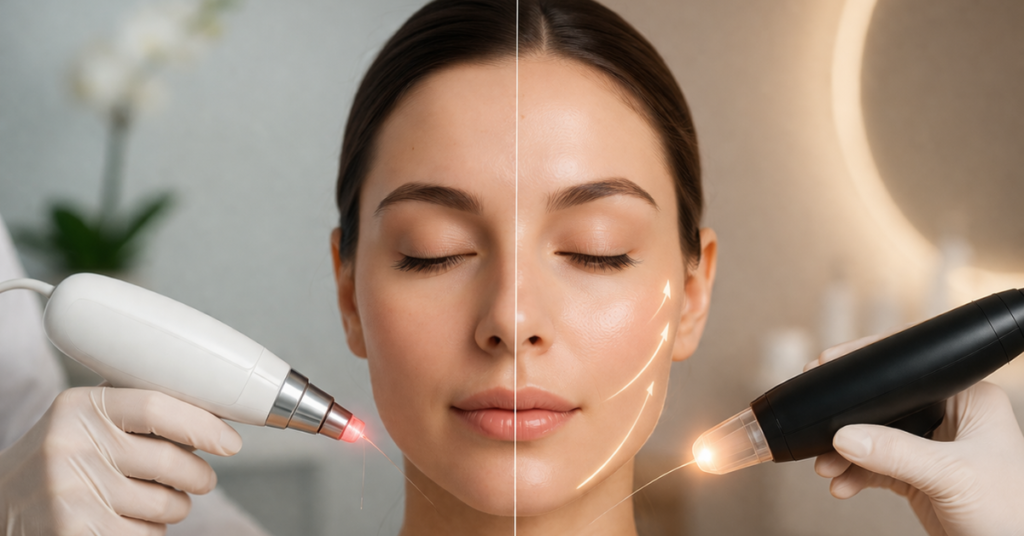
ToggleEndolift and Endolaser are both advanced laser skin tightening treatments, but they differ in how they target the skin and underlying fat. Endolift focuses mainly on lifting and tightening the skin using laser energy, making it ideal for facial rejuvenation. Endolaser, on the other hand, works beneath the skin to both tighten tissue and reduce small fat deposits, offering a more comprehensive solution for contouring.
For patients seeking a non-surgical facelift with added fat reduction and longer-lasting definition, Endolaser is often considered the more versatile and effective option.
At Deep Aesthetics, we know that the nuances between these two treatments is the key to achieving the natural, snatched look you desire. In this guide, we will compare every detail – from fat-melting capabilities to recovery times – to help you decide which is the ultimate skin tightening treatment for your face and body.
Disclaimer: Endolift® is a registered trademark of Eufoton S.r.l. Deep Aesthetics is not affiliated with, authorised by, or a registered provider of Endolift®. References to Endolift® in this article are made for comparative and informational purposes only.
What Is Endolift and How Does It Work?
Endolift is a specialized, minimally invasive outpatient laser procedure used for endo-tissue (inter-tissue) aesthetic medicine. Unlike traditional lasers that sit on top of the skin, Endolift works from within. It utilizes specific single-use micro-optical fibers, which are as thin as a human hair (around 200 or 300 microns). These fibers are easily inserted under the skin directly into the superficial hypodermis.
The core technology is a 1470nm diode laser. This specific wavelength has a high affinity for both water and fat. When the fiber is moved in a fan-like motion under the skin, it creates selective heat. This heat causes immediate connective tissue relaxation and subsequent contraction.
It isn’t just a surface-level fix; it is a structural remodeling of the skin’s foundation. The procedure is performed without incisions or general anesthesia, making it a popular choice for those wary of the operating theater.
Pros and Cons of Endolift
Advantages of Endolift
The primary advantage of Endolift is its precision. Because the fibers are so thin, practitioners can target very delicate areas, such as the lower eyelids or fine lines around the mouth.
- No Scalpels: There are no incisions, meaning no scars.
- Safety: It is performed under local anesthesia, eliminating the risks of being “put under.”
- Immediate Retraction: Many patients see a “shrink-wrap” effect immediately after the procedure.
- Collagen Boost: It forces the body to produce Type I and Type III collagen over several months.
Disadvantages of Endolift
While effective, Endolift has its limitations.
- Mild to Moderate Only: It cannot replace a surgical facelift for patients with severe skin redundancy.
- Fat Removal: While it has an affinity for fat, its primary design is “lifting.” It may not be powerful enough for significant double chin reduction in a single pass.
- Cost: Being a branded technology, the consumables (the fibers) can be expensive, often driving up the price for the patient.
What Is Endolaser and How Does It Work?
Endolaser is a robust subdermal laser treatment that represents the next evolution in laser skin tightening. While it shares some similarities with Endolift – specifically the use of micro-optical fibers – Endolaser is often viewed as a more versatile “workhorse” in clinical settings. It operates on the principle of Laser-Assisted Lipolysis and Endodermal Tightening.
During an Endolaser session, the laser energy is delivered through the fiber into the subcutaneous layers. The energy creates a “thermal grid” beneath the skin. This grid does two things simultaneously: it emulsifies (melts) localized fat cells and creates controlled thermal injury to the dermal collagen.
At Deep Aesthetics, we find that Endolaser provides a more intense thermal response, which is often necessary for body contouring and heavy jowl reduction. It essentially “spot-welds” the skin to the underlying muscle fascia, creating a tighter, more defined silhouette.
Pros and Cons of Endolaser
Advantages of Endolaser
Endolaser is often the preferred choice for practitioners who want maximum control over fat reduction and skin contraction.
- Superior Fat Melting: It is exceptionally effective at dissolving stubborn fat pockets (like the submental fat under the chin).
- Versatility: It is strong enough for body contouring (stomach, arms, thighs) but precise enough for the face.
- One-and-Done: Due to the intensity of the laser energy, a second session is rarely required.
- Affordability: Because it isn’t tied to a specific single-brand consumable in the same way, clinics can often offer more competitive pricing, such as our current.
Disadvantages of Endolaser
- Swelling: Because the fat-melting process is more intensive, patients may experience slightly more swelling in the first 72 hours compared to lighter laser treatments.
- Heat Management: It requires an expert hand to manage the temperature, as the laser is powerful.
How Endolift and Endolaser Support Skin Tightening
The Technology Behind Endolift (Laser-Assisted Lifting)
Endolift’s 1470nm wavelength is specifically tuned to interact with the water in our connective tissues. When the laser fires, it creates “tunnels” of heat. This leads to an immediate shortening of the collagen fibers. Over the next 3 to 6 months, a process called neocollagenesis occurs. This is your body’s natural healing response, replacing old, tired skin cells with fresh, elastic ones.
The Technology Behind Endolaser (Subdermal Laser Energy)
Endolaser technology focuses on photobiomodulation. The laser energy is absorbed by the adipocytes (fat cells), causing them to rupture. Once the fat is liquefied, the remaining heat energy targets the septoreticular system – the web of fibers that holds your skin to your body.
By tightening this “web,” Endolaser provides a lift that is anchored deeply, providing a more structural change than surface-level RF or HIFU.
Key Differences in Treatment Approach
Endolift is primarily a lifting technique. It aims to reposition the skin.
Endolaser is a remodeling technique. It aims to change the composition of the area by removing fat and forcing a massive collagen rebuild.
If you have “thin” sagging skin, Endolift is great. If you have “heavy” sagging skin with fat deposits, Endolaser is the superior tool.
Endolift vs Endolaser: Key Differences Explained
1. Treatment Depth and Precision
Both treatments use the same fiber-optic delivery system, meaning precision is equal. However, Endolaser is often calibrated to work slightly deeper in the fat layers (the deep hypodermis), whereas Endolift stays in the more superficial layers to focus on the skin’s surface “snap.”
2. Skin Tightening Results
Endolaser typically produces a more “industrial-strength” tightening. Because it induces a slightly higher thermal load, the resulting collagen bridge is denser. This makes it highly effective for areas like the neck, which are notorious for being difficult to tighten.
3. Fat Reduction Capability
This is the biggest divider. Endolaser is essentially a non-surgical liposuction alternative. It doesn’t just “shrink” fat; it destroys the cell. Endolift can shrink fat cells, but for a true “snatched” jawline, the lipolysis power of Endolaser is unmatched.
4. Number of Sessions Required
In our clinical experience at Deep Aesthetics, Endolaser is almost always a single-session treatment. Endolift, depending on the patient’s age and skin laxity, may sometimes require a “top-up” at the six-month mark to reach the desired level of firmness.
5. Recovery Time and Downtime
Both are significantly easier than surgery. You can expect:
- Day 1-3: Mild swelling and a “full” feeling in the treated area.
- Day 4-7: Any minor bruising (if it occurs) begins to yellow and fade.
- Day 7+: You look normal to the world, but your internal “healing engine” is just starting.
Endolift vs Endolaser: Quick Comparison At a Glance
| Feature | Endolift | Endolaser |
| Technology | 1470nm Diode Laser | High-Intensity Subdermal Laser |
| Primary Focus | Skin Retraction & Lifting | Fat Melting & Deep Tightening |
| Incisions | None | None |
| Ideal For | Fine lines, mild sagging | Jowls, double chins, body fat |
| Typical Cost (UK) | £1,500 – £3,500 | £995 – £2,500 |
| Anaesthesia | Local | Local |
| Duration of Results | 2-3 Years | 3-5 Years |
Endolift vs Endolaser: Which Treatment Delivers Better Results?
Endolift Results: What to Expect
With Endolift, the results are elegant and subtle. You will notice that your skin feels “sturdier.” The fine lines around your jawline will soften, and the “crepey” texture of the neck will improve. It is an excellent choice for someone who wants to look like they’ve had a very long, restful holiday.
Endolaser Results: What to Expect
Endolaser results are often more transformative. Because we can remove the “weight” of the fat, the lift is more pronounced. The jawline becomes distinct from the neck again. For body areas, the skin looks smoother and the “dimpling” often associated with cellulite or loose skin is significantly reduced.
Which Lasts Longer?
Both treatments trigger biological changes that last for years. However, because Endolaser permanently removes fat cells (which do not grow back), those contouring results can last as long as you maintain a stable weight. The skin tightening for both usually peaks at 6 months and holds strong for 2 to 5 years.
Natural-Looking Results Comparison
The beauty of both treatments is that they are “operator-dependent.” At Deep Aesthetics, we use an artistic approach. We don’t just “hit” the skin with a laser; we follow the natural vectors of your face. Both treatments avoid the “surprised” or “wind-swept” look of surgery because the skin is tightening itself, not being pulled by a thread or stitch.
Endolift vs Endolaser for Different Areas of the Face and Body
1. Jawline and Double Chin
For the “double chin,” Endolaser is the undisputed champion. It melts the submental fat pad and then tightens the “skin envelope” so it doesn’t hang loose after the fat is gone. For patients who also want added structure, jawline filler can complement the results.
2. Neck Tightening
The neck has very thin skin. Both lasers work well here, but Endolaser’s ability to target the platysma area (the neck muscles) with heat helps create a more defined “swan neck.”
3. Under-Eye and Mid-Face Areas
For malar bags (fat pads under the eyes), Endolift’s extreme precision with the 200-micron fiber is excellent. It can shrink those bags without the need for a surgical blepharoplasty.
4. Body Contouring (Abdomen, Arms, Thighs)
When we move to the body, the “Endolift alternative” (Endolaser) is the only real choice. Endolift fibers are often too delicate for the thick fat layers of the abdomen or thighs. Endolaser is designed to handle these larger areas, making it perfect for “bingo wings” or post-pregnancy stomach tightening. For a full cost breakdown, see our guide on body contouring surgery cost UK.
Is Endolaser a Better Alternative to Endolift?
In many cases, yes. If you are looking for an Endolift alternative, Endolaser offers a higher “bang for your buck.” It covers more ground, removes more fat, and provides a deeper level of tightening. However, Endolift remains a fantastic option for younger patients who have zero fat but want to “pre-empt” the aging process.
At Deep Aesthetics, we often find that patients who come in asking for Endolift actually achieve better results with our Endolaser protocols because they require that extra bit of fat melting to truly reveal their bone structure.
Endolift vs Endolaser: Safety, Side Effects, and Recovery Comparison
Safety Profile of Both Treatments
The safety lies in the “internal” nature of the heat. Because the laser fires under the skin, the surface (the epidermis) is protected from burns. This makes it safe for all skin types, including darker skin tones (Fitzpatrick IV-VI) which can sometimes struggle with external lasers.
Side Effects: Endolift vs Endolaser
Endolift: Expect very mild swelling and perhaps a “stinging” sensation for 24 hours.
Endolaser: Expect moderate swelling for 3 to 5 days. You may also feel some “numbness” or “tingling” in the treated area – this is normal and shows the nerves are reacting to the heat; it resolves within a few weeks.
Downtime and Healing Process
There is no “medical” downtime, meaning you don’t need bed rest. However, there is “social” downtime. Most people prefer to take Thursday and Friday off, enjoy a quiet weekend, and return to work on Monday looking slightly “refreshed” (or perhaps just appearing as if they had a minor dental procedure).
Cost Comparison: Endolift vs Endolaser in the UK
Average Cost of Endolift
In Harley Street or high-end London clinics, Endolift is rarely less than £2,500 per area. The branding and the cost of the patented fibers keep this price point high.
Average Cost of Endolaser
Endolaser is more flexible. In the UK, it typically ranges from £1,500 to £2,500.
Which Is More Affordable?
Currently, Deep Aesthetics is leading the market in making these treatments accessible. We believe in providing affordable laser facelifts without compromising on the medical-grade environment.
- Our Current Promotion: Endolaser for Face or Neck, Now £995.
This makes it the most cost-effective laser skin tightening London has to offer, providing 5-star Harley Street quality at a fraction of the price.
Factors That Affect Pricing
- The Number of Fibers Used: Large areas require more consumables.
- Practitioner Level: At our clinic, you are treated by experts who understand the “Deep” philosophy of aesthetics.
- Combination Therapy: Sometimes adding a small amount of dermal filler or Botox alongside the laser can improve the overall “wow” factor.
Who Is the Ideal Candidate for Each Treatment?
Best Candidates for Endolift
- Age 30-45.
- Mild skin laxity.
- No significant fat deposits.
- Looking for “preventative” aging care.
Best Candidates for Endolaser
- Age 40-65+.
- Moderate to heavy jowls.
- Double chin or “turkey neck.”
- Post-weight loss skin laxity on the body.
- Looking for a true “Endolift alternative” that packs more power.
When to Avoid These Treatments
Avoid these if you have active skin infections, are pregnant, or have a pacemaker. During your consultation, we will review your full medical history to ensure you are a safe candidate.
Why Choose Endolaser Lift Treatment in London at Deep Aesthetics?
Selecting a clinic for an Endolaser Lift treatment is a major decision. You aren’t just buying a machine; you are buying the hands that hold the fiber. At Deep Aesthetics, we specialize in the “natural look.”
We use the latest 1470nm and dual-wavelength systems. Our team is trained in the most advanced safety protocols, ensuring that the heat is delivered perfectly to stimulate collagen without damaging surrounding tissue.
We don’t do “cookie-cutter” faces. We look at your bone structure, your skin thickness, and your personal goals. Whether you are a man looking for a “chiselled” jawline or a woman looking for a soft, lifted neck, we tailor the laser vectors to you.
Our current £995 offer is a testament to our mission: making elite aesthetics affordable. We operate clean, medical-grade environments in Canary Wharf (London), Birmingham, and Nottingham.
Our reputation is built on the hundreds of patients who now walk the streets of London with renewed confidence. We are known for our “Deep” approach – artistry meets anatomy.
Frequently Asked Questions (FAQs)
1. Is Endolift the same as Endolaser?
No, Endolift and Endolaser are not the same. Both are laser skin tightening treatments, but Endolift mainly focuses on lifting the skin, while Endolaser tightens skin and reduces small fat deposits for better contouring.
2. Does Endolaser remove fat better than Endolift?
Yes, Endolaser is more effective for fat reduction. It uses laser lipolysis to break down small fat pockets, while Endolift focuses more on lifting and tightening rather than fat removal.
3. How long do Endolift and Endolaser results last?
Results from both treatments can last 1 to 3 years, depending on skin condition, age, and lifestyle. Collagen production continues for several months after the procedure, improving results over time.
4. Is Endolaser available in the UK?
Yes, Endolaser is widely available across the UK, especially in major cities like London. Many aesthetic clinics offer it as a non-surgical facelift and body contouring solution.
- Which treatment is more affordable: Endolift or Endolaser?
Endolaser is often considered more cost-effective because it typically requires fewer sessions and combines skin tightening with fat reduction in one treatment.
6. Is Endolift or Endolaser painful?
Both treatments are minimally invasive and usually involve mild discomfort rather than pain. Local anaesthesia is often used, and most patients tolerate the procedure well.
7. What is the recovery time for Endolaser vs Endolift?
Recovery time is minimal for both treatments. Most patients return to normal activities within 1-2 days, although mild swelling or redness may last a few days.
8. Can Endolaser replace a surgical facelift?
Endolaser can be a good alternative for patients with mild to moderate skin laxity, but it does not fully replace a surgical facelift for severe sagging or excess skin.
Final Verdict
The battle of Endolift vs Endolaser isn’t about which machine is “better” – it’s about which tool is right for your face. If you want a subtle, preventative lift for thin skin, Endolift is a solid choice. However, if you want to tackle jowls, melt a double chin, or tighten body skin with a single, powerful session, Endolaser is the clear winner. It’s the ultimate Endolift alternative, offering deeper results and better value.
Are you ready to stop hiding behind filters and scarves? There has never been a better time to invest in yourself. So, contact us anytime for a consultation and our team at Deep Aesthetics will help you reclaim your profile. Also, feel free to check out the current ongoing offers at our clinic, our price list and the wide range of top-class treatments we offer.
