
Table of Contents
ToggleIf you’re wondering how do I choose the best CO2 laser treatment, you’re not alone. Most people considering CO2 laser treatment spend hours researching online and end up more confused than when they started. Different clinics promote different machines, different treatment types, and wildly different prices. Without knowing what to look for, choosing the right one feels like guesswork.
Choosing the best CO2 laser treatment comes down to five key factors: the type of laser (ablative vs fractional), the practitioner’s qualifications and experience, the specific machine being used, whether the treatment suits your skin type, and the quality of aftercare the clinic provides.
Getting this decision wrong is not just about wasted money. CO2 laser is one of the most powerful skin resurfacing treatments available. In the right hands, it delivers transformative results. In the wrong hands, it can cause burns, scarring, or permanent pigmentation changes.
At Deep Aesthetics, we offer CO2 laser treatment with full consultation, skin assessment, and aftercare support at our London Canary Wharf and Birmingham clinics. Small area treatments start from £300, with full face treatments from £750.
In this blog, we explain exactly how to evaluate CO2 laser treatments, what questions to ask before booking, and how to make sure you get the safest, most effective treatment for your skin.
What Is CO2 Laser Treatment and What Does It Treat?
CO2 laser is a medical-grade skin resurfacing treatment that uses carbon dioxide laser energy to remove damaged outer layers of skin and stimulate new collagen production beneath the surface. It is the most powerful laser resurfacing technology available.
This is not a facial. It is not a light peel. CO2 laser creates controlled damage to the skin’s surface, forcing it to regenerate from the inside out. The result is smoother texture, reduced scarring, tighter skin, and a visibly refreshed complexion that continues improving for months after treatment.
CO2 laser treats a wide range of skin concerns, including acne scars, fine lines and wrinkles, sun damage and age spots, uneven skin texture, enlarged pores, pigmentation irregularities, and mild to moderate skin laxity.
How CO2 Laser Works
The laser emits a concentrated beam of light at a wavelength of 10,600nm, which targets water molecules in the skin. When the laser energy hits the skin, it vaporises the damaged surface layer in a controlled way.
This does two things simultaneously. First, it physically removes the old, damaged skin. Second, the thermal energy penetrates deeper layers and triggers a healing response. Your body starts producing new collagen and elastin, the proteins responsible for skin firmness and elasticity.
The skin you see 3 to 6 months after treatment is genuinely new skin. Not resurfaced or polished on top, but rebuilt from within. That is why CO2 laser results are considered among the most dramatic of any non-surgical skin treatment.
Who Is a Good Candidate?
CO2 laser works best on lighter to medium skin tones, classified as Fitzpatrick types I to III. If you have fair or olive skin with dark hair, you are generally a strong candidate.
Darker skin tones (Fitzpatrick IV to VI) carry a higher risk of post-inflammatory hyperpigmentation after CO2 laser. This does not mean treatment is impossible, but it requires a practitioner who is specifically experienced with darker skin and may involve adjusted settings or fractional rather than fully ablative treatment.
You are a good candidate if you have acne scars that have not responded to lighter treatments, deep lines or wrinkles especially around the mouth or eyes, significant sun damage or age spots, or textural issues that topical skincare has not improved.
You are not a good candidate if you have active acne, are currently taking isotretinoin (you must wait at least 6 months after stopping), have a history of keloid scarring, or are pregnant or breastfeeding.
Ablative vs Fractional CO2 Laser: Which Is Better?
This is the single most important decision when choosing CO2 laser treatment. The two types work differently, recover differently, and suit different skin concerns.
Fully Ablative CO2 Laser
Fully ablative CO2 laser removes the entire top layer of skin in the treated area. Nothing is left behind. The skin regenerates completely from scratch.
This is the most aggressive form of CO2 laser and delivers the strongest results. It is best suited for severe acne scarring, deep wrinkles, and significant sun damage where lighter treatments have already failed.
The trade-off is recovery. Fully ablative CO2 requires 2 to 4 weeks of downtime. Skin will be raw, swollen, and peeling for the first week, with redness lasting several weeks. There is also a higher risk of complications, including infection, prolonged redness, and pigmentation changes.
Only a small number of specialists in the UK perform a fully ablative CO2 laser. It requires significant experience and a deep understanding of laser physics and skin healing.
Fractional CO2 Laser
Fractional CO2 laser splits the laser beam into thousands of tiny columns that penetrate the skin in a grid-like pattern. The laser treats a percentage of the skin’s surface, typically 5% to 40%, while leaving the surrounding skin intact.
Think of it like aerating a lawn. The holes heal quickly because the untreated skin around them supports faster recovery. The same principle applies to fractional CO2. Healing is faster, risk is lower, and results are still impressive.
Recovery from fractional CO2 typically takes 5 to 10 days depending on the intensity settings used. Redness, swelling, and peeling are common but resolve much faster than with fully ablative treatment.
Fractional CO2 is the most commonly offered type in UK clinics, including at Deep Aesthetics. It delivers excellent results for moderate acne scars, fine lines, texture issues, pigmentation, and mild skin laxity.
How to Decide Between Ablative and Fractional
The right choice depends on three things.
Severity of your concern: If you have severe, deep scarring or extensive sun damage, fully ablative may deliver the transformation you need. For moderate concerns, fractional will produce strong results with less risk.
Downtime tolerance: Can you take 2 to 4 weeks away from work and social life? Ablative requires it. If you can only manage a week, fractional is the better fit.
Your skin type: If you have darker skin (Fitzpatrick IV or above), fractional is the safer choice. The untreated skin between the laser columns helps prevent widespread pigmentation changes.
Your practitioner should guide this decision during your consultation based on examining your skin, not based on what machine they happen to own.
How Do I Choose the Best CO2 Laser Treatment: 7 Key Factors
CO2 laser is a powerful treatment that demands the right clinic, the right practitioner, and the right preparation. Here is exactly what to check before you commit.
1. Check the Practitioner’s Qualifications
CO2 laser is a medical-grade procedure. It should be performed or directly supervised by a medically qualified professional, ideally a doctor, dermatologist, or advanced clinical practitioner with specific laser training.
The UK currently has no legal requirement for laser operators to hold medical qualifications. You can verify whether a clinic meets UK healthcare standards by checking the CQC register. This means anyone can technically offer CO2 laser treatment, regardless of their training. That is a genuine patient safety concern.
Ask your practitioner what laser qualifications they hold, how many CO2 laser treatments they have performed, and whether they are insured for this specific procedure.
2. Ask Which Laser Machine They Use
Not all CO2 lasers deliver the same results. The machine brand, model, and power output all affect treatment quality and safety.
Reputable CO2 laser machines include the Lutronic eCO2, Lumenis UltraPulse, and SmartXide Punto. These are medical-grade devices with published clinical data behind them.
If a clinic tells you they use “the latest CO2 technology” but cannot name the specific device, treat that as a warning sign. The machine matters.
3. Confirm They Do a Proper Consultation and Skin Assessment
A responsible clinic will never book you for a CO2 laser without a thorough consultation first. This should include an assessment of your Fitzpatrick skin type, a review of your medical history and current medications, a discussion of your skin concerns and realistic expectations, and a clear explanation of the treatment type, recovery, and risks.
Any clinic that offers same-day treatment without consultation is prioritising revenue over your safety.
4. Ask About Recovery and Aftercare Support
CO2 laser recovery is real. Your skin will be raw, red, and peeling for days to weeks depending on the treatment intensity. A good clinic provides a detailed aftercare plan, recommends specific recovery products, and schedules follow-up appointments to monitor healing.
Ask what happens if you experience a complication. Does the clinic have a protocol? Can you reach someone outside normal hours? These details matter more than the treatment itself.
5. Check Skin Type Suitability
If you have darker skin (Fitzpatrick IV to VI), confirm the clinic has specific experience treating patients with your skin tone. Ask how many darker-skinned patients they have treated with the CO2 laser and request to see before and after photos.
Not every practitioner is comfortable or experienced with adjusting CO2 laser settings for darker skin. If they seem uncertain, find someone who is not. The British Association of Dermatologists guides laser treatments and skin type suitability, which can help you prepare for your consultation.
6. Understand the Pricing Structure
CO2 laser in the UK costs £300 to £2,000+ per session depending on the area being treated and the intensity of the treatment.
Small areas like a single scar or upper lip cost £300 to £500. Full face fractional treatments range from £750 to £1,500. Fully ablative full face treatments can exceed £2,000.
Check what is included in the price. Consultation, aftercare products, and follow-up appointments should all be part of the package. If they are charged separately, the real cost may be significantly higher than the headline figure.
7. Look at Before and After Photos
Ask to see the clinic’s own before and after photos. Not stock images from the laser manufacturer. Not results from a different clinic. Their actual patients, treated by their actual practitioners.
Look for patients with skin concerns similar to yours. Consistent results across multiple patients indicate genuine skill and experience. A clinic that cannot show you their own results should make you cautious.
CO2 Laser vs Other Skin Resurfacing Treatments
CO2 laser is the most powerful option, but it is not the only one. Depending on your concern, a different treatment might be more suitable, or a combination might deliver the best result.
CO2 Laser vs Morpheus 8
Morpheus 8 combines radiofrequency energy with microneedling to tighten skin and stimulate collagen. It is less aggressive than a CO2 laser, has shorter downtime (2 to 5 days), and is safer for darker skin tones.
CO2 laser is better for deep acne scars, significant texture issues, and severe sun damage. Morpheus 8 is better for mild to moderate skin laxity, fine lines, and patients who cannot take more than a few days off.
Some patients benefit from combining both. CO2 laser for resurfacing, followed by Morpheus 8 for ongoing tightening and maintenance.
CO2 Laser vs Chemical Peel
Chemical peels use acid solutions to remove damaged skin layers. They are lighter, less expensive, and have shorter recovery times compared to the CO2 laser.
For mild texture issues, superficial pigmentation, or general skin refreshing, a chemical peel may be all you need. For deeper scars, wrinkles, or significant sun damage, the CO2 laser penetrates much deeper and delivers stronger results.
Chemical peels also work well as maintenance between CO2 laser sessions, keeping the skin smooth and clear in the months following laser treatment.
CO2 Laser vs Profhilo
Profhilo is a skin hydration and bio-remodelling treatment. It does not resurface the skin at all. Instead, it floods the skin with hyaluronic acid to improve hydration, elasticity, and overall glow.
CO2 laser and Profhilo serve completely different purposes. If your concern is texture, scars, or wrinkles, the CO2 laser is the answer. If your concern is dull, dehydrated, or crepey skin, Profhilo is the better choice.
They can also work together beautifully. CO2 laser first to resurface and regenerate, followed by Profhilo a few weeks later to deeply hydrate the new skin and enhance the overall result.
How Much Does CO2 Laser Cost in the UK?
CO2 laser treatment in the UK costs between £300 and £2,000+ per session depending on the treatment area, the intensity (fractional vs ablative), and the clinic.
Here is a realistic breakdown:
| Treatment | UK Average | Deep Aesthetics |
| Small Area Single Session | £300 to £500 | £300 |
| Small Area Course of 3 | £750 to £1,200 | £750 (save £150) |
| Small Area Course of 6 | £1,500 to £2,500 | £1,500 (1 free treatment) |
| Full Face Single Session | £750 to £1,500 | From £750 |
| Full Face Package of 3 | £1,800 to £3,500 | From £1,650 |
For a complete pricing breakdown, read our detailed guide on how much CO2 laser treatment costs in the UK.
CO2 Laser Pricing at Deep Aesthetics
At Deep Aesthetics, our CO2 laser treatment pricing is transparent and competitive:
| Package | Price |
| Small Area Single Treatment | £300 |
| Small Area Course of 3 | £750 (save £150) |
| Small Area Course of 6 | £1,500 (1 treatment free) |
| Full Treatment Single Session | From £750 |
| Full Treatment Package of 3 | From £1,650 |
| CO2 Laser + Exosomes Stemcell Serum | £2,500 £1,500 (limited offer) |
The Exosomes combination package is worth highlighting. Exosomes contain 6 billion growth factors that accelerate healing and enhance regeneration after CO2 laser. The combination of laser resurfacing plus exosome recovery produces stronger, faster results than laser alone.
We also offer flexible payment through our finance option to spread the cost of larger treatment packages.
What to Expect During and After CO2 Laser Treatment
Knowing what to expect removes the anxiety and helps you prepare properly.
During the Treatment
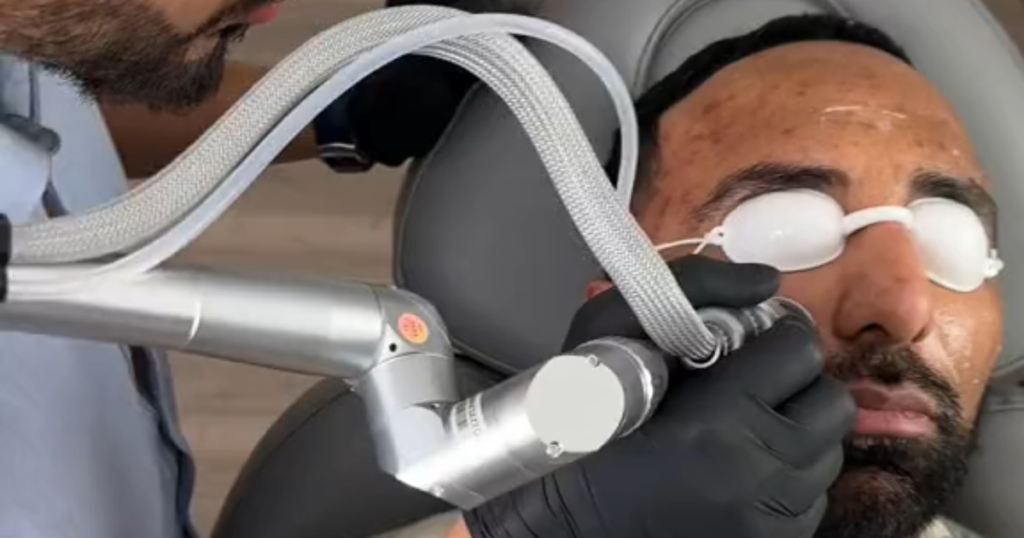
Your practitioner will cleanse your skin thoroughly and apply a numbing cream or local anaesthetic to the treatment area. Protective eyewear is provided for both you and the practitioner.
The laser is then applied in controlled passes across the skin. Each pass takes a few seconds. The entire session lasts 30 to 90 minutes depending on the area being treated. Full face takes longer than a small area like the upper lip or a single scar.
Most patients describe the sensation as a warm prickling or stinging, which the numbing cream manages well. It is uncomfortable but tolerable.
Recovery Timeline
Day 1 to 3: Skin feels hot, tight, and swollen. Redness is significant. This is the most intense phase. Keep the skin hydrated and protected.
Day 3 to 7: Peeling and flaking begins. The damaged skin starts to shed, revealing new pink skin underneath. Do not pick or pull at flaking skin. Let it separate naturally.
Day 7 to 14: Most redness fades. New skin is visible but may still look pink or slightly flushed. Makeup can usually be applied after day 7 to 10 with practitioner approval.
Week 4 onwards: Significant improvement in texture, tone, and scarring becomes evident. Skin looks fresher, smoother, and tighter.
3 to 6 months: Collagen continues building beneath the surface. This is when the full result appears. Many patients say their skin looks better at the 6-month mark than it did at the 1-month mark.
Sun protection is non-negotiable: Avoid direct sun exposure for at least 1 month after treatment. Wear SPF 30 or higher every single day for a minimum of 6 months. Your new skin is highly sensitive to UV damage and pigmentation during this period.
How to Boost Recovery
Exosomes can significantly accelerate healing after CO2 laser. They contain 6 billion growth factors that work with your skin’s natural repair process to speed up regeneration, enhance collagen production, and deeply hydrate the recovering skin.
At Deep Aesthetics, our CO2 Laser + Exosomes Stemcell Serum package is currently available at £2,500 £1,500. This combination delivers faster recovery and stronger long-term results than laser alone.
Beyond exosomes, the basics matter. Keep the skin hydrated with gentle, fragrance-free moisturiser. Avoid active skincare ingredients like retinoids and acids for at least 2 weeks before and after treatment. Drink plenty of water. Do not touch, pick, or scrub the treated area.
CO2 Laser Treatment at Deep Aesthetics
At Deep Aesthetics, we offer CO2 laser treatment with a consultation-first approach at both our London Canary Wharf and Birmingham clinics.
Every treatment starts with a thorough skin assessment. We evaluate your skin type, your specific concerns, and your downtime tolerance before recommending the right treatment intensity. We never apply a one-size-fits-all approach to the CO2 laser.
Our practitioners are trained in both fractional and ablative CO2 laser techniques, and we tailor settings to each patient’s skin. Aftercare products and follow-up appointments are part of the treatment package.
For patients wanting the fastest possible recovery, our CO2 Laser + Exosomes combination package accelerates healing with 6 billion growth factors at a limited-time price of £2,500 £1,500.
We also offer flexible payment through our finance option for larger treatment packages.
Book your free consultation today and find out which CO2 laser treatment is right for your skin. We will assess your concerns, explain your options honestly, and give you a clear treatment plan with transparent pricing.
Conclusion
Choosing the best CO2 laser treatment is not about finding the cheapest price or the fanciest machine. It is about finding the right practitioner who understands your skin, uses proven technology, and provides proper aftercare support throughout your recovery.
Check their qualifications, ask which machine they use, confirm they assess your skin type properly, and look at their own before and after results. These steps protect you from poor outcomes and ensure you get the transformative results CO2 laser is capable of delivering.
At Deep Aesthetics, we offer CO2 laser treatment with full consultation, personalised treatment planning, and aftercare support at both our London Canary Wharf and Birmingham clinics. Pricing starts from £300 for small areas and £750 for full face treatments.
Book your free consultation today and take the first step toward smoother, clearer, genuinely renewed skin.
Frequently Asked Questions
Question: How do I choose the best CO2 laser treatment?
Answer: Check seven key factors: the practitioner’s qualifications and laser-specific training, the machine brand being used, whether they conduct a proper consultation and skin assessment, their aftercare and recovery support, suitability for your skin type, pricing transparency, and the quality of their before and after photos. The practitioner’s experience matters more than any single machine brand.
Question: What is the difference between ablative and fractional CO2 laser?
Answer: Fully ablative CO2 laser removes the entire top layer of skin for the strongest possible results, but requires 2 to 4 weeks of recovery. Fractional CO2 treats a percentage of the skin surface while leaving surrounding skin intact, allowing faster healing in 5 to 10 days. Fractional carries lower risk and is more commonly offered. Your practitioner should recommend the right type based on the severity of your concern and your available downtime.
Question: Is a CO2 laser safe for dark skin?
Answer: CO2 laser carries a higher risk of pigmentation changes on darker skin tones (Fitzpatrick IV to VI). Fractional CO2 is generally safer than fully ablative for darker skin because the untreated skin between laser columns supports more predictable healing. Always consult a practitioner with specific experience treating darker skin types, and insist on a patch test before proceeding with a full treatment.
Question: How much does CO2 laser cost in the UK?
Answer: £300 to £2,000+ per session, depending on the treatment area and intensity. Small areas like a scar or upper lip cost £300 to £500. Full face fractional treatments range from £750 to £1,500. At Deep Aesthetics, small area sessions start from £300, full treatments from £750, and our CO2 Laser + Exosomes package is currently £2,500 £1,500. For a full cost breakdown by area and treatment type, see our CO2 laser cost UK guide.
Question: How long does it take to recover from CO2 laser?
Answer: Fractional CO2 recovery takes 5 to 14 days with redness, swelling, and peeling. Fully ablative CO2 requires 2 to 4 weeks. Skin continues improving for 3 to 6 months as new collagen forms. Sun avoidance for at least 1 month and daily SPF 30+ for 6 months are essential to protect the new skin and prevent pigmentation issues.
