
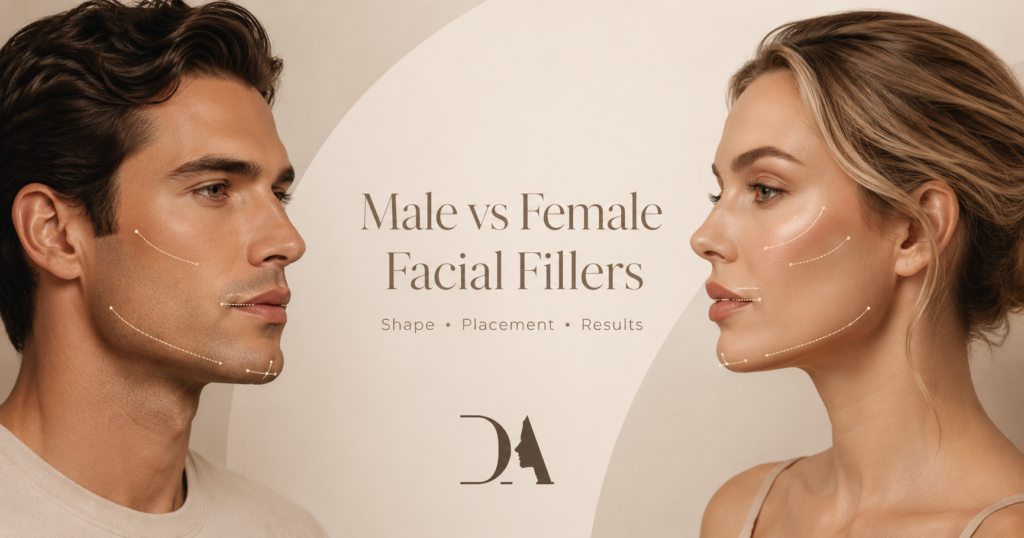
Male vs female facial fillers can use the same types of injectable products, but the treatment plan, placement and intended shape may be very different. Male treatment often prioritises structural definition through the chin, jawline and lateral cheek, while female treatment may place greater emphasis on cheek contour, facial taper and softer transitions. These are general patterns rather than fixed rules: the correct approach depends on the individual face and the result the patient wants.
At Deep Aesthetics, facial filler planning is based on facial proportions, existing anatomy and treatment goals rather than applying the same injection pattern to every patient.
Male vs Female Facial Fillers: Quick Comparison
| Area | More masculine treatment goal | More feminine treatment goal |
| Overall shape | Broader, straighter, more angular | Softer, tapered or heart-shaped |
| Cheeks | Structural, often lateral with less central roundness | Greater upper or lateral contour and smoother transitions |
| Chin | Broader, stronger projection | Narrower, more refined or tapered |
| Jawline | Wider and more angular | Defined without necessarily increasing lower-face width |
| Lips | Usually proportion-led and conservative where treated | May involve shape, border or selected volume |
| Filler placement | Often focused on structural support and angularity | Often focused on contour, transition and proportion |
These differences describe common aesthetic approaches rather than a prescription based on sex or gender. Published treatment data show that men and women can receive filler in different facial locations, but individual anatomy should remain the starting point.
Why Does Facial Filler Planning Differ Between Men and Women?
The visible face is shaped by bone structure, muscle, fat distribution, skin and soft tissue. Research describes average differences between male and female facial anatomy, including a broader and more angular lower face in men and, on average, a narrower mandibular width and more tapered facial outline in women.
That matters because filler adds or restores volume. Placing the same amount in the same location can therefore create a different effect on two different faces.
A good assessment should consider:
- Facial width and length
- Cheekbone projection
- Chin width and projection
- Mandibular angle
- Jawline definition
- Existing asymmetry
- Soft-tissue distribution
- Skin quality
- Age-related volume change
- The patient’s preferred facial character
The objective should not be to make every man look more masculine or every woman more feminine. Some patients want softer features; others want greater angularity. Treatment should follow the individual rather than a template.
How Is Cheek Filler Different in Men and Women?
Cheek placement is one of the clearest examples of why male vs female facial fillers should not be planned identically.
Research comparing actual filler treatment patterns found that male cheek injections were more commonly positioned inferomedially, while female cheek injections were more superolateral.
For a masculine-looking result, cheek treatment may aim to reinforce the zygomatic structure while avoiding excessive rounded fullness through the central cheek. Our facial masculinisation guidance similarly places emphasis on a defined zygoma and cautions against creating excessive medial cheek fullness when the goal is to preserve a masculine contour.
For a more feminine result, treatment may place greater emphasis on upper or lateral cheek projection and smoother transitions through the mid-face.
Neither placement strategy is inherently better. The important question is whether the proposed placement supports the patient’s existing anatomy and intended result.
How Is Chin Filler Different?
The chin strongly influences how the entire lower face is perceived.
A masculine treatment plan may aim for:
- Greater anterior projection
- More width
- A squarer appearance
- Stronger transition into the jawline
A feminine treatment plan may instead aim for:
- Selected projection
- A narrower shape
- Greater taper
- Balance with the lips and cheekbones
Average anatomical research describes male chins as broader and more projected, while female chins are generally narrower and more tapered.
Simply making a chin larger does not automatically improve facial balance. Someone concerned mainly about profile projection may need a different treatment from someone whose concern is lower-face width. Our Jawline & Chin treatment assesses both areas together rather than treating them as interchangeable.
Male vs Female Jawline Filler
Jawline treatment is another area where the desired shape can substantially change placement.
For a more masculine result, filler may be used to support a:
- Broader lower face
- More visible mandibular angle
- Straighter jaw border
- Stronger connection between jaw and chin
For a more feminine treatment plan, the goal may be a clearly defined jaw border while maintaining a narrower or more tapered lower face.
Our Jawline & Chin treatment focuses on selected placement at the mandibular angle, chin and peri-jowl region rather than simply filling the entire jawline uniformly.
This distinction matters. Adding excessive width around the jaw angle could work against the desired result in someone seeking a tapered lower face, while insufficient structural support may fail to produce the stronger angularity requested by another patient.
Do Men Need More Filler Than Women?
Not necessarily. Men may sometimes require more product in structural areas because an average male lower face can be wider and larger, meaning filler may need to cover a greater surface area to create a visible change. Research also describes greater average skeletal and muscle dimensions in male faces.
But gender alone should never determine the number of millilitres.
A man seeking a subtle chin adjustment may need less filler than a woman undergoing a broader jawline and chin treatment. Our guide to how many ml are used for jawline filler explains how anatomy, surface area and treatment goals affect volume.
The correct principle is appropriate volume in appropriate locations, not “more for men, less for women.”
Does Filler Type or Depth Change?
Potentially, yes. Different areas require different mechanical characteristics from a filler. Structural areas such as the jawline or chin may require a product chosen to provide support and definition, while more delicate facial areas may require a different product and placement strategy.
Our Jawline & Chin treatment describes the use of appropriately selected hyaluronic acid filler to create structural contour in the lower face.
Placement depth may also vary according to the treatment area, product, anatomy and intended effect. This is a clinical decision rather than something that should be determined from gender alone.
Are the Results Different?
They can be, because the desired endpoint is different.
A successful masculine treatment may make the lower face appear:
- More structured
- Wider
- Straighter
- More angular
- Better defined through the chin and jaw
A successful feminine treatment may create:
- Greater cheek contour
- A smoother mid-face transition
- A more tapered lower face
- Refined chin projection
- Balanced facial proportions
The intention should still be that the features work together. Filler should not be judged by how much volume was added. The more useful question is whether the treatment improved proportion while preserving the facial character the patient wanted.
Can Facial Fillers Accidentally Feminise or Masculinise the Face?
Yes, an unsuitable placement pattern can shift the perceived facial character.
Research and clinical literature specifically warn that excessive central cheek volume in a male face can create unwanted feminising convexity when the goal is masculinisation.
The reverse can also occur. Adding excessive jaw width or creating a very square chin may produce more angularity than desired in someone seeking a softer result.
This is why consultation should establish the intended appearance before product or volume is chosen. The British Association of Dermatologists advises patients to seek fully qualified, experienced practitioners for any injectable facial treatment.
What About Non-Binary and Gender-Affirming Filler?
Facial filler does not need to follow a binary male-versus-female template.
Some patients want to enhance traditionally masculine features; others want more traditionally feminine contours, a more androgynous balance or simply correction of one specific concern.
Published literature on gender-related facial treatment similarly emphasises that facial structure and treatment goals vary and require individual analysis.
The useful question is therefore not only “Are you male or female?” but “Which features do you want to preserve, soften or strengthen?”
What Are the Risks of Facial Fillers?
Dermal filler is an injectable medical aesthetic procedure and is not risk-free.
Potential complications can include:
- Swelling
- Bruising
- Tenderness
- Infection
- Lumps or irregularity
- Asymmetry
- Filler migration
- Vascular complications
- Tissue injury
Risk also varies according to treatment area, product, injection plane and individual anatomy. The CQC sets standards for regulated aesthetic practice in the UK and recommends always choosing a qualified medical practitioner for injectable treatments.
Where hyaluronic acid filler has been used, hyaluronidase may sometimes be considered to dissolve some or all of the product when clinically appropriate, but complete or immediate reversal cannot be guaranteed.
Facial Filler Treatment at Deep Aesthetics
We provide facial filler assessment and treatment in London Canary Wharf and Birmingham, including our Jawline & Chin treatment and dedicated facial masculinisation service.
A consultation should assess the entire face rather than treating one feature in isolation. This includes the relationship between the cheeks, chin, jawline, profile and existing soft tissue.
Patients comparing treatment costs can also read our guide to dermal filler prices in the UK.
Frequently Asked Questions
Are male and female fillers actually different?
The filler product itself does not have to be labelled male or female. The main differences are often where it is placed, how much is used and what facial shape the treatment is trying to create.
Where is filler most commonly placed in men?
Published treatment data found more jawline filler use in men, while cheek treatment patterns also differed from women. Chin, jawline and structural cheek enhancement are common areas when the desired result is more masculine.
Where is filler most commonly placed in women?
The same study found more lip and perioral filler treatment among women and different cheek placement patterns, although individual treatment preferences vary substantially.
Can women have a strong jawline with filler?
Yes. Treatment does not have to conform to a stereotypically feminine facial shape. A woman who prefers greater jaw definition can have a treatment plan designed around that goal, subject to anatomy and suitability.
Can men have lip or cheek filler?
Yes. Men can have filler in any appropriate facial area. Placement and volume should simply be planned around the desired result and existing proportions rather than copied from another patient’s treatment.
Is male facial filler more expensive?
Not automatically. Cost normally depends on the areas treated, product and volume required. A larger treatment plan may cost more regardless of whether the patient is male or female.
Final Thoughts
The main difference between male vs female facial fillers is not the label on the syringe. It is the treatment plan.
Masculine treatment commonly places more emphasis on chin width, jaw structure and controlled cheek projection, while feminine treatment may emphasise cheek contour, softer transitions and lower-face taper. Research confirms that real-world filler placement patterns differ between men and women, but those averages should never replace individual facial assessment.
At Deep Aesthetics, treatment planning considers your anatomy, proportions and preferred facial character before filler placement or volume is decided.
Disclaimer: This blog is for informational purposes only and does not constitute medical advice. Dermal filler is an injectable cosmetic procedure with recognised risks. Suitability, product selection, volume, placement, results and complication risk vary between individuals and should be assessed during consultation.
To book a consultation at our London Canary Wharf or Birmingham clinic.
