
Table of Contents
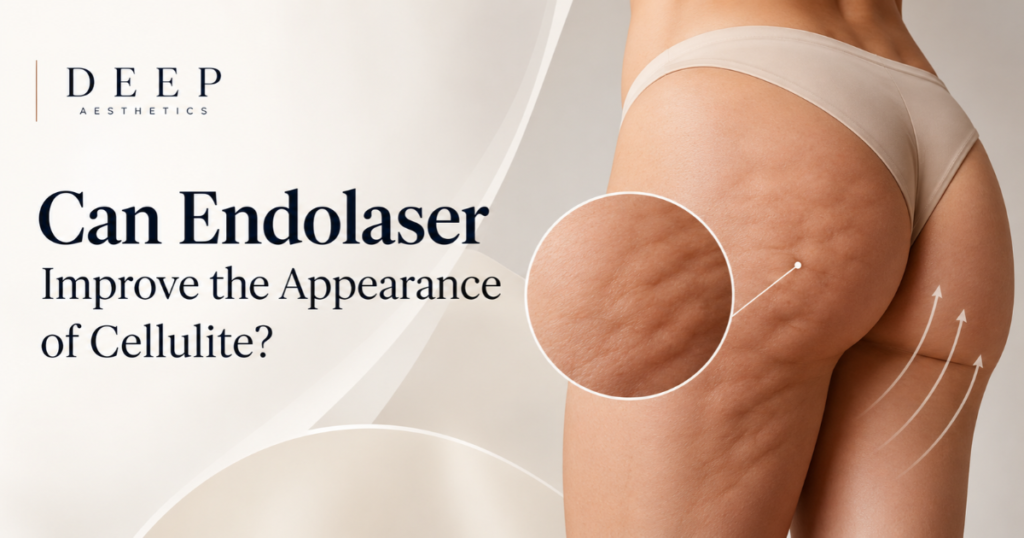
ToggleEndolaser may help improve the appearance of cellulite in selected patients when skin laxity, localised subcutaneous fat or tissue quality contribute to uneven skin texture. However, cellulite is multifactorial, so Endolaser should not be described as a guaranteed cellulite-removal treatment. Results depend on the cause and severity of the dimpling.
Cellulite is extremely common, particularly around the thighs and buttocks. Research estimates that it affects approximately 80–90% of post-pubertal women, yet its exact development is complex and no single treatment has been proven to work reliably for every patient.
At Deep Aesthetics, we assess skin laxity, localised fat, tissue quality and the pattern of dimpling before discussing whether Endolaser may be appropriate. The aim is to understand what is contributing to the visible texture rather than promising complete cellulite removal.
In this guide, we explain why cellulite develops, where Endolaser may fit into treatment planning, what the research actually shows, the limitations of laser treatment and what patients should realistically expect.
What Is Cellulite?
Cellulite is the dimpled, uneven or “orange-peel” appearance most commonly seen on the thighs, buttocks and hips. It develops through interactions between the skin, subcutaneous fat and fibrous connective-tissue structures beneath the skin.
It is not simply excess body fat.
Fibrous bands known as septae connect the skin with deeper tissue. Differences in the way fat pushes upward and fibrous structures pull downward can create visible depressions and raised areas on the surface.
Reviews of cellulite anatomy also describe contributions from skin quality, connective tissue, local fat distribution and other biological factors. This is one reason cellulite can appear in people across a wide range of body weights.
Why Can Cellulite Be Difficult to Treat?
Cellulite is difficult to treat because different patients may have different structural causes of the same dimpled appearance.
For example, one person may have noticeable skin laxity with relatively little excess fat. Another may have stronger fibrous tethering beneath the skin. Someone else may have a combination of localised fat, laxity and dimpling.
That means a treatment aimed primarily at one tissue component cannot automatically correct every feature of cellulite.
| Contributing factor | Possible visible effect | Relevance to Endolaser |
| Skin laxity | Loose or crepey texture | May be relevant |
| Localised subcutaneous fat | Uneven contour/fullness | May be relevant |
| Fibrous septae | Deeper dimples or tethering | Requires individual assessment |
| Skin quality | Reduced firmness | Tissue remodelling may be relevant |
| Significant volume or laxity | More pronounced contour changes | Endolaser alone may be insufficient |
This is why the question is usually not simply, “Can Endolaser treat cellulite?” but rather, “What is causing this person’s cellulite appearance?”
Can Endolaser Improve Cellulite?
Endolaser may improve some features that contribute to the appearance of cellulite, particularly selected skin laxity, tissue firmness and localised fat. However, direct high-quality evidence specifically proving Endolaser as a dedicated cellulite treatment remains limited.
Laser energy delivered beneath or into tissue has been studied for skin remodelling and body contouring. Thermal energy may influence collagen remodelling and tissue structure, which could alter how the overlying skin appears.
There is also evidence from other minimally invasive laser systems suggesting improvement in cellulite appearance.
One small prospective study treated 10 women with a 1440-nm pulsed laser delivered at the dermal-hypodermal interface. Investigators reported improvements in skin thickness, elasticity and cellulite appearance lasting through 12 months.
However, this study involved only 10 participants and a specific laser platform and technique.
Those findings should not be interpreted as proof that every Endolaser procedure, wavelength or protocol will provide the same result.
If you are new to the treatment itself, read our guide to What Is Endolaser? to understand how the procedure works, what it may address and its limitations.
What Does the Wider Research Say?
The wider evidence on cellulite treatment remains mixed.
A major evidence-based review examining 67 cellulite-treatment studies found methodological weaknesses across many therapies. At that time, the authors found some potential evidence for acoustic wave therapy and a minimally invasive 1440-nm laser, but concluded that no treatment had clear evidence of consistently strong efficacy.
More recently, a 2025 systematic review assessed 24 randomised controlled trials involving 2,084 patients. Treatments included laser and light devices, radiofrequency, shock-wave therapy, ultrasound and injectable approaches.
The review found promising findings particularly for shock-wave therapy, radiofrequency and selected injectables, while emphasising that cellulite still has no definitively established treatment.
A separate 2024 systematic review of electrophysical cellulite treatments found that only a small proportion of the available studies had strong methodology and concluded that better-designed trials are still needed.
So the evidence supports a cautious conclusion:
Energy-based treatments can improve cellulite appearance in some patients, but current research does not justify guaranteeing complete or permanent cellulite removal.
How Might Endolaser Affect the Appearance of Cellulite?
Endolaser treatment planning may focus on several tissue characteristics.
1. Skin Firmness
When reduced skin firmness contributes to uneven texture, controlled laser energy may support tissue remodelling.
Improving the appearance of skin firmness may make superficial irregularity appear less noticeable in appropriately selected patients.
2. Localised Subcutaneous Fat
Localised fat can contribute to thigh and buttock contour.
Where appropriate, Endolaser may form part of a laser lipolysis treatment plan for selected superficial fat.
This is different from surgical liposuction and should not be presented as a weight-loss treatment.
3. Tissue Contour
Changes in tissue firmness and localised fat may make an area appear smoother or better defined.
However, improving contour does not necessarily mean that every cellulite depression will disappear.
4. Skin Laxity
Cellulite may become more visually noticeable when skin is lax.
Where laxity is an important component, supporting skin remodelling may improve the overall appearance even if some dimpling remains.
Is Endolaser Better for Mild or Severe Cellulite?
Endolaser may be more relevant where mild-to-moderate uneven texture occurs alongside skin laxity or selected localised fat. More pronounced, deeply tethered cellulite may require another treatment strategy or a combination approach.
A 2023 clinical review proposed treating cellulite according to severity and contributing tissue factors rather than applying one treatment to every patient. It noted that moderate cellulite may be considered for energy-based treatments, while more severe cases can require minimally invasive approaches targeting deeper structural components.
This reinforces the importance of proper assessment.
A patient with superficial laxity is fundamentally different from someone whose main concern is multiple deep, fixed depressions caused by strong connective-tissue tethering.
Endolaser for Cellulite on the Thighs
The thighs are one of the most common areas where cellulite becomes visible.
Inner and outer thigh appearance can be influenced by skin laxity, localised fat and the connective-tissue architecture beneath the skin.
Endolaser may therefore be discussed where thigh skin tightening or selected fat reduction could improve overall contour.
For patients whose main concerns involve thigh laxity or localised fat, the dedicated Endolaser Thighs and Buttocks treatment page should be the primary service page linked from this section.
It is important to distinguish between:
- improving thigh firmness,
- reducing selected localised fat,
- improving overall contour, and
- treating specific cellulite depressions.
These are not necessarily the same treatment goal.
Can Endolaser Improve Cellulite on the Buttocks?
It may improve the appearance of selected buttock-area texture when skin laxity or tissue quality contributes to the concern, but it cannot guarantee removal of individual cellulite dimples.
The buttocks are particularly prone to cellulite because of the interaction between subcutaneous fat and fibrous connective tissue.
If the visible concern involves deeper fixed depressions, a practitioner may need to consider whether Endolaser alone is likely to address the main structural cause.
That assessment should happen before treatment rather than after an unrealistic expectation has been created.
Is Cellulite the Same as Localised Fat?
No. Cellulite and localised fat are different concerns, although they may occur in the same area.
Someone can be slim and still have cellulite.
Likewise, reducing a pocket of thigh fat does not automatically eliminate cellulite because fibrous tissue, skin laxity and underlying architecture can remain.
This distinction is particularly important with laser lipolysis.
A reduction in selected localised fat may improve contour while leaving some skin dimpling visible.
Therefore, before-and-after assessment should consider skin texture separately from circumference or fat reduction.
Can Weight Loss Remove Cellulite?
Weight loss does not reliably remove cellulite.
Changes in body fat may alter its visibility, but cellulite is not simply a consequence of being overweight.
In some cases, significant weight loss can also leave skin laxity that makes surface irregularity more noticeable.
Healthy weight maintenance can be useful for general wellbeing and body composition, but patients should not be told that dieting or weight loss will necessarily eliminate cellulite.
Endolaser vs Other Cellulite Treatments
Because cellulite can involve different tissue components, several treatment categories have been studied.
| Treatment approach | Main target | Important consideration |
| Endolaser / subdermal laser | Tissue remodelling, selected fat/laxity | Evidence depends on laser and protocol |
| Radiofrequency | Skin/tissue heating | Evidence shows potential benefit |
| Shock-wave therapy | Tissue/mechanical effects | Promising evidence in systematic reviews |
| Subcision | Fibrous tethering | May suit selected deeper dimples |
| Topical products | Skin surface | Generally limited effects |
| Lifestyle measures | Overall health/body composition | Do not directly remove structural cellulite |
The 2025 systematic review found promising evidence for several approaches but still concluded that there is no definitively established universal cellulite treatment.
For that reason, treatment selection should depend on the anatomical cause rather than whichever device is currently most heavily marketed.
How Many Endolaser Sessions Are Needed for Cellulite?
There is no evidence-based universal number of Endolaser sessions that can be promised specifically for cellulite.
The appropriate plan depends on the area being treated, severity of laxity, localised fat, skin quality, treatment protocol and individual response.
A consultation should establish whether Endolaser is appropriate at all before discussing treatment frequency.
Promising that a fixed number of sessions will “remove cellulite” would not reflect the limitations of current evidence.
When Might Results Appear?
Visible change should be evaluated after initial treatment effects settle and tissue remodelling has had time to develop.
Laser-related tissue changes are not necessarily immediate.
Published research involving minimally invasive laser treatment for cellulite has assessed outcomes over several months rather than simply relying on same-day photographs.
The timeline for an individual patient will depend on the actual treatment undertaken.
Temporary swelling can also change how the area looks early in recovery, so immediate photographs should not be interpreted as final results.
Are Cellulite Results Permanent?
Permanent cellulite removal should not be promised.
Cellulite appearance can change over time with ageing, changes in skin elasticity, hormones, weight fluctuations and tissue structure.
Some studies of specific cellulite technologies have reported improvements lasting a year or longer, but durability varies by procedure and this cannot automatically be applied to Endolaser.
Patients should therefore be given realistic expectations about both the degree and duration of improvement.
Before and After Photos: What Should You Look For?
Before-and-after images can help demonstrate individual outcomes, but they must be interpreted carefully.
Look for:
- similar lighting,
- similar body position,
- similar camera distance,
- similar clothing,
- appropriate follow-up timing,
- genuine treatment cases.
Deep Aesthetics should only use genuine, appropriately consented patient images.
Photographs show what happened in one individual and do not predict another patient’s result. Our Endolaser Before and After guide explains what patients should look for when comparing treatment photographs and why individual results should never be treated as guaranteed outcomes.
Endolaser for Cellulite in London
Deep Aesthetics offers consultations at:
Mirror Works
12 Marshgate Lane
Stratford, London
E15 2NH
Patients concerned about cellulite around the thighs or buttocks can be assessed to determine whether skin laxity, localised fat or another structural factor appears to be contributing.
Where appropriate, the consultation can include discussion of Endolaser Thighs and Buttocks rather than presenting Endolaser as a universal cellulite treatment.
Endolaser for Cellulite in Birmingham
Consultations are also available at:
25 King Edwards Wharf
Sheepcote Street
Birmingham
B16 8AB
Treatment recommendations should be based on individual anatomy, skin condition, localised fat, degree of dimpling and realistic cosmetic goals.
Frequently Asked Questions
Can Endolaser get rid of cellulite completely?
No. Endolaser should not be described as guaranteed cellulite removal. It may improve selected tissue factors that influence cellulite appearance, including skin laxity and localised fat, but deeper fibrous tethering can remain. Results depend on anatomy, severity and individual response.
Does Endolaser work for thigh cellulite?
It may be considered when thigh cellulite occurs alongside mild-to-moderate skin laxity or selected localised fat. However, cellulite is multifactorial, and Endolaser may not address every underlying structural cause. A consultation is required to determine whether treatment is appropriate.
Does Endolaser work for cellulite on the buttocks?
Endolaser may improve overall tissue firmness or contour in suitable patients, which can make some irregularity less noticeable. It cannot guarantee that individual buttock dimples will disappear, particularly when strong fibrous tethering is the main cause.
Can Endolaser reduce fat and cellulite at the same time?
Selected localised subcutaneous fat may form part of an Endolaser laser-lipolysis treatment plan. Improving fat distribution and skin firmness may influence overall contour, but fat reduction does not automatically remove cellulite because fibrous and structural factors may remain.
Is cellulite caused by being overweight?
No. Cellulite occurs across a wide range of body weights and is related to skin, fat and connective-tissue architecture rather than weight alone. Weight changes can influence its appearance, but losing weight does not guarantee that cellulite will disappear.
Is Endolaser a weight-loss treatment?
No. Endolaser is not a weight-loss treatment and should not be positioned as an alternative to diet, exercise or medical weight management. Where appropriate, it may be considered for selected localised subcutaneous fat or skin-laxity concerns.
How long do cellulite improvements last?
Duration varies according to the treatment used, individual anatomy, skin ageing and future body changes. Some laser research has reported improvement lasting at least one year with specific devices, but those findings cannot be assumed to apply to every Endolaser procedure.
What is the best treatment for cellulite?
There is no single treatment proven to be best for every type of cellulite. Current research supports several approaches, including radiofrequency, shock-wave therapy and selected minimally invasive procedures. Treatment choice should reflect whether laxity, fat, fibrous tethering or multiple factors are responsible.
Final Thoughts: Can Endolaser Improve the Appearance of Cellulite?
Yes, Endolaser may improve the appearance of cellulite in selected patients when skin laxity, localised fat or tissue firmness contribute to uneven contour—but it should not be described as a treatment that removes cellulite completely.
The scientific evidence is much stronger for saying that cellulite is multifactorial than for claiming any one procedure can reliably eliminate it. Recent systematic reviews continue to find variation in study quality, treatment methods and outcomes.
At Deep Aesthetics, we assess the thighs and buttock area individually before recommending treatment, with consultations available in Stratford, London and Birmingham. The aim is to determine whether Endolaser is appropriate for the specific combination of skin laxity, localised fat and contour concerns present.
Individual results vary. No degree of cellulite improvement, skin tightening or fat reduction can be guaranteed.
Disclaimer: This article is for general educational purposes and does not constitute medical advice. Cellulite is a cosmetic concern with multiple possible contributing factors. Endolaser suitability, risks, recovery and outcomes vary between individuals. An in-person consultation is required before treatment.
