
Table of Contents
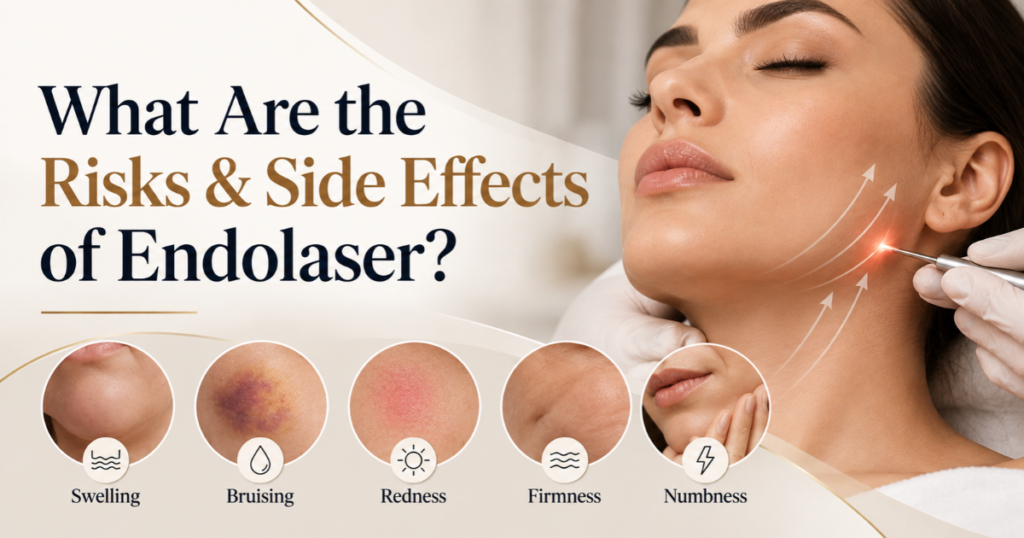
ToggleEndolaser side effects can include temporary swelling, bruising, tenderness, redness, firmness and altered sensation. Less common but more significant complications reported with Endolaser and related laser-assisted procedures include burns, seromas, haematomas, infection and scarring. Rare severe thermal injuries have also been reported.
Endolaser is minimally invasive, but minimally invasive does not mean risk-free. A fine optical fibre delivers laser energy beneath the skin, which means both fibre placement and controlled heat delivery matter. Treatment area, anatomy, device parameters, technique and individual healing can all influence what happens afterwards.
At Deep Aesthetics, we believe potential benefits should be discussed alongside recognised risks, realistic outcomes and recovery before treatment is agreed.
In this guide, we explain which Endolaser side effects may occur during normal recovery, which complications deserve more attention, what current scientific evidence tells us and what patients should ask before booking.
Is Endolaser Safe?
Endolaser can have a favourable safety profile in appropriately selected patients, but current evidence is not strong enough to describe it as universally risk-free or to quote one complication rate for every device and protocol.
A 2025 scoping review specifically examining aesthetic Endolaser literature found only 26 publications: one randomised controlled trial, 23 case series, one case study and one pilot study. The researchers identified substantial variation between treatment protocols and concluded that better standardisation and stronger long-term evidence are needed.
This matters when discussing safety.
An Endolaser procedure performed on the jawline cannot automatically be assumed to have the same risk profile as treatment performed on the abdomen, arms or thighs. Likewise, different laser wavelengths, fibre dimensions, power settings and treatment techniques cannot simply be treated as interchangeable.
What Are the Common Temporary Side Effects of Endolaser?
Temporary local reactions can occur because tissue has been entered with a fibre and exposed to controlled laser energy.
Potential early effects can include:
| Possible effect | What it may feel or look like |
| Swelling | Puffiness or increased volume around the treated area |
| Bruising | Temporary skin discolouration |
| Tenderness | Soreness when touching or moving the area |
| Redness | Temporary erythema around treatment or entry points |
| Firmness | Tissue may temporarily feel harder or uneven |
| Warmth | Heat or warmth around the treated tissue |
| Altered sensation | Temporary tingling, numbness or sensitivity |
| Mild discomfort | Aching, pressure or tenderness during early healing |
A 2023 study of 1444-nm laser-assisted lipolysis reported transient pain, oedema, erythema and slight induration, which resolved within the first week in that particular study population. However, this was one specific laser system and protocol, so its timeline should not be treated as universal.
Deep Aesthetics’ existing recovery guide also discusses swelling, bruising, tenderness and altered sensation as possible recovery effects. For more detailed recovery information, see our Endolaser Recovery Time guide.
How Long Does Swelling Last After Endolaser?
There is no single swelling timeline that applies to every Endolaser patient.
The amount and duration may depend on the treatment area, extent of treatment, energy delivered, individual inflammatory response and healing.
Facial swelling may also look different from swelling after a larger body-area treatment.
The important distinction is between expected swelling that gradually improves and swelling that becomes increasingly severe, painful or associated with other concerning symptoms.
That is why personalised aftercare and a clear follow-up pathway matter more than promising that everyone will look normal after a fixed number of days.
Can Endolaser Cause Bruising?
Yes. Bruising can occur after minimally invasive laser treatment.
A fibre passes through tissue, and treatment can affect small blood vessels. The degree of bruising can vary between patients and treatment areas.
Research into laser-assisted lipolysis has often described bruising or ecchymosis as a possible postoperative effect, although some studies suggest laser-assisted techniques may reduce bruising compared with certain conventional procedures.
That does not mean bruising can be ruled out.
Medicines, supplements, individual bleeding tendency and treatment extent may also be relevant and should be discussed during consultation.
Can Endolaser Cause Burns?
Yes. Burns are one of the most important recognised complications of laser-assisted procedures because Endolaser works using thermal energy beneath the skin.
Laser energy needs to create a controlled tissue effect without overheating the skin or surrounding structures.
A major review of laser lipolysis explains that thermal injury is an inherent concern because there is a relatively narrow margin between generating sufficient heat for tissue effects and producing excessive thermal damage.
A more recent 2026 literature overview examining 88 studies of technologies including Endolaser and laser-assisted lipolysis identified skin burns among the most commonly reported complications.
Burn risk is one reason why device settings, fibre position, tissue depth, anatomy and practitioner technique matter.
Can Endolaser Cause Skin Necrosis?
Rare severe thermal injury is possible.
A recently published case report documented cutaneous necrosis following aesthetic Endolaser treatment. The report described thermal tissue injury resulting in fibrosis and skin-colour changes.
A case report cannot tell us how frequently this happens.
It does, however, demonstrate why it would be inaccurate to say that severe thermal complications are impossible.
Necrosis should not be presented as a routine outcome, but patients should understand that energy-based treatment can cause significant tissue injury if thermal damage occurs.
Can Endolaser Cause a Seroma?
Seroma is a recognised potential complication in the wider Endolaser and technology-assisted lipolysis literature.
A seroma is an accumulation of fluid within tissue after a procedure.
The 2026 literature overview identified seromas alongside burns, haematomas, infection and scars among the complications reported across technology-assisted lipolysis studies.
Not every area of swelling after Endolaser represents a seroma.
That distinction requires clinical assessment rather than self-diagnosis from photographs or social-media advice.
Can Endolaser Cause a Haematoma?
Haematomas have also been reported.
A haematoma is a collection of blood within tissue and is different from ordinary superficial bruising.
Again, the 2026 review of technology-assisted procedures identified haematomas among commonly reported complications.
Patients should disclose relevant medical conditions, medications and supplements during consultation so the treating clinician can assess factors that may affect bleeding or healing.
Can Endolaser Cause Infection?
Any procedure that passes through the skin carries an infection risk, even when the entry point is very small.
Infection has been documented within laser-assisted lipolysis literature.
For example, an older review describing 537 laser-assisted lipolysis cases reported one local infection, while the broader 2026 literature overview also lists infection among recognised complications.
This is why sterile technique, entry-point care and appropriate post-treatment instructions matter.
Increasing redness, worsening pain, discharge or systemic illness should not simply be dismissed as normal treatment recovery.
Can Endolaser Cause Scarring?
Scarring is possible, particularly if significant tissue injury or another complication occurs.
The 2026 technology-assisted lipolysis review included scarring among reported complications and also presented a case series involving patients treated for scars resulting from these procedures.
Most people undergoing uncomplicated minimally invasive treatment would not expect extensive scarring.
However, it would be misleading to say that scarring can never occur.
Severe thermal injury may also result in persistent fibrosis or pigmentary change, as demonstrated by the published necrosis case report.
Can Endolaser Cause Numbness or Tingling?
Temporary altered sensation may occur after treatment.
Patients may describe numbness, tingling, sensitivity or an unusual sensation as swelling and tissue response develop.
Evidence across laser procedures suggests that nerve-related symptoms are influenced by anatomy, technique and energy delivery. The older laser-lipolysis literature discusses nerve damage as a theoretical safety concern, although persistent neuropathy was not observed in the large case experience described in that particular review.
Persistent or worsening sensory change therefore should not automatically be assumed to be normal.
Does Endolaser Have Different Risks on the Face and Body?
Potential risks overlap, but anatomical context changes their importance.
The face and neck contain delicate structures within relatively small treatment areas, while body procedures can involve larger tissue volumes.
For example, treatment planning around the jawline requires attention to skin thickness, fat compartments, facial anatomy and adjacent structures.
Body treatment may involve larger areas such as the abdomen, arms or thighs, where swelling, bruising and contour considerations can differ.
This is another reason a single online list cannot replace an individual assessment.
Patients considering facial treatment can also read our Is Endolaser Painful? guide for a separate discussion of treatment sensation and discomfort.
What Symptoms Should You Contact the Clinic About?
Some swelling or tenderness may be expected, but unexpected, severe or worsening symptoms deserve assessment.
Contact your treating clinic promptly if you develop symptoms such as:
- pain that becomes significantly worse rather than improving,
- marked or rapidly increasing swelling,
- spreading redness,
- blistering,
- unusual or worsening skin-colour changes,
- discharge from an entry point,
- fever or feeling systemically unwell,
- persistent or worsening numbness,
- any symptom that concerns you or does not match the recovery plan you were given.
These symptoms do not automatically prove that a serious complication has occurred.
They mean the treatment area should be reviewed rather than managed solely through assumptions made online.
If symptoms are severe or you feel acutely unwell, seek appropriate urgent medical care.
What Increases the Risk of Endolaser Complications?
There is no reliable formula for predicting complications in every patient.
However, treatment safety can reasonably depend on several factors:
Patient Selection
Endolaser is not suitable simply because somebody wants skin tightening or fat reduction.
The degree of laxity, tissue thickness, fat distribution, anatomy, previous treatment history and medical history all need consideration.
Practitioner Technique
Endolaser delivers energy below the skin.
Fibre depth, movement, anatomical awareness and treatment planning therefore matter.
The 2026 complications review specifically emphasised the need for clinicians using these technologies to understand both complication prevention and management.
Energy and Treatment Parameters
Too little energy may fail to achieve the intended effect.
Excessive or poorly controlled heat can damage tissue.
Published literature also demonstrates substantial variation between laser wavelengths, energy levels and protocols, making standardisation an ongoing problem.
Treatment Area
Different anatomical areas contain different tissue thicknesses, vessels, nerves and structures.
Treatment should therefore be planned according to anatomy rather than using one identical protocol everywhere.
Medical and Medication History
A consultation should include relevant health conditions, current medicines, allergies, previous procedures and factors that may affect healing.
Do not stop prescribed medication simply because you are considering an aesthetic procedure. Medication decisions should be discussed with the appropriate clinician.
How Common Are Serious Endolaser Complications?
A reliable universal percentage cannot currently be given.
This is one of the most important findings from the research.
The Endolaser literature is relatively small and heavily dominated by case series. Devices, protocols, wavelengths, treatment areas and follow-up methods vary considerably.
Some studies report few significant complications. For example, a 2025 meta-analysis of laser-assisted arm lipolysis described reported complications as generally mild and transient.
At the same time, wider reviews and individual case reports demonstrate that more serious complications can occur.
The responsible message is therefore neither “Endolaser is dangerous” nor “Endolaser has no serious risks.”
The available evidence supports informed, individual risk assessment.
What Should You Ask Before Booking Endolaser?
Before agreeing to treatment, ask:
- What exactly are you treating in my case?
- Why am I considered suitable for Endolaser?
- What degree of improvement is realistic?
- What are the recognised side effects and complications?
- What recovery should I expect for this particular area?
- What should make me contact the clinic after treatment?
- What happens if a complication occurs?
- What alternatives should I consider?
- When should my final result be assessed?
- Can I see genuine, appropriately consented examples of comparable cases?
These questions help separate informed consent from marketing.
For another useful perspective before booking, read Why Didn’t My Endolaser Work?, which explains how suitability, treatment planning and expectations can affect outcomes.
Endolaser Safety in London
Patients considering treatment in London can book an individual consultation with Deep Aesthetics at:
Mirror Works
12 Marshgate Lane
Stratford, London
E15 2NH
The consultation should review the area being treated, relevant medical history, realistic outcomes, recovery and recognised risks before any procedure is agreed.
For treatment-specific information, visit our Endolaser London page.
Endolaser Safety in Birmingham
Consultations are also available at:
25 King Edwards Wharf
Sheepcote Street
Birmingham
B16 8AB
The same principle applies: suitability and risk should be assessed individually rather than assuming that a treatment is appropriate based solely on age or cosmetic concern.
See our Endolaser Birmingham page for location-specific treatment information.
Frequently Asked Questions
Is Endolaser dangerous?
Endolaser is not automatically dangerous, but it is not risk-free. Temporary effects such as swelling, bruising and tenderness may occur. Published literature also reports less common complications including burns, seromas, haematomas, infection and scarring. Individual risk depends on several treatment and patient factors.
What is the most common Endolaser side effect?
There is no single reliable incidence figure across every Endolaser protocol. Temporary swelling, tenderness, bruising and local tissue reactions are commonly discussed in recovery literature, but their frequency and duration vary by device, area, treatment extent and individual response.
Can Endolaser burn your skin?
Yes. Thermal injury and burns are recognised risks of internal laser procedures because laser energy produces heat in tissue. Appropriate fibre placement, technique and energy control are therefore important parts of treatment safety.
Can Endolaser cause permanent damage?
Most published treatment effects are temporary, but significant complications can potentially leave lasting changes. Published literature includes scarring, and a recent case report described thermal necrosis resulting in fibrosis and dyschromia. Such reports demonstrate possibility rather than providing a reliable frequency estimate.
Is swelling normal after Endolaser?
Temporary swelling can occur as part of tissue response and healing. The amount and duration vary. Swelling that becomes severe, rapidly worsens or is accompanied by increasing pain, redness, discharge, fever or concerning skin changes should be assessed by the treating clinic.
Can Endolaser cause numbness?
Temporary altered sensation, including numbness or tingling, may occur. Persistent, worsening or unusual sensory changes should be reviewed rather than assumed to be normal. Risk may depend on anatomy, treatment area, technique and the energy delivered.
Are Endolaser complications common?
Current research does not provide a single trustworthy complication rate for all Endolaser procedures. Studies use different wavelengths, devices, treatment areas and protocols, while much of the aesthetic Endolaser literature consists of small case series rather than large controlled trials.
How can I reduce my Endolaser risk?
Start with an appropriate consultation, provide an accurate medical and medication history, understand realistic outcomes and recognised risks, and follow your personalised aftercare instructions. You should also know how to contact the clinic and what symptoms require review before treatment takes place.
Conclusion: What Are the Risks and Side Effects of Endolaser?
Endolaser side effects can range from temporary swelling, bruising, tenderness and altered sensation to less common complications such as burns, seromas, haematomas, infection and scarring. Rare severe thermal injury has also been documented.
The current evidence suggests that many Endolaser and laser-assisted procedures can have favourable safety outcomes, but the research base remains heterogeneous. A 2025 scoping review found only 26 aesthetic Endolaser publications, while a 2026 review of technology-assisted lipolysis highlighted both recognised complications and the need for greater caution and stronger evidence.
The most useful question therefore is not simply “Is Endolaser safe?” It is:
“Is this treatment appropriate for my anatomy, goals and medical circumstances, and have the potential risks and alternatives been properly explained?”
At Deep Aesthetics, consultations are available in Stratford, London and Birmingham to assess suitability, realistic outcomes, recognised risks and expected recovery before treatment proceeds.
Individual outcomes and recovery vary. No treatment can be guaranteed to be complication-free.
Disclaimer: This article provides general educational information and is not medical advice. It does not provide a complete list of contraindications or complications for every Endolaser device or treatment protocol. If you have symptoms after a procedure, contact your treating clinician for individual assessment; seek urgent medical care for severe or rapidly worsening symptoms.
