
Table of Contents
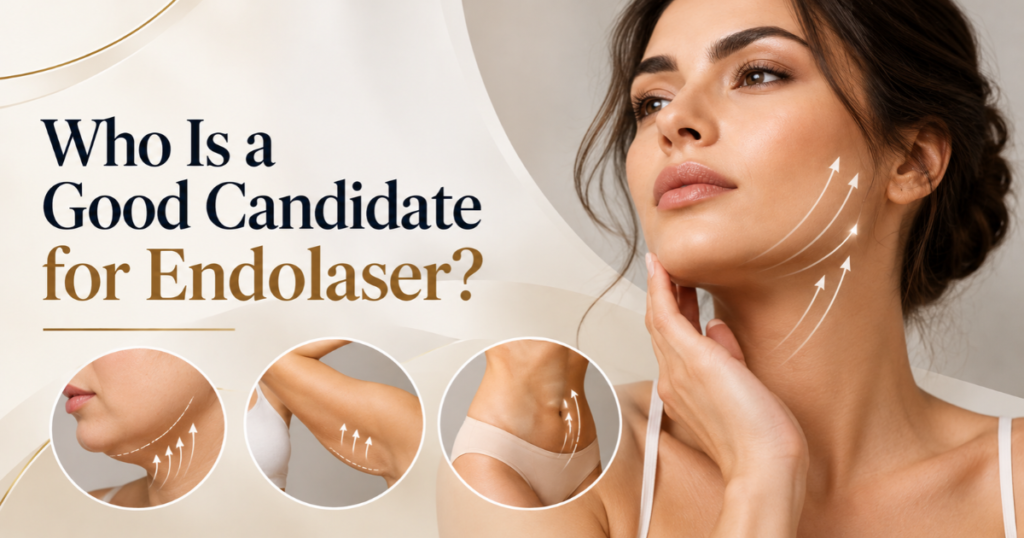
ToggleA good candidate for Endolaser is generally an adult with a defined concern involving mild-to-moderate skin laxity, a small area of localised subcutaneous fat, or both, who is in suitable general health and has realistic expectations about a minimally invasive treatment. Suitability depends more on anatomy and tissue quality than age alone.
Two people of the same age can have completely different skin elasticity, fat distribution and degrees of laxity. Likewise, a soft jawline caused mainly by localised fat is a different problem from one caused by substantial loose skin or underlying bone structure.
At Deep Aesthetics, we assess anatomy, skin condition, localised fat, medical history and the degree of change being requested before recommending Endolaser. Treatment should match the underlying concern rather than simply the name of the body area.
In this guide, we explain who may be a good Endolaser candidate, who may need another option, how skin elasticity and localised fat affect suitability, and what to discuss before booking.
What Makes Someone a Good Candidate for Endolaser?
The strongest Endolaser candidate usually has a specific, relatively limited concern that matches what a minimally invasive laser procedure can reasonably address.
Older laser-lipolysis literature describes ideal candidates as generally healthy people with isolated localised fat and suitable skin quality. It also emphasises careful patient education and realistic expectations.
For Endolaser specifically, the evidence base remains developing. A 2025 scoping review found only 26 aesthetic Endolaser publications, including just one randomised controlled trial, while treatment protocols varied substantially between studies. This means there is no scientifically established universal age, BMI or checklist that can guarantee a good outcome.
Instead, suitability should be assessed across several factors.
| Factor | More compatible with Endolaser | May require another approach |
| Skin laxity | Mild to moderate | Significant hanging or redundant skin |
| Localised fat | Small, defined subcutaneous area | Large-volume or generalised fat |
| Skin elasticity | Reasonable residual elasticity | Markedly poor elasticity |
| Treatment goal | Subtle-to-moderate improvement | Surgical-level transformation |
| Anatomy | Concern mainly involves suitable soft tissue | Main issue is bone or deeper structure |
| Health | Medically suitable for treatment | Condition may increase procedural risk |
| Expectations | Realistic and informed | Guaranteed or dramatic outcome expected |
Is Mild-to-Moderate Skin Laxity a Good Indication?
Yes, selected mild-to-moderate skin laxity is one of the more logical reasons to discuss Endolaser.
The goal is not to remove skin. Instead, controlled laser energy is delivered beneath the skin and may support tissue remodelling in appropriately selected patients.
Patient-selection research across skin-tightening technologies shows that outcomes can vary with factors including the degree of laxity, age, BMI, smoking history, treatment area and device protocol. Importantly, the literature does not identify one single variable that reliably predicts the best response.
This is why someone with early lower-face looseness may have a very different treatment opportunity from a person with substantial facial or body skin excess.
Does Skin Elasticity Affect Endolaser Suitability?
Skin elasticity appears to matter, particularly when the treatment goal involves tissue retraction rather than fat reduction alone.
A 2026 study involving 59 patients undergoing abdominal laser-assisted lipolysis found measurable skin retraction and reported that pre-treatment skin elasticity significantly influenced the degree of vertical skin retraction.
This does not establish a guaranteed Endolaser result because laser-assisted lipolysis studies may use different devices and protocols.
It does, however, reinforce an important clinical principle: the condition of the tissue before treatment influences what can realistically happen afterwards.
Someone with reasonable residual elasticity may therefore present a different treatment opportunity from someone with extensively stretched, thin or redundant skin.
Is Localised Fat Suitable for Endolaser?
Selected localised subcutaneous fat may be suitable for an Endolaser treatment plan, particularly when the area is relatively small and contour-focused rather than a general weight concern.
Laser-lipolysis literature has historically focused on isolated fatty deposits alongside modest laxity. Areas studied include the submental region, arms, abdomen, hips and thighs.
A more recent 2025 review of laser-assisted lipolysis also describes its role particularly in small-to-moderate fat-reduction areas and skin retraction.
Endolaser should therefore not be positioned as a weight-loss procedure.
If the concern is larger-volume fat reduction, generalised body fat or a major change in body size, another approach may be more appropriate.
Can You Be a Good Candidate if You Have Both Loose Skin and Fat?
Yes. A combination of selected skin laxity and localised fat can be one of the reasons Endolaser is considered.
This is relevant around areas such as the jawline, submental region, upper arms, abdomen and thighs.
However, the practitioner needs to determine how much of the visible concern comes from each tissue component.
For example, somebody may describe having a “double chin”, but reduced definition can reflect localised fat, skin laxity, chin projection, jaw structure or several factors together.
Deep Aesthetics’ Endolaser Face and Neck treatment page similarly explains that suitability depends on whether the concern involves laxity, contour, selected submental fat or a combination.
The treatment cannot correct every anatomical cause.
Is There an Ideal Age for Endolaser?
There is no scientifically established ideal age for Endolaser.
Age can affect skin ageing and elasticity, but age by itself does not tell a practitioner how much loose skin, localised fat or tissue quality a patient has.
The current Endolaser evidence is too heterogeneous to support rules such as “everyone between X and Y years old is an ideal candidate.” The 2025 scoping review specifically highlighted major protocol variation and the need for stronger, standardised research.
A younger patient may still have an unsuitable concern, while an older patient may have anatomy that is reasonable for a selected minimally invasive treatment.
Skin condition and anatomy should therefore come before the date of birth.
Are Good Candidates Usually at a Stable Weight?
A relatively stable body weight can make contour-based treatment planning easier because major future weight change may alter fat distribution and skin appearance.
Endolaser is intended for selected contour and laxity concerns rather than general weight reduction. Older laser-lipolysis literature specifically warns that laser lipolysis should not be considered a substitute for diet, exercise or broader weight management.
That does not mean every candidate needs a particular BMI.
The useful question is whether the person’s concern is localised and anatomically suitable rather than whether they meet an arbitrary number on a scale.
Are Realistic Expectations Part of Being a Good Candidate?
Yes. Realistic expectations are one of the most important parts of Endolaser suitability.
A minimally invasive procedure should not be expected to reproduce the result of a surgical facelift, neck lift, arm lift or abdominoplasty.
Patient-selection literature repeatedly emphasises that treatment satisfaction depends partly on understanding what the procedure can and cannot achieve.
A suitable patient understands that improvement may be subtle or moderate, results differ between individuals, tissue remodelling takes time and no exact amount of tightening or fat reduction can be guaranteed.
For a more detailed evidence review, see Does Endolaser Work?.
Who May Not Be a Good Candidate for Endolaser?
Endolaser may be unsuitable when the concern exceeds what a minimally invasive procedure can reasonably address or when medical factors make treatment inappropriate.
Examples include substantial redundant skin, a request for large-volume fat removal, a contour problem caused primarily by skeletal anatomy, active problems in the intended treatment area, or expectations of a guaranteed surgical-level transformation.
Deep Aesthetics’ current published information also states that treatment suitability is assessed individually based on medical history and includes exclusions such as pregnancy, breastfeeding and active skin infection.
This is not an exhaustive contraindication list.
Medical suitability needs to be determined during consultation because health conditions, medications, previous procedures and the specific treatment area can affect the risk-benefit assessment.
What if You Have Significant Loose Skin?
Significant hanging or redundant skin usually deserves a different discussion from mild laxity.
Endolaser does not surgically remove skin.
Research on body contouring also illustrates why severity matters. A 2025 systematic review of arm laser-assisted lipolysis noted that patient selection should consider the combination of fat accumulation and skin laxity, while evidence remained limited and heterogeneous.
Someone with relatively mild upper-arm laxity may therefore be very different from someone with substantial excess skin after major weight loss.
Increasing laser energy cannot simply turn a minimally invasive procedure into a surgical skin-removal operation.
Is Endolaser Suitable After Weight Loss?
It may be, particularly when weight has stabilised and the remaining concern involves selected localised fat or mild-to-moderate laxity.
After substantial weight loss, however, the skin envelope may be significantly stretched.
In that situation, the important question is how much true redundant skin remains. Endolaser may improve selected tissue characteristics but cannot physically excise large folds of excess skin.
Assessment should therefore distinguish a skin-quality problem from an excess-skin problem.
That distinction can help avoid unrealistic treatment expectations.
Does the Treatment Area Affect Whether You Are Suitable?
Yes. Suitability is area-specific because facial and body anatomy differ considerably.
Lower-face treatment may involve skin laxity, submental fat and facial structure. Upper arms may involve different combinations of fat and skin redundancy. The abdomen can involve localised fat, stretched skin, muscle separation or postoperative changes.
Thigh and buttock concerns can involve laxity, localised fat and tissue texture.
This means someone can potentially be a reasonable candidate for Endolaser in one area while another area may require a different treatment.
There is no requirement that every aesthetic concern on the same patient be treated with the same technology.
Why Is an In-Person Consultation Important?
A photograph can show appearance, but it cannot reliably assess everything needed for treatment planning.
A proper consultation can evaluate skin elasticity, tissue thickness, the distribution of subcutaneous fat, previous scars, existing asymmetry, medical history and the amount of change the patient expects.
This is also where alternatives should be discussed.
If Endolaser is unlikely to provide the requested change, saying so before treatment is more useful than trying to make the treatment fit an unsuitable concern.
Deep Aesthetics follows this individual-assessment approach on both its Endolaser London page and Endolaser Birmingham page.
What Should You Ask Before Booking Endolaser?
Before proceeding, useful questions include:
- What anatomical problem are we actually treating?
- Is my main concern loose skin, localised fat or both?
- How severe is my skin laxity?
- What degree of improvement is realistic for my starting anatomy?
- What can Endolaser not change in my case?
- What recognised risks and recovery should I understand?
- Is another non-surgical or surgical treatment more appropriate?
- When should the result be meaningfully assessed?
- What happens if my response is less noticeable than expected?
These questions are particularly important because published Endolaser protocols are not yet standardised.
Patients who are mainly concerned about variability in results may also find Why Didn’t My Endolaser Work? useful.
Who Is a Good Candidate for Endolaser in London?
At Deep Aesthetics London, Mirror Works, 12 Marshgate Lane, Stratford, London E15 2NH, Endolaser suitability is assessed individually.
A consultation can review whether the concern involves skin laxity, localised fat, contour or several anatomical factors together.
Patients seeking treatment in London can view the clinic-specific Endolaser London treatment information.
The goal is not to label someone a good candidate simply because they want a minimally invasive procedure. It is to establish whether Endolaser realistically matches the concern.
Who Is a Good Candidate for Endolaser in Birmingham?
Deep Aesthetics also offers consultations at 25 King Edwards Wharf, Sheepcote Street, Birmingham B16 8AB.
The same suitability principles apply: anatomy, skin condition, localised fat, medical history and realistic treatment goals should be assessed before Endolaser is recommended.
Further clinic-specific information is available on the Endolaser Birmingham page.
Frequently Asked Questions
What is the ideal Endolaser candidate?
An ideal candidate generally has a defined concern involving mild-to-moderate skin laxity, selected localised subcutaneous fat or both, is medically suitable for treatment and understands that Endolaser is minimally invasive rather than a surgical replacement. Anatomy and tissue condition matter more than age alone.
Am I too young for Endolaser?
Age alone does not determine Endolaser suitability. A younger adult would still need a genuine anatomical concern that the treatment can realistically address. A consultation should assess skin laxity, fat distribution, skin quality and the intended outcome rather than selecting treatment simply based on age.
Am I too old for Endolaser?
There is no universal maximum age established by the current evidence. Older skin can have different elasticity and healing characteristics, so suitability needs individual assessment. Medical history, skin quality, laxity severity and realistic expectations are more useful than using age alone as the deciding factor.
Is Endolaser suitable if I only have loose skin?
It may be considered where mild-to-moderate skin laxity is the principal concern. Significant redundant or hanging skin is different and may not respond sufficiently to a minimally invasive procedure. The degree of laxity and remaining skin elasticity should therefore be assessed before treatment.
Is Endolaser suitable if I only have localised fat?
Selected small areas of subcutaneous fat may be considered for laser-lipolysis treatment planning. Endolaser is not intended for general weight loss or major fat-volume reduction. The amount, depth and location of fat need to be assessed to determine whether the treatment is appropriate.
Can I have Endolaser after losing weight?
Possibly. Patients with stable weight and selected residual laxity or localised fat may be considered. However, major weight loss can leave significant redundant skin, which a laser procedure cannot surgically remove. Treatment choice should depend on how much excess skin remains.
Do I need good skin elasticity for Endolaser?
Skin elasticity is relevant to treatment planning. A 2026 abdominal laser-assisted lipolysis study found that greater pre-treatment elasticity was associated with greater measured skin retraction, although this does not guarantee an individual Endolaser result or apply equally to every device and area.
Can everyone have Endolaser?
No. Endolaser is not suitable for every person or every aesthetic concern. Medical suitability, anatomy, skin condition, treatment area, previous procedures and expectations should all be reviewed. Some patients may need treatment deferred or may be better suited to another procedure.
Conclusion: Who Is a Good Candidate for Endolaser?
A good Endolaser candidate is not defined by age alone. The strongest match is usually an adult with mild-to-moderate skin laxity, a selected area of localised subcutaneous fat or both, suitable tissue characteristics, appropriate general health and realistic expectations about what a minimally invasive procedure can achieve.
Research supports the importance of patient selection, but it also shows why certainty should be avoided. The 2025 Endolaser scoping review found considerable variation between protocols, while broader laser-lipolysis research shows that skin quality, elasticity, laxity severity and treatment goals can influence outcomes.
At Deep Aesthetics, we assess the underlying concern first and the treatment second, with consultations available in Stratford, London and Birmingham.
If significant excess skin, larger-volume fat or structural anatomy is the main issue, Endolaser may not be the most appropriate option.
Individual results vary, and no specific degree of tightening, fat reduction or contour improvement can be guaranteed.
Disclaimer: This article provides general educational information and does not constitute medical advice. It is not a complete list of Endolaser indications or contraindications. Suitability depends on individual anatomy, medical history, treatment area and clinical assessment. An appropriately trained practitioner should assess you before treatment is recommended.
