
Table of Contents
ToggleThousands of people in the UK are choosing to lift sagging skin without surgery, and the most searched question behind that decision is: what is a PDO thread lift?
A PDO thread lift is a minimally invasive, non-surgical treatment that uses fine, dissolvable threads made from polydioxanone to physically lift and reposition sagging skin, while simultaneously stimulating the body’s own collagen production for longer-lasting skin tightening. The threads dissolve naturally over several months, leaving behind firmer, smoother, more youthful-looking skin.
It is not a facelift. But for many people, it achieves results that come remarkably close.
At Deep Aesthetics, we offer PDO Thread Lift treatment at our clinics in Birmingham and London. We treat the face, jawline, neck, and other areas experiencing laxity, delivering natural-looking lift without anaesthesia, incisions, or weeks of recovery.
In this blog, we explain exactly how a PDO thread lift works, what happens during the procedure, how long results last, and who the treatment is best suited for.
What Is a PDO Thread Lift and How Does It Work?
The name tells you a lot. PDO stands for polydioxanone, a biocompatible, fully absorbable material that surgeons have used in medical sutures since the 1980s. Originally developed for cardiac procedures, it has been used in medicine for over 30 years (PubMed, 2023). Its track record in the body is well established.
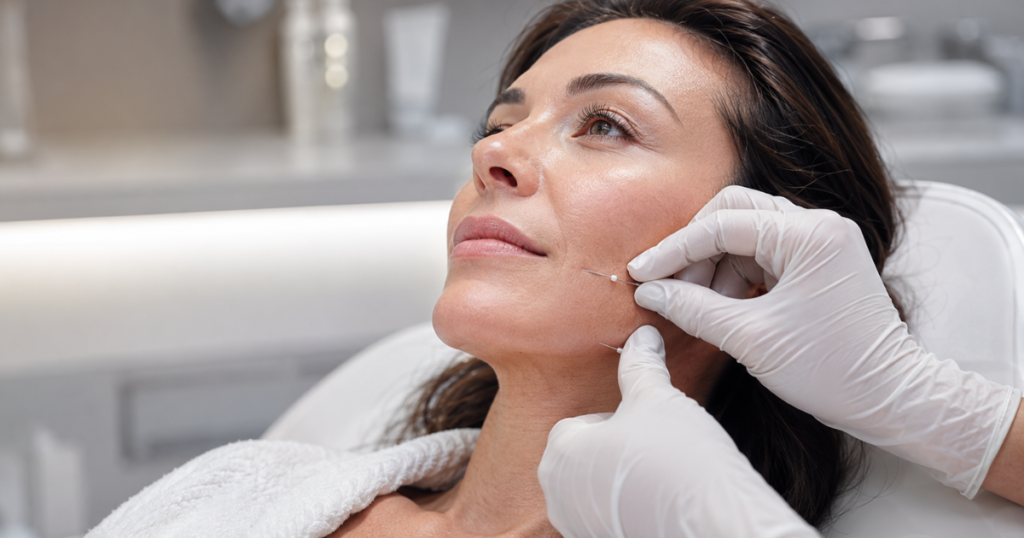
In aesthetic medicine, PDO threads are inserted just beneath the surface of the skin using a fine needle. The process mirrors the acupuncture technique. The thread sits inside the needle and deposits itself under the skin as the needle is withdrawn. Once in place, the thread works in two distinct ways.
The Two-Stage Mechanism of PDO Thread Lifting
Stage one is mechanical. The thread physically repositions sagging tissue. Barbed or cog threads feature tiny directional hooks that anchor into the surrounding skin. When the practitioner gently tensions the thread after placement, those anchored barbs lift and reposition the tissue immediately. You see the result the moment the procedure is finished.
Stage two is biological. The body identifies the thread as a foreign body and responds the way it always does to any material placed under the skin: it sends collagen and elastin to the area. New collagen wraps around the thread, thickening and tightening the skin from within. This secondary effect continues for weeks after treatment and builds gradually, which is why results actually improve over the first few months rather than fading.
By the time the threads fully dissolve, usually within four to six months, the collagen they stimulated remains. That is the real secret behind why PDO thread results outlast the threads themselves.
What Types of PDO Threads Are There?
Three main types of PDO threads exist, each designed for a different purpose:
Barbed or cog threads produce the most significant physical lift. The barbs hook into tissue and reposition it upward or laterally. These are the threads used for treating the cheeks, jowls, jawline, and brows.
Mono threads are smooth, without barbs. They do not provide significant mechanical lift but trigger an excellent collagen response. Practitioners often use these in a mesh pattern across the neck, décolletage, or forehead to improve skin texture and tightness.
Screw threads involve two threads twisted together around a needle. These create higher volume in the treatment area and are used for deep tissue tightening.
At Deep Aesthetics, the type of thread we use depends entirely on your anatomy, the areas you want to treat, and the degree of lift you want to achieve. We assess this at your consultation before any treatment takes place.
What Areas Can a PDO Thread Lift Treat?
More areas than most people realise.
The face is the most common treatment zone. But PDO threads are not just a facial treatment. We use them across a wide range of areas where the skin has started to lose structure, definition, or elasticity.
Face and Jawline
The cheeks are one of the most frequently treated areas. As collagen depletes with age, the mid-face loses volume and the skin begins to descend. A barbed thread placed along the cheekbone and tensioned upward lifts the cheek back toward its original position, sharpening the definition of the face.
Jowls respond well to PDO threads. The tissue that has migrated downward from the lower face can be repositioned toward the jawline, restoring a cleaner, sharper jaw shape. Many patients tell us this single change takes years off their appearance.
Brow lifting with PDO threads addresses the drooping of the outer brow that makes people look tired or permanently frowning. A thread placed above the brow and tensioned upward opens the eye area and gives the face a more awake, refreshed look.
Neck and Décolletage
The neck ages visibly and quickly. Horizontal banding, loose skin at the jawline, and a loss of definition through the throat all respond to PDO treatment. Mono threads placed in a mesh pattern across the neck stimulate collagen throughout the area, gradually tightening the skin and reducing banding.
The décolletage, the chest area below the neckline, develops fine lines and crepey skin texture as collagen levels fall. PDO threads treat this effectively and with minimal discomfort.
Other Body Areas
PDO threads work on body areas beyond the face. Loose skin on the upper arms, knees, and abdomen can all be treated. These are areas that diet and exercise cannot address because the issue is skin laxity, not fat. The thread stimulates collagen production in the skin itself, gradually tightening and firming the tissue.
What Happens During a PDO Thread Lift at Deep Aesthetics?
You arrive at the clinic. No fasting, no preparation the night before. The whole appointment, from walking in to walking out, takes roughly an hour to an hour and a half depending on how many areas we treat.
Step 1: Consultation and Marking
Before any thread is placed, we carry out a thorough assessment. We look at your skin quality, the degree of laxity in the areas you want treated, and the underlying anatomy. Everyone’s face is structured differently, and the placement of threads needs to respect that.
We mark the entry points and thread pathways on your skin with a dermatological pen. This mapping is done precisely because thread placement is not guesswork. The paths follow the natural architecture of your face to produce a lifted result that looks natural, not pulled.
Step 2: Anaesthesia
We apply a topical anaesthetic cream to the treatment areas. For most patients, this is enough to make the procedure completely comfortable. Allow up to an hour for the anaesthetic to take full effect. Some patients choose a local anaesthetic injection for deeper numbing, particularly in more sensitive areas.
The procedure is not painful for the vast majority of patients. Most describe mild pressure or a sensation of tugging as the threads are positioned.
Step 3: Thread Insertion
The thread sits inside a fine needle. We insert the needle at the marked entry point, guide it through the tissue along the planned pathway, and deposit the thread as the needle is withdrawn. The thread remains in place beneath the skin.
For barbed threads, we gently tension the thread after placing it. This is the moment the lift becomes visible. Tissue repositions upward or laterally, and the change is immediate.
Depending on the areas being treated, we may place anywhere from a few threads to significantly more. A neck treatment using mono threads may involve a mesh of 20 or more individual threads. A jawline lift uses fewer barbed threads placed precisely along specific vectors.
Step 4: Results and Aftercare
Results are visible immediately. The skin appears lifted, tighter, and more defined as soon as the procedure is complete. Some mild swelling and bruising is normal, particularly in the first 24 to 48 hours. We provide a topical gel to soothe the area and minimise bruising at home.
Most patients return to normal activities the same day or the following morning. Avoid vigorous exercise for approximately one week to allow the threads to anchor properly. Avoid sleeping face-down for the first few nights.
The results improve over the following four to six weeks as collagen builds around the threads. By six to eight weeks post-treatment, you are seeing the full benefit.
How Long Does a PDO Thread Lift Last?
Results from a PDO thread lift typically last up to two years.
The threads themselves dissolve within four to six months. But the collagen they triggered does not dissolve with them. According to PubMed (2023), PDO threads promote dermal thickening and new collagen formation, resulting in firmer, rejuvenated skin that persists well beyond the life of the thread material itself.
High-quality cog and barbed threads, used for lifting rather than texture improvement, have been shown to provide visible lifting and collagen regeneration for one to two years (PMC, 2024).
Several factors influence longevity:
Your age and baseline skin quality affect how much collagen your body produces in response to the threads. Younger skin responds more vigorously. A 35-year-old with early jowling will typically see longer-lasting results than a 60-year-old with significantly depleted collagen reserves.
The areas treated also matter. The neck and décolletage experience more movement and environmental exposure than the mid-face, and results in those areas may settle slightly faster.
Combining PDO threads with other treatments extends results considerably. A 2025 PMC study found that combining PDO monofilament threads with botulinum toxin produced a 90% patient-reported improvement in skin texture and brightness at four months, with only mild transient side effects. We regularly combine PDO threads with dermal fillers or anti-wrinkle injections for a holistic rejuvenation approach that addresses both structural lift and volume.
Who Is a Good Candidate for a PDO Thread Lift?
The procedure suits most adults from the age of 25 onward. This is when collagen and elastin depletion first becomes visible in the tissues.
The ideal candidate has mild to moderate skin laxity. Sagging cheeks, early jowling, a soft jawline, a slightly drooping brow, or loose skin along the neck. These are the patients who see the most dramatic, natural-looking improvements.
PDO threads are not a replacement for a surgical facelift. If you have significant, advanced skin laxity or substantial volume loss throughout the face, surgery may produce a more dramatic result. We tell patients this honestly at consultation.
But many patients who think they need surgery do not. They come in expecting to be told they need a facelift and leave with PDO threads and a result they love. That happens regularly.
People who cannot have surgery also benefit significantly. Patients with medical conditions that make general anaesthesia risky, or those who simply do not want surgery and the recovery it requires, find PDO thread lifting a genuinely effective alternative.
PDO Thread Lift vs Surgical Facelift: Key Differences
Surgery has long been seen as the gold standard for facial lifting. PDO threads have changed that conversation.
| PDO Thread Lift | Surgical Facelift | |
| Anaesthesia | Topical or local | General |
| Treatment time | 45 to 90 minutes | 3 to 5 hours |
| Downtime | 24 to 48 hours | 2 to 6 weeks |
| Results duration | Up to 2 years | 5 to 10 years |
| Reversible | Threads dissolve naturally | No |
| Scarring | None | Yes |
| Cost | Significantly lower | £8,000 to £20,000+ |
| Suitable from age | 25 onward | Typically 40+ |
Neither option is universally better. The right choice depends entirely on your degree of skin laxity, your goals, your health, and your lifestyle. What PDO threads offer is a meaningful result with minimal risk, minimal downtime, and none of the permanence of surgery.
For patients in their 30s and 40s with early to moderate laxity, PDO threads are often the smarter starting point.
PDO Thread Lift Side Effects and Safety
PDO thread lifts carry a strong safety profile. The material itself, polydioxanone, has been used in surgical sutures for over 30 years. Its behaviour in the human body is well understood.
Common side effects include mild swelling, bruising, and tenderness in the treatment area. These typically settle within 24 to 48 hours. Most patients manage these comfortably with the aftercare gel we provide at the clinic.
Less common side effects include minor dimpling or puckering of the skin immediately after treatment. This nearly always resolves on its own within a few days as the threads settle into position.
Serious complications are rare. A 2025 PMC review found complication rates below 5% for smooth mono threads, with the vast majority of adverse effects being mild and transient. Barbed threads carry a slightly higher risk of minor bleeding and temporary dimpling, but serious complications remain uncommon when treatment is performed by a trained, experienced practitioner.
The key word there is experienced. PDO thread placement requires knowledge of facial anatomy, injection technique, and thread vectors. This is not a treatment to have at a beauty salon. It belongs in a clinical setting, carried out by someone with specific training in aesthetic medicine.
At Deep Aesthetics, every PDO thread lift treatment is carried out by our practitioner, who has years of experience in advanced facial aesthetics and has been featured in national publications including Tatler, Women’s Health, and The Times.
How Much Does a PDO Thread Lift Cost in the UK?
Our PDO Thread Lift starts from £695.
The final cost depends on the number of threads used, the areas being treated, and the complexity of the procedure. A single-area treatment, such as the jawline or brows, will sit at the lower end. A full-face and neck treatment involving multiple thread types across several zones will be priced higher.
We offer finance options for patients who prefer to spread the cost of treatment. Monthly payment plans mean you can access the treatment now rather than waiting.
The cost of a PDO thread lift is a fraction of surgical alternatives. Surgical facelifts in the UK typically cost between £8,000 and £20,000. PDO threads deliver meaningful, visible lift starting from £695, with no general anaesthesia, no incisions, and no weeks off work.
Conclusion
A PDO thread lift delivers real, visible lift without surgery, without scarring, and without weeks of recovery. If sagging skin has been affecting how you feel about your face, this treatment gives your body the tools it needs to rebuild from within.
Time does not wait. And neither should you.
At Deep Aesthetics, we combine clinical precision with an artist’s eye, guiding every treatment by the principles of the Golden Ratio to produce results that look genuinely natural. We treat patients at our Birmingham and London clinics, and every treatment begins with an honest, no-pressure consultation.
Book your consultation today and find out what our PDO Thread Lift can do for you.
FAQ: What Is a PDO Thread Lift?
Question: What is a PDO thread lift and how is it different from a facelift?
Answer: A PDO thread lift is a non-surgical procedure that uses fine, dissolvable threads inserted beneath the skin to physically lift sagging tissue and stimulate collagen production. Unlike a surgical facelift, it requires no general anaesthesia, no incisions, and no significant downtime. Results last up to two years. A surgical facelift produces more dramatic, longer-lasting results but carries significantly higher cost, risk, and recovery time.
Question: Does a PDO thread lift hurt?
Answer: Most patients experience minimal discomfort. We apply a topical anaesthetic cream to the treatment area before beginning. Most people describe the sensation as mild pressure or tugging rather than pain. For more sensitive areas, a local anaesthetic injection is available. The procedure takes between 45 and 90 minutes in total.
Question: How long do PDO thread lift results last?
Answer: Results typically last up to two years. The threads themselves dissolve within four to six months, but the collagen they stimulate persists long after. Factors including your age, skin quality, and the areas treated all influence how long results last. Combining PDO threads with other treatments such as dermal fillers or botulinum toxin can extend and enhance results.
Question: Who is suitable for a PDO thread lift?
Answer: The procedure is suitable for most adults from the age of 25 onward. It works best for patients with mild to moderate skin laxity, including sagging cheeks, jowling, a soft jawline, a drooping brow, or loose skin on the neck. It is not recommended for patients with severe, advanced skin laxity, active skin infections, or certain medical conditions. We assess your suitability at consultation before any treatment is agreed.
Question: What are the side effects of a PDO thread lift?
Answer: Common side effects include mild swelling, bruising, and tenderness, which typically settle within 24 to 48 hours. Minor temporary dimpling occasionally occurs and resolves on its own within a few days. Serious complications are rare when treatment is performed by a trained, experienced practitioner. A 2025 PMC review found complication rates below 5% for smooth mono threads, with most effects being mild and short-lived.
