
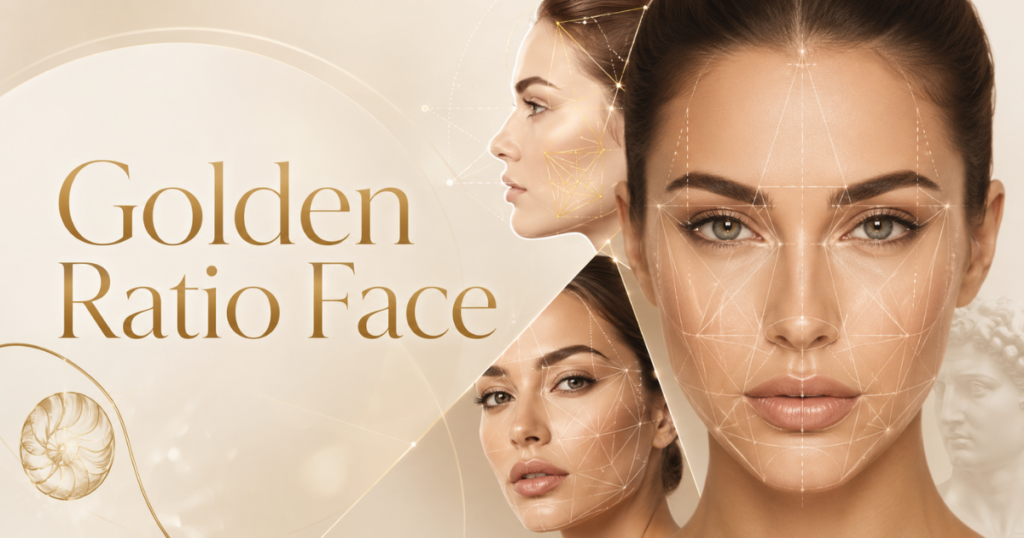
The golden ratio face refers to a mathematical framework, based on the proportion 1.618, used to assess facial symmetry, balance, and proportion. In aesthetic medicine, practitioners use golden ratio measurements as a guide during facial assessment to identify imbalances and plan treatments that improve overall harmony.
But the science behind it is more nuanced than most clinics admit.
A 2024 systematic review published in the Journal of Prosthetic Dentistry concluded that “no significant association was found between the golden ratio and facial evaluation scores among all ethnicities.” And yet the golden ratio remains one of the most widely used assessment tools in UK aesthetic practice, including at our clinic.
This guide explains what the golden ratio face actually is, what the research says, and how we use it at Deep Aesthetics to plan personalised treatment, not to impose a mathematical ideal on every face we see.
What Is the Golden Ratio Face?
The golden ratio face is not a specific face shape. It is a measurement framework based on the mathematical constant phi (Φ), approximately 1.618, applied to facial features to assess proportional harmony.
The idea is straightforward: if the proportions between key facial landmarks, such as the width of the face relative to its height, or the width of the nose relative to the width of the mouth, approach the 1.618 ratio, the face is considered more balanced and visually appealing.
In facial aesthetics, this framework helps practitioners identify where proportion is off and where treatment might improve balance. It is a starting point for analysis, not a fixed template that every face should match.
The Maths Behind the 1.618 Proportion
The golden ratio, denoted by the Greek letter phi (Φ), is approximately 1.618. It is derived from the Fibonacci sequence, where each number is the sum of the two before it: 0, 1, 1, 2, 3, 5, 8, 13, 21, 34, and so on.
As the sequence progresses, the ratio between consecutive numbers approaches 1.618. This relationship appears throughout nature, from the spiral of a nautilus shell to the arrangement of seeds in a sunflower.
Mathematically, the golden ratio is expressed as (a + b)/a = a/b = Φ, where a is larger than b. In practical terms, this means a segment divided in golden ratio proportions has a larger part that is 1.618 times the size of the smaller part.
The golden ratio has been associated with aesthetic harmony since at least the Renaissance. In 1509, mathematician Luca Pacioli published De Divina Proportione, illustrated by Leonardo da Vinci, establishing the ratio as a principle of beauty and design that persists in aesthetic medicine today.
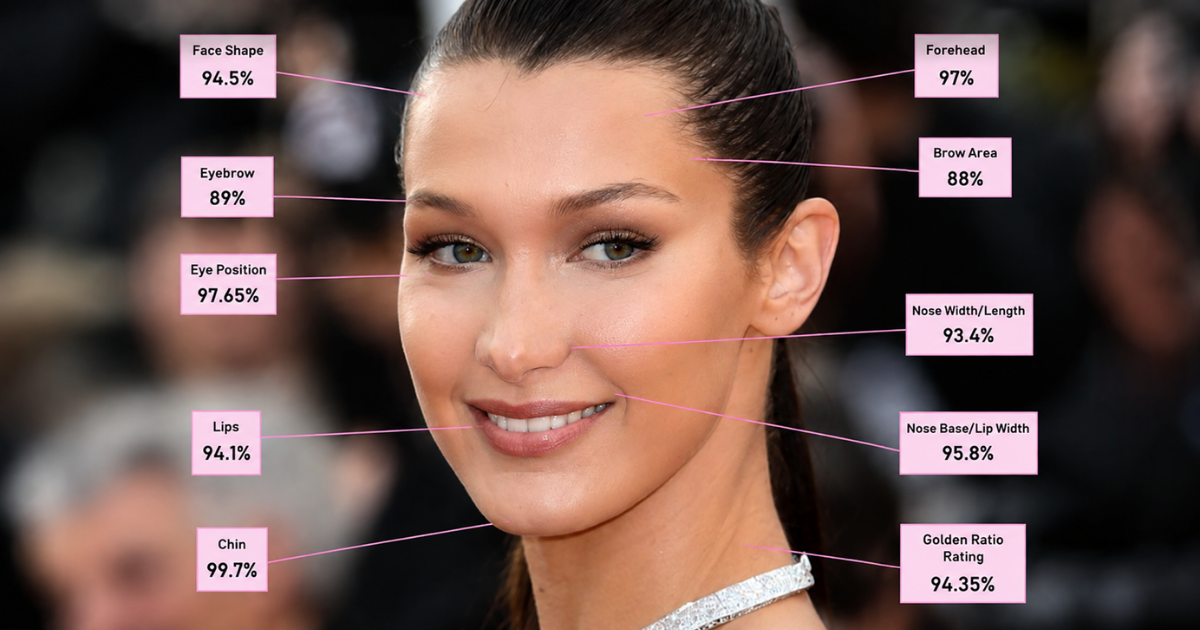
How the Golden Ratio Applies to Facial Proportions
In facial aesthetics, the golden ratio is applied across several key measurement zones.
Facial Thirds
The face is considered balanced when it divides into three roughly equal vertical zones:
- Upper third: Hairline to the brow
- Middle third: Brow to the base of the nose
- Lower third: Base of the nose to the chin
When these thirds are unequal, the face appears top-heavy, bottom-heavy, or elongated depending on which zone is disproportionate.
Facial Fifths
Horizontally, the face divides into five equal widths, each approximately equal to the width of one eye. The nose sits within the central fifth, and the outer corners of the eyes align with the inner edges of the ears.
Key Ratio Measurements
Practitioners using the golden ratio framework assess several specific measurements:
| Measurement | Golden Ratio Application |
| Face length to width | Length should be approximately 1.618 times the width |
| Nose width to mouth width | Mouth width approximately 1.618 times the nose width |
| Upper lip to lower lip | Lower lip approximately 1.618 times the upper lip height |
| Eye width to nose width | Nose width approximately equal to the distance between eyes |
| Chin to nose to brow | Each segment of the lower face in proportion to 1.618 |
Marquardt’s Phi Mask
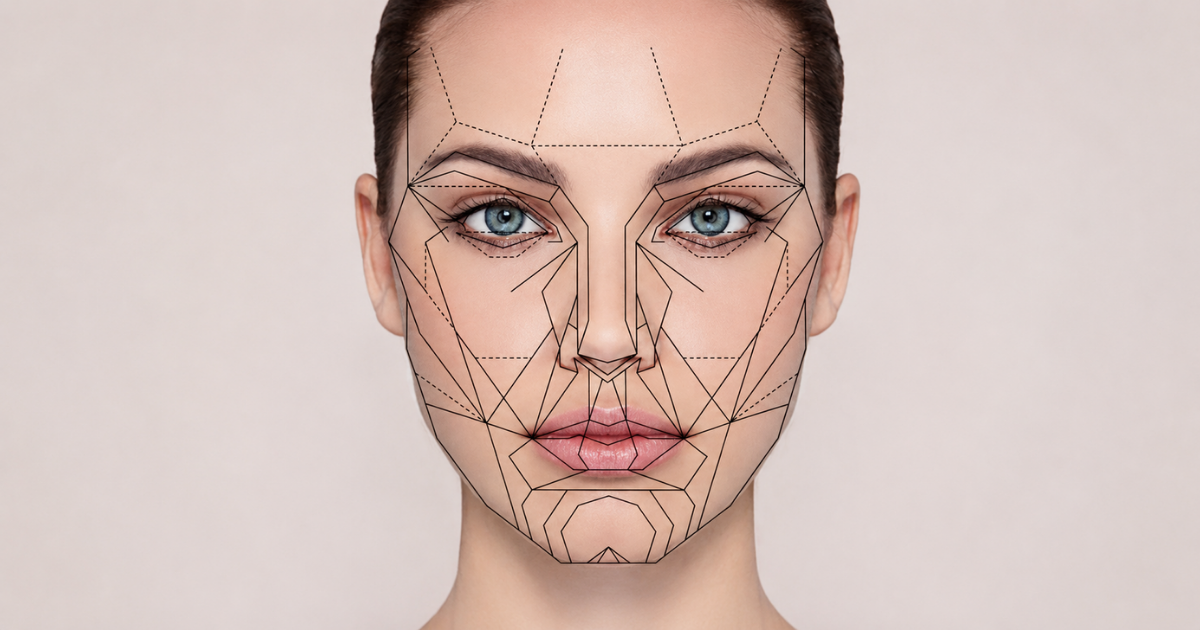
The most prominent practical application of the golden ratio in aesthetics is Marquardt’s Phi Mask, developed by oral and maxillofacial surgeon Stephen Marquardt. The mask overlays a geometric template derived from the golden ratio onto the face to assess how closely facial landmarks align with the phi proportion.
It has been widely used in aesthetic training as a teaching tool. Its visual elegance and mathematical origin gave it an air of objectivity. But as the research discussed below shows, its limitations are significant.
What the Science Actually Says About the Golden Ratio Face
Here is the part most clinic blogs leave out.
A 2024 study in the Journal of Clinical and Experimental Dentistry found that seven of ten facial distance ratios were statistically different from the 1.618 value, and the three that were similar showed no correlation to attractiveness scores.
A comprehensive 2024 study concluded that “there is no convincing evidence that the golden ratio is linked to idealized human proportions or facial beauty,” pointing to historical inaccuracy in claims about ancient use of the ratio, significant cultural variation in beauty standards, and the fact that many universally recognised beautiful faces do not conform to golden ratio measurements.
And Marquardt’s Phi Mask? The research literature tells a more complicated story: the golden ratio turns out to be a weak predictor of what people find attractive, and the mask derived from it fails for most of the world’s population.
None of this means the golden ratio is useless in clinical practice. It means it should be used as a proportional guide rather than a universal ideal.
The golden ratio is used in assessing facial symmetry and proportionality across cultures and populations, and its implications span digital imaging, cosmetic surgery, and art, where it plays a role in shaping perceptions of beauty. The framework remains valuable as a starting point for identifying imbalance, even if the 1.618 number itself is not a universal truth.
The useful clinical question is not “how closely does this face match 1.618?” It is: “where is the proportion off, and what would improve balance for this individual patient?”
How We Use the Golden Ratio at Deep Aesthetics
At Deep Aesthetics, our Golden Ratio assessment is a structured facial analysis process, not a machine that scores your face against a mathematical ideal.
Before any treatment is planned, we assess:
- The relationship between your facial thirds
- Chin projection relative to the nose and brow
- Jawline definition and lower-face width
- Cheekbone position and lateral projection
- Lip proportion relative to surrounding facial features
- Facial symmetry and existing asymmetries
That assessment tells us where proportion can be improved and, just as importantly, which features should be left exactly as they are. Not every measurement needs to change. Not every face has the same starting point.
A patient in their late 20s coming in at our London Canary Wharf clinic with a naturally recessed chin and soft jaw border will have a very different assessment outcome than a patient in their 40s with age-related volume loss across the mid-face. Same framework. Completely different treatment plan.
That is what a proper golden ratio assessment looks like in practice. It is a tool for personalised planning, not a template.
Can Treatment Improve Your Golden Ratio Proportions?
Yes, for many patients, non-surgical treatment can meaningfully improve facial proportion and balance.
The most commonly treated imbalances identified through golden ratio assessment include:
Chin Projection
A recessed or underprojected chin shortens the lower third of the face and reduces the chin-to-nose-to-brow balance. Chin filler adds anterior projection, improving profile balance and facial harmony.
Jawline Definition
A soft or undefined jaw border reduces the perception of lower-face structure. Our Jawline & Chin treatment adds definition along the mandible, improving the jaw-to-neck transition and strengthening the lower facial frame.
Cheek Proportion
Flat or deflated cheeks reduce mid-face volume and can make the nose appear more prominent relative to surrounding features. Cheek filler restores lateral projection and improves the upper-to-lower face proportion.
Lip Balance
A thin upper lip relative to the lower lip, or lips that are narrow relative to the nose width, can be addressed with targeted lip enhancement to improve the lip-to-face proportion.
Non-Surgical Rhinoplasty
The nose sits at the centre of every facial proportion measurement. A dorsal hump, drooping tip, or asymmetry can skew multiple golden ratio measurements simultaneously. Our Non-Surgical Rhinoplasty treatment reshapes the nose without surgery, correcting visual imbalances that affect surrounding proportions.
Not every imbalance requires treatment. And no treatment plan should aim to hit 1.618 at every measurement point. The goal is a face that looks balanced, harmonious, and natural, not one that scores well on a mathematical overlay.
FAQ
What is the golden ratio face?
Answer: The golden ratio face is a measurement framework based on the mathematical proportion 1.618 (phi), applied to facial features to assess symmetry and proportional balance. In facial aesthetics, it is used as a guide during treatment planning to identify where proportion is off and where improvement may help. It is not a fixed ideal that every face should conform to.
What is the golden ratio in facial aesthetics?
Answer: In facial aesthetics, the golden ratio (1.618) is applied to key facial measurements, including the ratio of face length to width, nose width to mouth width, and the division of the face into equal thirds. Practitioners use these measurements as a proportional guide during assessment, not as a universal beauty standard.
Does a perfect golden ratio face actually exist?
Answer: Rarely, and research suggests it may not matter as much as commonly claimed. A 2024 systematic review in the Journal of Prosthetic Dentistry found no significant association between golden ratio conformance and attractiveness ratings across ethnicities. Proportion matters, but the exact 1.618 value is not a universal predictor of beauty.
How is the golden ratio used in aesthetic treatment planning?
Answer: Practitioners use golden ratio measurements to identify proportional imbalances in the face, such as a recessed chin, flat cheeks, or an undefined jawline. These findings guide treatment decisions about where and how much filler to place. The framework provides structure for the assessment without dictating a single ideal outcome.
Can non-surgical treatments improve facial golden ratio proportions?
Answer: Yes. Treatments including chin filler, jawline filler, cheek filler, lip enhancement, and non-surgical rhinoplasty can all improve specific proportional imbalances identified through golden ratio assessment. The goal is improved balance and harmony for the individual face, not mathematical perfection.
Is the golden ratio the same for men and women?
Answer: The proportional framework is the same, but the aesthetic goals differ. Male treatment typically aims for stronger structural definition through the chin and jawline, while female treatment often emphasises softer transitions and cheek contour. Individual anatomy and patient goals always override gender-based assumptions.
Conclusion
The golden ratio face is a useful framework, but it is not a rulebook. The proportion 1.618 gives practitioners a structured way to assess facial balance and identify where proportion is off. But the research is clear: no face needs to hit that number at every measurement point, and chasing mathematical perfection produces results that look less natural, not more.
What actually matters is proportion relative to the individual. A stronger chin does not need to match a formula. It needs to work with the nose, the jawline, and the overall facial structure of the person sitting in front of you.
At Deep Aesthetics, our Golden Ratio assessment at our London Canary Wharf and Birmingham clinics is the starting point for every treatment plan. We use it to understand your face, not to change it into something it is not. Whether the concern is chin projection, jawline definition, cheek volume, or nasal balance, everything we recommend follows from that initial assessment.
Disclaimer: This blog is for informational purposes only and does not constitute medical advice. Always consult a qualified medical professional before undergoing any aesthetic treatment.
To book a consultation, visit calendly.com/deepaesthetics.
