
Table of Contents
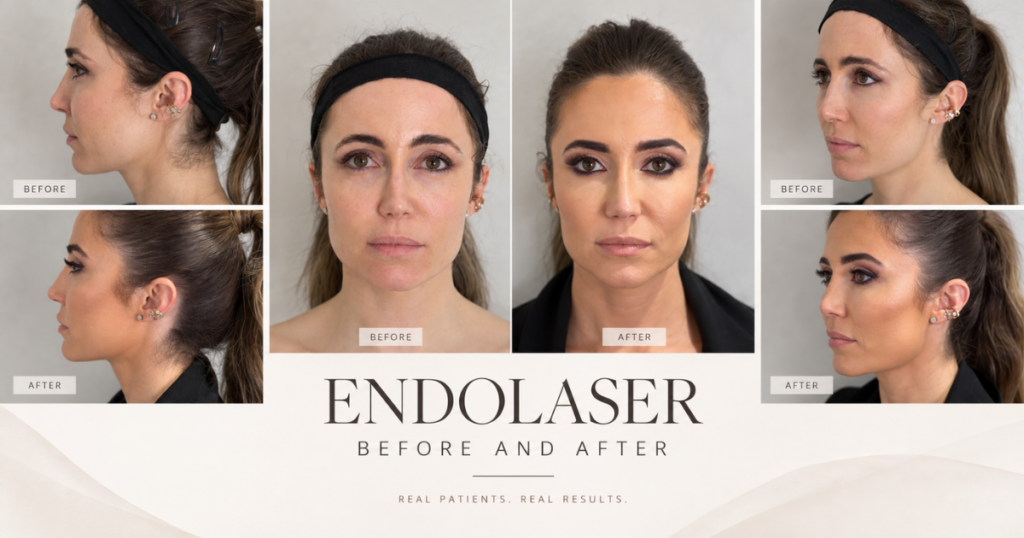
ToggleEndolaser before and after results can include improved skin firmness, contour and definition in suitable patients, but the degree and timing of change vary. Early swelling can affect how the area looks, while tissue settling and collagen remodelling may continue over the following weeks and months.
Endolaser is a minimally invasive laser-based treatment used for selected skin laxity and localised contour concerns.
At Deep Aesthetics, treatment is planned around individual anatomy, skin condition, treatment area and realistic goals rather than promising a standard transformation.
This guide explains what Endolaser results may look like, when changes can become visible and how to assess before-and-after photographs properly.
Key Takeaways
- Endolaser results vary between patients.
- Early photographs may be affected by swelling.
- Jawline, double chin, face, neck and selected body areas can respond differently.
- Before-and-after photos should use similar lighting, angle and expression.
- Final assessment should not rely only on an immediate post-treatment image.
- Clinical suitability and practitioner technique can influence the outcome.
What Do Endolaser Before and After Results Show?
Endolaser before and after photographs may show changes in skin firmness, jawline definition or localised contour, depending on the area treated and the patient’s starting anatomy.
A good result should look proportionate rather than dramatically different.
Common areas where patients may notice change include:
- Jawline definition
- Fullness beneath the chin
- Lower-face laxity
- Face and neck skin firmness
- Selected loose-skin concerns on the body
Endolaser does not provide the same degree of tissue repositioning or skin removal as surgery.
Patients considering treatment should therefore compare their expectations with what a minimally invasive procedure can realistically achieve.
For an overview of the treatment itself, read What Is Endolaser and How Does It Work?.
When Do Endolaser Results Show?
Some changes may become noticeable after early swelling settles, while further changes can develop over the following weeks and months.
It is useful to separate recovery from results. Immediately after treatment, swelling, tenderness or temporary changes in contour can make the area look different. This does not necessarily represent the finished result.
Published evidence on subdermal 1470 nm laser techniques shows that researchers assess outcomes at different follow-up points rather than treating day-one appearance as the final result. A 2025 report, for example, described facial changes at 30 and 90 days after treatment. (PubMed)
A practical timeline may look like this:
| Stage | What You May Notice |
| First few days | Swelling, tenderness or temporary contour changes |
| First few weeks | Treatment area begins to settle |
| Following months | Further tissue remodelling may become more apparent |
| Follow-up review | Practitioner assesses progress against baseline photographs |
Individual healing varies, so these stages should not be treated as guaranteed deadlines.
Endolaser Jawline Before and After
Endolaser jawline results may include a cleaner-looking lower-face contour in suitable patients with mild-to-moderate laxity or selected localised fullness.
The jawline is one of the areas where before-and-after photography can be especially useful.
Photos should ideally compare:
- The same head position
- The same camera distance
- Similar lighting
- A relaxed facial expression
- Similar posture
A slightly raised chin or stronger side lighting can make a jawline appear more defined even without treatment.
That is why consistent clinical photography matters.
Patients researching lower-face treatment can also read about Endolaser Jawline and Double Chin treatment.
Endolaser Double Chin Results
For selected patients, Endolaser may form part of a treatment plan for skin laxity and localised fat beneath the chin.
It should not be described as guaranteed chin-fat removal.
The appearance of a double chin can be influenced by several factors, including:
- Localised fat
- Skin laxity
- Chin projection
- Neck anatomy
- Age-related tissue changes
- Overall body composition
Two people with a similar-looking concern may therefore require different treatment approaches. Deep Aesthetics assesses these factors before recommending treatment.
See Can Endolaser Remove a Double Chin? for a more detailed explanation.
Face and Neck Results
Endolaser face and neck treatment may be considered for selected patients concerned about mild-to-moderate laxity or reduced definition.
Changes may appear around the lower face, neck or jawline rather than producing a completely different facial shape.
This distinction matters.
A minimally invasive treatment should not be marketed as providing the same result as a surgical facelift.
Patients with significant loose skin may require a surgical opinion if they want a greater degree of change.
For treatment-specific information, see Endolaser Face and Neck.
What About Endolaser Eyes?
The eye area requires careful patient selection because puffiness, loose skin, fat prominence and fluid-related swelling can look similar but have different causes.
An Endolaser before-and-after photo around the eyes should therefore be interpreted in the context of diagnosis and suitability.
Treatment may be considered for selected eye-area concerns, but Endolaser is not the same as surgical blepharoplasty.
People with more significant excess skin, structural eyelid concerns or other eye conditions may require a different approach.
Read more about Endolaser Eyes.
What Does the Research Say About Endolaser Results?
Published research suggests that intralesional 1470 nm diode-laser techniques may support skin tightening and contour changes, but the evidence should be interpreted carefully.
A 2024 systematic review included 23 studies covering aesthetic uses of intralesional 1470 nm diode laser technology. The authors reported favourable findings across facial and body indications, while also highlighting the need for stronger and more standardised research. (PubMed)
An older study examining neck and submental laser-assisted lipolysis measured contour changes at six months. It reported measurable improvement in the treated group, although it involved only ten patients.
These studies support potential benefit, but they do not mean every patient will achieve the same result.
Why Can Endolaser Results Differ?
Endolaser results can vary because treatment outcome depends on more than the device alone.
Important factors include:
- Starting anatomy: Mild laxity can respond differently from significant loose skin.
- Skin quality: Age, elasticity and previous treatments can affect how tissue responds.
- Treatment area: Jawline, eyes, neck and abdomen have different anatomy.
- Amount of localised fat: Endolaser is not a weight-loss procedure and is not intended for large-volume fat removal.
- Treatment planning: Energy delivery and treatment design need to be tailored to the individual area.
- Practitioner assessment: Proper patient selection is important because the wrong treatment for the wrong concern can lead to disappointing results.
This is one reason a consultation matters before focusing on before-and-after photographs alone.
How Should You Judge Before-and-After Photos?
Before-and-after images are most useful when the photography itself is consistent.
Look for:
- Same camera angle
- Same distance from the camera
- Similar lighting
- Similar facial expression
- Similar head and neck position
- Clear timing between photographs
- Confirmation that the images show a real treated patient
Be cautious when the “after” image uses different lighting, makeup, posture or facial expression.
Before-and-after imagery can illustrate possible changes, but it cannot predict your individual result.
When Should Before-and-After Photos Be Taken?
Photographs immediately after treatment may not represent the final outcome because swelling can temporarily change contour.
A better assessment normally includes a baseline photograph and later follow-up photographs once early recovery has progressed. The exact review timing should depend on the treatment area and clinical plan.
For more detail on swelling and downtime, see our guide to Endolaser Recovery Time.
Are Endolaser Results Guaranteed?
No. Endolaser results cannot be guaranteed. Patients differ in anatomy, tissue quality, healing and treatment goals.
A clinic should explain:
- What the treatment may realistically improve
- What it is unlikely to change
- Possible side effects and risks
- Expected recovery
- Alternative options
- Whether surgery may be more appropriate
Be cautious of marketing that promises an exact degree of tightening or guarantees a particular before-and-after result.
Endolaser Before and After in London
Patients considering Endolaser in London should focus on suitability and treatment planning rather than choosing a clinic based only on dramatic photographs.
At Deep Aesthetics, consultation includes assessment of:
- Anatomy
- Skin condition
- Treatment area
- Medical history
- Previous aesthetic treatment
- Expected recovery
- Realistic treatment goals
Deep Aesthetics is located at: Mirror Works, 12 Marshgate Lane, Stratford, London, E15 2NH
Learn more about Endolaser treatment in London.
Endolaser Before and After FAQs
Q1. How soon can I see Endolaser results?
Answer: Some changes may become noticeable after swelling settles, while further changes can develop over subsequent weeks and months.
Q2. Are Endolaser results immediate?
Answer: Not completely. Early tissue response and swelling can affect appearance, while longer-term remodelling develops later.
Q3. Does Endolaser work on a double chin?
Answer: It may be considered for selected patients with localised fullness and skin laxity beneath the chin. Suitability depends on anatomy and the cause of the concern.
Q4. Can Endolaser tighten loose skin?
Answer: Endolaser may support tissue contraction and skin tightening in appropriately selected patients. The degree of improvement varies.
Q5. Is one Endolaser session enough?
Answer: Treatment planning is individual. A practitioner should assess the concern rather than promise the same number of sessions for every patient.
Final Thoughts
Endolaser before and after results are best judged over time, using consistent photographs and realistic expectations. Suitable patients may notice improvements in firmness, definition or localised contour, but results vary according to anatomy, skin quality, treatment area and clinical planning.
Before choosing treatment, focus on suitability, risks and realistic outcomes rather than a single dramatic photograph. To discuss whether Endolaser may be appropriate for your concerns, contact Deep Aesthetics for a consultation in Stratford, London.
Individual results vary. Before-and-after photographs should only be published where appropriate marketing consent has been documented.
