
Table of Contents
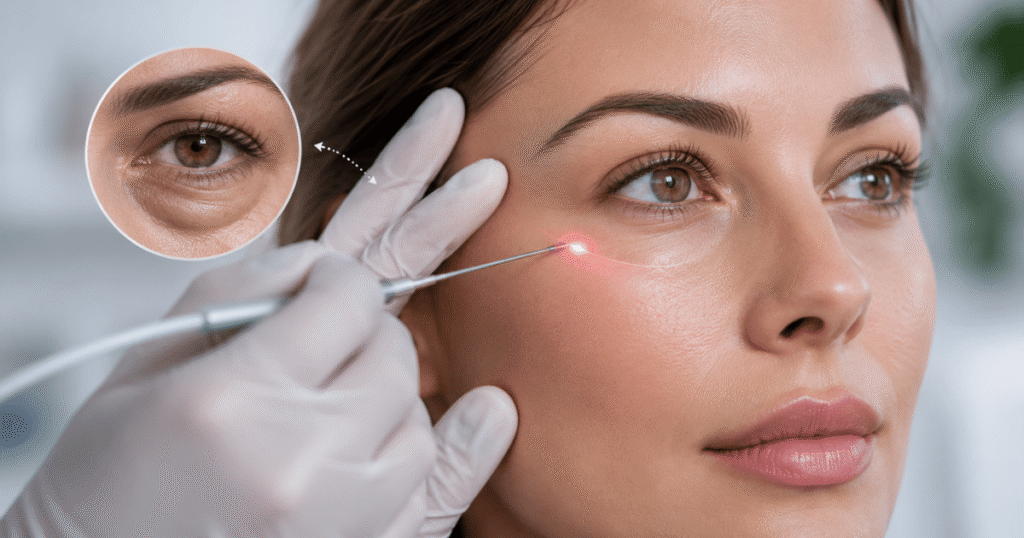
ToggleEndolaser may help selected eye bags when skin laxity or a suitable localised tissue concern contributes to the under-eye appearance. However, not every eye bag has the same cause. Puffiness may involve protruding fat, loose skin, fluid, tear-trough hollowing or malar festoons, so assessment is essential before deciding whether Endolaser is appropriate.
At Deep Aesthetics, Endolaser eye treatment is considered individually rather than offered as a universal solution for under-eye puffiness. Treatment is available following consultation at our Stratford, London and Birmingham clinics.
Current research into fibre-based and laser-assisted lower-eyelid procedures is encouraging, but the evidence is still limited and different laser systems and treatment protocols should not be treated as interchangeable.
Key Takeaways
- Endolaser may be considered when under-eye skin laxity or selected localised tissue concerns contribute to eye bags.
- Eye bags have several possible anatomical causes, so one treatment cannot suit everyone.
- Tear-trough hollows, pigmentation, malar edema and festoons are different problems and may require different approaches.
- Published lower-eyelid laser studies are promising, but evidence is not strong enough to guarantee a particular cosmetic result.
- Deep Aesthetics currently lists Endolaser Eyes from £750.
- Individual assessment is particularly important because the tissues around the eye are anatomically delicate.
What Causes Bags Under the Eyes?
Under-eye bags do not have one single cause. Their appearance may result from several structural and soft-tissue changes occurring at the same time.
A study of 114 people seeking treatment for lower-eyelid bags found multiple anatomical contributors rather than one dominant cause. Relative contribution scores included cheek descent and tear-trough hollowing, orbital fat prolapse, skin laxity or sun damage, eyelid fluid and other structural factors.
That distinction matters because Endolaser cannot reasonably be expected to correct every one of those causes in the same way.
| Main concern | What may be contributing | Is Endolaser automatically suitable? |
| Loose or crepey under-eye skin | Skin laxity and tissue quality | It may be considered in selected cases |
| Lower-eyelid puffiness | Fat prominence and surrounding anatomy | Requires individual assessment |
| Deep tear trough | Volume loss or lid-cheek anatomy | Not primarily a skin-tightening problem |
| Malar bags / festoons | Fluid, muscle, skin and structural factors | Complex; not automatically suitable |
| Dark circles | Pigment, vessels, shadowing or hollowing | Endolaser may not address the underlying cause |
| Significant excess skin/fat | More advanced anatomical change | Surgical assessment may sometimes be more appropriate |
This is why searching simply for “eye bag removal” can be misleading. The first step is identifying what is actually creating the visible bag.
Can Endolaser Help Eye Bags?
It may help selected patients, particularly when skin laxity or an appropriate localised lower-eyelid concern contributes to the appearance.
Endolaser uses a fine optical fibre to deliver controlled laser energy beneath the skin. The intended tissue response can include thermal remodelling and tightening, while laser-assisted lipolysis may be relevant in carefully selected fatty tissue.
The evidence specifically around the lower eyelid remains limited.
A 2022 case series followed only nine patients with lower-eye bags for six months and reported improvements in measured skin characteristics and appearance. Because it was a very small case series rather than a large randomised trial, it should be viewed as early evidence rather than proof that everyone will obtain the same result.
Related research into laser-assisted lower-eyelid procedures has also reported favourable results in selected patients, but these studies used particular devices, techniques and wavelengths and should not be treated as direct evidence for every Endolaser platform.
Which Type of Eye Bag May Be More Suitable for Endolaser?
Endolaser is more logically considered when the concern being assessed is something the treatment mechanism can plausibly address.
For example, a patient with mild-to-moderate under-eye laxity is anatomically different from someone whose tired appearance is mainly caused by a deep tear trough.
Likewise, someone with localised lower-eyelid fat prominence should not automatically receive the same treatment plan as somebody with fluid-related malar swelling.
An appropriate consultation therefore looks at:
- lower-eyelid skin laxity
- position and amount of fatty tissue
- tear-trough anatomy
- lid-cheek transition
- malar swelling or festoons
- skin quality
- previous procedures
- overall facial structure
The treatment goal should follow the anatomy rather than forcing every under-eye concern into one procedure.
Are Malar Bags and Eye Bags the Same Thing?
No. Lower-eyelid bags, malar bags and festoons are related cosmetic concerns but they are not necessarily the same anatomical problem.
Malar bags occur lower down over the upper cheek region. Festoons can involve lax skin, muscle and fluid-related changes around the lid-cheek area.
A 2026 review from authors affiliated with Moorfields Eye Hospital described malar edema, malar mounds and festoons as overlapping but multifactorial conditions. The authors noted that evidence for their treatment remains limited and management needs to be individualised.
This distinction is especially important when someone searches for Endolaser for eye bags after seeing a dramatic before-and-after result online. A result from one type of under-eye concern cannot automatically predict the result for another.
Is Endolaser a Non-Surgical Blepharoplasty?
Endolaser is sometimes discussed online alongside the phrase “non-surgical blepharoplasty,” but the two should not be treated as the same procedure.
Traditional lower-eyelid blepharoplasty is surgery. Depending on the surgical approach, excess skin or orbital fat can be removed, repositioned or otherwise surgically managed.
Endolaser, by contrast, is a minimally invasive laser-based procedure.
That means a patient with substantial excess skin or significant orbital fat protrusion may have different treatment options from someone with comparatively mild skin laxity.
The useful question is therefore not:
“Is Endolaser better than blepharoplasty?”
It is:
“Which procedure matches the anatomical cause and degree of my under-eye concern?”
What Happens During Endolaser Under-Eye Treatment?
The exact treatment plan depends on the patient’s anatomy and the technology being used.
In general, Endolaser treatment involves introducing a very fine optical fibre beneath the skin through small access points and delivering controlled laser energy to selected tissue.
Because the lower eyelid is a delicate anatomical region, treatment planning should be conservative and individualised.
At Deep Aesthetics, patients researching this treatment can first review the dedicated Endolaser Eyes service information and then have their suitability assessed before proceeding.
View Endolaser Eyes at Deep Aesthetics
What Results Can You Expect From Endolaser for Eye Bags?
The realistic objective is improvement rather than guaranteed removal. Where the patient is suitable, the intended cosmetic change may include a firmer-looking lower-eyelid area or improvement in selected puffiness or laxity concerns.
However, the visible result depends on factors including:
skin quality, anatomy, degree of laxity, type of eye bag, treatment technique, healing response and the underlying cause of the puffiness.
It is therefore better to assess outcomes using consistent before-and-after photography rather than expecting every patient to reproduce another person’s result.
Individual results vary.
When Will Endolaser Eye Results Show?
The appearance immediately after treatment should not be treated as the final result. Swelling and other temporary post-treatment changes can affect how the area looks initially. Tissue remodelling also occurs over time rather than instantaneously.
Published lower-eyelid laser studies have used follow-up periods extending for months rather than judging outcomes only in the first few days. The nine-patient fibre-laser study, for example, evaluated patients over six months.
For this reason, your clinic’s scheduled follow-up assessment is more meaningful than making a judgement immediately after the procedure.
What Is the Recovery Like?
Recovery varies between individuals and depends on the treatment plan. Temporary swelling, tenderness, bruising or altered sensation may occur after minimally invasive laser treatment. The eye area can make even relatively modest swelling particularly noticeable.
Published studies of related lower-eyelid laser procedures have also reported complications such as transient altered sensation, prolonged swelling, pigmentation changes, skin irregularity and thermal injury. These studies involve different laser systems and techniques, so their complication rates should not be assumed to represent Deep Aesthetics’ Endolaser treatment directly.
Any unexpected, severe or worsening symptom following treatment should be assessed by the treating clinician.
Endolaser Eye Bags Before and After: What Should You Look For?
Before-and-after photos can be useful, but only when viewed carefully. Look for photographs taken at similar angles, lighting, camera distance and facial expression. Ideally, the photographs should also state how much time passed between treatment and the after image.
Most importantly, compare patients with similar anatomy and concerns to your own. Someone treated primarily for loose lower-eyelid skin is not directly comparable with someone whose main concern was a tear trough, malar festoon or prominent orbital fat.
Before-and-after photography demonstrates an individual outcome; it cannot guarantee yours.
Endolaser vs Tear Trough Filler for Eye Bags
These treatments address different problems. Tear-trough filler is primarily a volume-based treatment. It may be considered when hollowing creates a depression or shadow between the lower eyelid and cheek.
Endolaser is a laser-based treatment intended for selected tissue laxity or contour concerns. Neither treatment should be chosen simply because the area is “under the eye.” The underlying anatomy needs to determine the approach.
This distinction can also prevent unnecessary treatment in patients whose apparent eye bags are actually produced primarily by hollowing or shadowing.
Endolaser vs Surgery for Under-Eye Bags
Neither option is universally appropriate.
| Endolaser | Lower-eyelid surgery |
| Minimally invasive | Surgical |
| Uses laser energy beneath the skin | May remove or reposition skin/fat |
| Considered for selected concerns | Can address structural problems unsuitable for non-surgical treatment |
| Usually less extensive recovery | Typically requires greater surgical recovery |
| Result depends heavily on patient selection | Result also depends on anatomy, procedure and surgeon |
| Does not replace surgery in every case | Not necessary for every mild concern |
For significant structural change, a surgical consultation may sometimes provide a more appropriate option. For less advanced concerns, a minimally invasive treatment may be worth discussing.
How Much Does Endolaser for Eye Bags Cost?
Deep Aesthetics currently lists Endolaser Eyes from £750. Final pricing and treatment planning depend on the individual assessment.
Price should not be the only factor when choosing treatment around the eye area. Patient selection, anatomical assessment, informed consent, treatment planning and aftercare are particularly important.
Endolaser for Eye Bags in London
Deep Aesthetics provides Endolaser consultations at Mirror Works, 12 Marshgate Lane, Stratford, London E15 2NH.
Patients specifically researching treatment in London can also visit the dedicated Endolaser London page.
Endolaser London at Deep Aesthetics
The consultation should establish whether the appearance comes primarily from lower-eyelid laxity, localised fat, hollowing, malar swelling or another concern before a treatment plan is recommended.
Endolaser for Eye Bags in Birmingham
Patients in Birmingham can also book an Endolaser consultation at Deep Aesthetics, 25 King Edwards Wharf, Sheepcote Street, Birmingham B16 8AB.
For full treatment details, visit our Endolaser Birmingham at Deep Aesthetics page.
Suitability is assessed individually, with the treatment plan based on the cause of the under-eye concern, the patient’s anatomy and realistic treatment goals.
Frequently Asked Questions
Q1. Does Endolaser get rid of under-eye bags?
Answer: Endolaser may improve selected under-eye concerns, particularly when suitable skin laxity or localised tissue contributes to the appearance. It cannot be assumed to remove every type of eye bag because puffiness may also result from orbital fat, tear-trough anatomy, fluid-related malar swelling or other structural factors.
Q2. Is Endolaser good for puffy eyes?
Answer: It depends on why the area looks puffy. If the puffiness is due primarily to a concern suitable for laser treatment, Endolaser may be considered. Fluid-related swelling, malar festoons and other causes may require a different approach.
Q3. Can Endolaser tighten loose skin under the eyes?
Answer: Skin tightening is one of the reasons fibre-based laser procedures have been studied around the lower eyelid. Early published evidence is encouraging, but treatment response varies and the evidence base remains limited.
Q4. How long does swelling last after Endolaser under the eyes?
Answer: Recovery varies by individual and treatment protocol. Temporary swelling is expected with many minimally invasive lower-eyelid laser procedures, but your treating clinic should provide a personalised recovery plan and follow-up schedule.
Q5. Are Endolaser eye-bag results permanent?
Answer: A permanent result should not be promised. The result depends on anatomy, treatment response and ageing, which continues after any aesthetic procedure.
Q6. How much is Endolaser for the eyes?
Answer: Deep Aesthetics currently lists Endolaser Eyes from £750, with final treatment planning subject to consultation and suitability.
Final Thoughts
Endolaser for eye bags can be an option for selected patients, but correctly identifying the cause of the under-eye appearance is more important than simply choosing a treatment by name.
Loose skin, orbital fat, tear-trough hollowing, malar swelling and festoons can all produce a tired or puffy appearance, and they do not necessarily respond to the same procedure.
At Deep Aesthetics, patients in Stratford, London and Birmingham can have their under-eye anatomy assessed before deciding whether Endolaser is appropriate. The aim should be a realistic, individual treatment plan rather than a guaranteed eye-bag transformation.
Individual results vary, and no specific cosmetic outcome can be guaranteed.
