
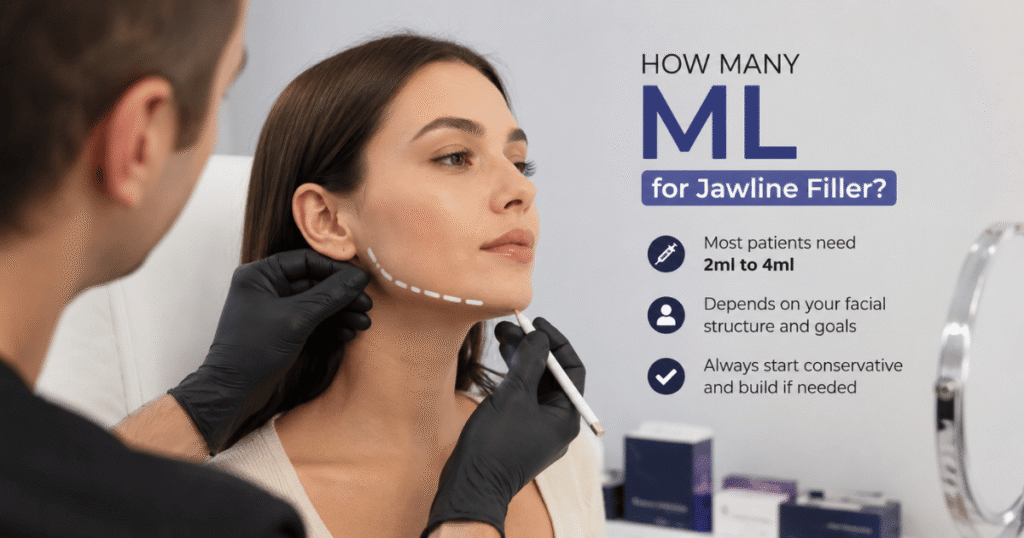
How many ml for jawline filler? It is one of the most practical questions people ask before booking, and it rarely gets a straight answer.
Most patients need between 2ml and 4ml of filler for the jawline. The exact volume depends on your facial structure, your goals, and whether you are treating the jawline alone or combining it with chin filler. First-time patients almost always start at the lower end of this range, with more added at a review if needed.
Volume is not just a clinical detail. It directly affects your result, your cost, and your risk of overfilling. Understanding what is normal before you walk into a clinic puts you in a far better position to have an informed conversation with your practitioner.
At Deep Aesthetics, our Jawline & Chin package at our London Canary Wharf and Birmingham clinics includes a Golden Ratio facial assessment before any filler is placed, so volume is always matched to your individual anatomy.
In this blog, we’ll break down exactly how much filler the jawline needs, by goal, by gender, and by session type.
How Many ML for Jawline Filler?
For most patients in the UK, jawline filler requires between 2ml and 4ml. This is the standard range across the majority of treatment plans, and it accounts for the fact that the jawline is a structural area that needs meaningful volume to show a visible change.
Unlike the lips, which respond to 0.5ml to 1ml, or the tear troughs, which need as little as 0.5ml per side, the jawline runs the full length of the lower face. Creating definition along that entire border requires more product than most people expect.
But more is not always better. And the right number for you is not the same as the right number for the person next to you.
Why Jawline Filler Is Measured in ML
Every syringe of dermal filler contains 1ml of product. That 1ml is roughly the size of a blueberry, or one fifth of a teaspoon. It sounds significant. In the jawline area, it is actually a relatively modest amount.
The jawline spans from the chin to the angle of the jaw on each side of the face. Placing enough product to create visible definition along this entire border, on both sides, while maintaining natural proportions, requires multiple syringes working together.
This is why jawline filler costs more than lip or tear trough filler. It is not a premium for the area itself. It is simply a reflection of the volume required to produce a result.
What Does 1ml of Filler Actually Look Like?
Picture a small blueberry. That is 1ml. Now picture the full length of your jawline from chin to ear on both sides. The gap between those two images explains why a single syringe rarely produces meaningful jawline definition on its own.
2ml covers subtle contouring across the jaw. 3ml to 4ml creates the kind of structured, defined result most patients are looking for. Beyond 4ml in a first session starts to carry risk of overfilling, which is why conservative treatment over two sessions is often better than placing everything upfront.
How Many ML Do You Need by Goal?
Volume should always follow the goal, not the other way around. Here is how to think about it by treatment objective.
2ml Jawline Filler: Who Is It For?
2ml is appropriate for patients who want subtle improvement rather than significant structural change. This includes younger patients in their late 20s or early 30s with naturally soft jaw definition, patients who want to test how filler looks before committing to more, and patients with a naturally well-defined jaw who want a small refinement rather than a full restructure.
At 2ml, you will see a cleaner jaw border and mild improvement in the jaw-to-neck transition. The result is natural and understated. For many patients, this is exactly what they want.
But for patients wanting a noticeably sharper, more angular jawline, 2ml alone will typically not be enough to deliver that level of definition.
3ml to 4ml Jawline Filler: Who Is It For?
This is the most common volume range for patients wanting visible, structured results. 3ml to 4ml works well for patients with mild to moderate jaw softening, patients who want a clearly defined jaw angle and border, and patients combining jawline and chin treatment in the same session.
At this volume, the result is noticeable without looking overdone when placed correctly. The jaw angle becomes sharper, the border becomes cleaner, and the overall lower face looks more balanced and structured.
For most patients at Deep Aesthetics, the first session sits in the 2ml to 3ml range, with a review at six weeks to assess whether additional volume is needed.
How Many ML for Jawline Filler: Men vs Women
Volume requirements differ between male and female patients, and this is one of the most underexplained aspects of jawline filler.
Male facial anatomy typically features a wider, more angular mandible with stronger underlying bone structure. To create visible definition over that larger surface area, men generally need more product than women. Most male patients require 3ml to 5ml for a well-defined jawline result, with some wanting up to 6ml for a particularly strong, angular look.
Female patients typically aim for a cleaner, more refined jaw border rather than aggressive angularity. The goal is framing and balance rather than structural dominance. Most female patients achieve their goals within the 2ml to 4ml range.
And here is the thing. These are starting points, not fixed rules. A female patient with a wider jaw may need more volume. A male patient wanting a subtle improvement may need less. Individual anatomy always overrides generalisation.
At Deep Aesthetics, we use the Golden Ratio assessment to measure your specific facial proportions before recommending any volume. That assessment is what produces a result that looks right for your face, not just a result that falls within a textbook range.
First Session vs Maintenance: Does the Volume Change?
Yes, and this is an important distinction that most clinics do not explain clearly enough.
The first session builds the structure. The practitioner is working with tissue that has not been treated before, assessing how it responds to volume, and establishing the foundation of the result. Conservative volume at the first session gives both the patient and the practitioner the chance to review the result before deciding whether more is needed.
Most experienced practitioners place 2ml to 3ml at a first session, review at four to six weeks, and add more only if the assessment confirms it is appropriate.
Maintenance sessions, typically every 12 to 18 months, almost always require less product. Once the structural foundation is in place, 1ml to 2ml is often enough to refresh the result. The filler placed at the original session integrates with the tissue and breaks down gradually, so top-ups maintain rather than rebuild from scratch.
This means the cost of maintaining jawline filler decreases over time. The first session is the biggest investment. Everything after that is upkeep.
How Many ML for Jawline and Chin Combined?
Most patients benefit more from treating the jawline and chin together than treating the jawline alone. The chin anchors the lower face. Without adequate chin projection, even a well-defined jawline can look unbalanced in profile.
When treating both areas in a single session, total volume typically falls between 3ml and 5ml. This breaks down roughly as follows for most patients:
- Jawline: 2ml to 3ml distributed along the mandible border on both sides
- Chin: 0.5ml to 1ml for projection and definition
The combined approach creates a cohesive lower face result rather than an isolated improvement in one area. Practitioners who understand facial balance always assess chin projection alongside jawline definition before placing any product.
At Deep Aesthetics, our Jawline & Chin package covers both areas within a single treatment plan at £995, with volume determined at consultation based on your specific anatomy and goals.
How Much Filler Is Too Much for the Jawline?
More than 4ml to 5ml in a single first session is where the risk of overfilling begins to increase meaningfully. Beyond this volume, the tissue can become visibly heavy, particularly around the jaw angle, and the result can look unnatural or disproportionate.
Overfilled jawline filler tends to look wide and boxy rather than sharp and defined. The jaw border loses its natural contour and instead appears uniformly thick, which creates a squared-off appearance that looks like filler rather than anatomy.
Signs your jawline filler may be overfilled include a jaw that appears significantly wider than before, a heavy or puffy appearance around the jaw angle, and a result that looks more prominent from the front than the side.
The good news: hyaluronic acid filler dissolves with hyaluronidase. Overfilling is correctable. But the far better approach is conservative treatment from the start, with volume added incrementally based on reviewed results.
For a full breakdown of pricing and what is included at Deep Aesthetics, read our guide on how much jawline filler costs in the UK.
The British Association of Dermatologists advises patients to choose qualified, experienced practitioners for all injectable treatments. The CQC sets standards for regulated aesthetic practice in the UK.
FAQ
Question: How many ml for jawline filler first time?
Answer: For most first-time patients, 2ml to 3ml is the appropriate starting volume for jawline filler. This allows the practitioner to assess how the tissue responds before adding more at a review appointment. Starting conservatively reduces the risk of overfilling and gives a more natural result that can be refined at six weeks if needed.
Question: Is 2ml enough for jawline filler?
Answer: For subtle contouring and mild refinement, yes. For patients wanting a noticeably sharper, more structured jawline, 2ml alone is often not enough to achieve that level of definition. Most patients wanting visible results end up in the 3ml to 4ml range across their full treatment plan.
Question: How many syringes is 4ml of jawline filler?
Answer: Each syringe contains 1ml of filler, so 4ml equals 4 syringes. Most clinics price treatment per ml or per syringe, which is why jawline filler costs more than treatments using smaller volumes. At Deep Aesthetics, we offer a fixed Jawline & Chin package at £995 that includes personalised volume planning rather than charging per syringe.
Question: How many ml for jawline filler for men?
Answer: Male patients typically need more volume than female patients due to the larger surface area of the male mandible. Most men require 3ml to 5ml for well-defined jawline results, with some wanting up to 6ml for a more pronounced, angular look. Volume is always confirmed at consultation based on individual facial anatomy and goals.
Question: Does more ml mean better results?
Answer: No. More volume does not automatically produce better results and can produce worse ones if placed incorrectly or in excess. The goal is always the right volume for the individual face, not the maximum possible. A conservative 2ml placed precisely by an experienced practitioner will look better than 5ml placed carelessly.
Conclusion
How many ml for jawline filler? For most patients, 2ml to 4ml. For men wanting stronger definition, 3ml to 5ml. For combined jawline and chin treatment, 3ml to 5ml total across both areas.
But the number is only part of the answer. Where the filler goes, how deep it is placed, and how conservatively the first session is approached matter just as much as the volume itself.
The best results come from starting conservatively, reviewing at six weeks, and adding more only when the assessment confirms it is appropriate.
Disclaimer: This blog is for informational purposes only and does not constitute medical advice. Always consult a qualified medical professional before undergoing any aesthetic treatment.
At Deep Aesthetics, every Jawline & Chin treatment starts with a Golden Ratio facial assessment at our London Canary Wharf and Birmingham clinics. We determine the right volume for your specific anatomy before placing a single drop of filler, and we include a follow-up review as standard.
To book a consultation, visit our Canary Wharf clinic on Google or call us directly to speak with our team.
