
Table of Contents
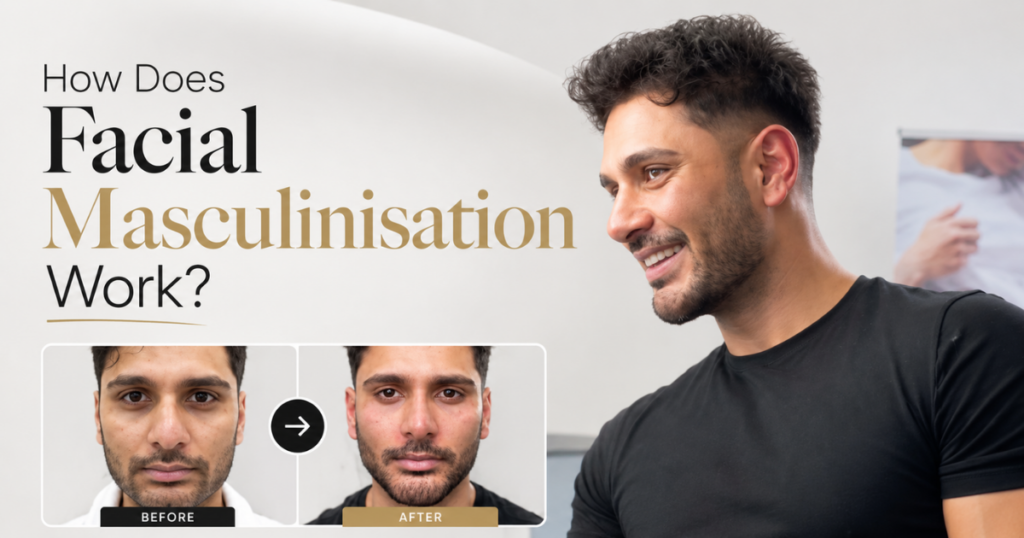
ToggleHow does facial masculinisation work? It is one of the most searched questions among men considering non-surgical aesthetic treatment in the UK right now, and it deserves a straight, detailed answer.
Facial masculinisation is a non-surgical treatment that uses dermal fillers to enhance and define traditionally masculine facial features, including the jawline, chin, and cheekbones. Filler is placed at structural depth using high-density hyaluronic acid products to create angular definition, stronger profile projection, and improved facial balance. Results are immediate and typically last 12 to 18 months.
Male aesthetic treatment in the UK has grown significantly. According to BCAM’s 2024 Annual Clinical Review, 16% of all aesthetic patients treated by member practitioners identified as male. Men are an increasingly active part of the aesthetic patient population, driven by the availability of treatments that can produce natural-looking results when performed by an experienced practitioner.
At Deep Aesthetics, our facial masculinisation treatment at our London Canary Wharf and Birmingham clinics is built around individual facial assessment rather than a fixed injection template.
In this blog, we’ll explain exactly how facial masculinisation works, which areas it treats, who it suits, and what to expect from the process.
What Is Facial Masculinisation?
Facial masculinisation is a non-surgical aesthetic treatment designed to enhance the structural features associated with a traditionally masculine face. Dermal fillers, primarily high-density hyaluronic acid products, are placed at strategic points to add angularity, definition, and projection to the jawline, chin, and cheekbones.
The goal is not to change who you are. Facial masculinisation refines what is already there.
A stronger jaw is the most common request. Others come in wanting better chin projection, or a more structured profile that reflects how they feel rather than the face genetics gave them. The goals vary, but the underlying desire is the same: features that feel like a better version of themselves. Male interest in aesthetic treatment has grown steadily over the past several years, with more men seeking non-surgical options that deliver visible but natural-looking improvements.
The treatment works for cisgender men wanting stronger features, for transgender men and non-binary individuals seeking gender-affirming results, and for men of any age whose features have softened over time and want to restore definition.
How Does Facial Masculinisation Work?
Facial masculinisation works by placing dermal filler at specific anatomical points to build structure, add projection, and create the angular definition associated with a masculine face.
Men have thicker, denser skin, approximately 25% thicker than female skin, stronger underlying musculature, and more prominent bone structure. The fillers used for masculinisation are higher density products placed at greater depth than those used for female facial treatment. The goal is angular definition and structural enhancement, not softening or volumising.
Product selection, placement depth, and intended result often differ significantly between male and female facial treatment, though the same HA filler product may sometimes be appropriate for both. What changes is the placement pattern, the volume, and the aesthetic goal, all of which depend on individual anatomy rather than gender alone.
To understand what dermal fillers are and how they work in general, read our complete guide.
The Role of Facial Anatomy in Treatment Planning
Male facial anatomy differs from female anatomy in several consistent ways. Testosterone drives mandibular growth during puberty, producing a broader, more angular lower face. The supraorbital ridge is typically more prominent. The jawline is wider. The chin is broader and more projected. The cheekbones sit higher and flatter rather than more rounded and anterior.
Effective facial masculinisation works with these anatomical differences rather than against them. The goal is always to enhance what is already present in the individual face, not to impose a generic “masculine” template.
At Deep Aesthetics, facial masculinisation treatment typically begins with a Golden Ratio facial assessment. We measure facial proportions, assess existing structure, and identify exactly where enhancement would produce the most meaningful improvement for that specific face.
Which Areas Does Facial Masculinisation Treat?
Most facial masculinisation treatment plans focus on three primary areas, though the specific combination depends entirely on individual anatomy and goals.
Jawline Definition
The jawline is the most requested area in male facial treatment. A well-defined jaw creates the angular lower face border associated with masculine features, improving profile view and front-facing facial balance.
Filler is placed along the mandible to widen the jaw border, sharpen the jaw angle, and create a cleaner transition between the jaw and neck. For men, this means a straighter, more prominent border rather than the softer, tapered jaw line more common in female treatment plans.
Our jawline filler treatment uses high-G-prime hyaluronic acid filler placed at depth along the mandibular border. Volume ranges from 2ml to 5ml depending on the starting anatomy and desired result. To understand how this works technically, read our guide on how jawline filler works.
Chin Projection and Width
The chin anchors the lower third of the face. In male facial aesthetics, a stronger chin creates a more decisive profile, improves the nose-to-chin-to-brow proportion, and balances a wider jaw.
Filler is placed to increase anterior projection, broaden the chin shape, or both. Male chin treatment typically aims for a squarer appearance with stronger forward projection, contrasting with the more tapered, refined chin goal common in female treatment.
Many patients find that treating the chin and jawline together produces far better results than treating either area alone. The two areas work as a system, and balance between them determines whether the lower face looks naturally structured or overdone in one area.
Cheekbone Structure
Male cheekbones tend to sit higher and flatter than female cheekbones, with less anterior roundness. Effective masculinisation places filler to reinforce the zygomatic structure while avoiding the central rounded fullness that can feminise the mid-face.
This is one of the most technically demanding aspects of male facial treatment. Too much cheek volume in the wrong plane creates a softer, rounder mid-face that works against the masculine result the patient is seeking. The placement must be lateral and structural, not medial and volumising.
Under-Eye and Periorbital Area
Some male patients present with significant under-eye hollowing that makes the face look tired. As Deep Aesthetics’ service page notes, one of the most common concerns men bring to consultation is looking tired rather than wanting to look more masculine. These often go together.
Tear trough treatment can significantly improve the periorbital area, reducing shadows and restoring a more alert, rested appearance. This is often included alongside structural jaw and chin work as part of a comprehensive masculinisation plan.
Who Is Facial Masculinisation For?
Facial masculinisation suits a wide range of patients.
Cisgender men who want stronger facial definition, a sharper jawline, or better chin projection. Age is not the main factor. Men in their late 20s with naturally soft jaw structure present as often as men in their 40s whose features have softened with age.
Transgender men and non-binary individuals seeking gender-affirming facial changes without surgery. Non-surgical masculinisation can produce meaningful changes in how the face reads, particularly through the jawline and chin, without the recovery time or permanence of surgical options.
Men experiencing age-related volume loss who have noticed their features becoming less defined over time. Facial fat shifts and bone density decreases with age, softening the jaw border, flattening the cheeks, and reducing chin projection. Masculinisation treatment can restore structure that has been lost.
The best candidates have realistic expectations, good baseline skin quality, and a clear sense of which features they want to enhance rather than a vague desire to “look better.”
How Is Male Facial Filler Different From Female Treatment?
The products, placement depth, and intended results differ significantly.
Facial masculinisation consists of applying reticulated hyaluronic acid dermal fillers to strategic points of the face, mainly the jawline, chin and cheekbones. But the specific product selection for male treatment tends toward higher-density, higher-G-prime fillers that provide structural support and resist compression from the stronger musculature of the male face.
Female treatment often uses softer, lower-viscosity products placed to create gentle contour and smooth transitions. Male treatment requires products that hold their shape under pressure and deliver angular definition rather than soft volume.
Placement depth is also different. Structural male treatment may involve placing product at greater depth than standard volumising treatment, depending on the area, the product selected, and the individual anatomy. Placement decisions are always made on clinical grounds, not based on gender alone.
For a detailed comparison of how treatment goals and placement differ by gender, read our guide on male vs female facial fillers.
What Does the Facial Masculinisation Process Look Like?
Step 1: Consultation and facial assessment. The practitioner assesses the entire face using the Golden Ratio framework, measures facial proportions, discusses treatment goals, and builds a personalised treatment plan. No product is selected until this assessment is complete.
Step 2: Product and volume planning. Based on the assessment, the practitioner selects the appropriate filler product and determines the volume and injection points for each area. The patient reviews and approves the plan.
Step 3: Numbing. Topical numbing cream is applied to all treatment areas approximately 20 to 30 minutes before the procedure begins. Most high-quality HA fillers also contain lidocaine, which numbs the area progressively as treatment proceeds.
Step 4: Treatment. Filler is placed using a cannula or needle depending on the area and clinical judgement. The jawline and chin typically use a cannula for precision and reduced bruising. The cheekbones may use either approach. The full treatment takes 30 to 60 minutes depending on the number of areas treated.
Step 5: Post-treatment review. At Deep Aesthetics, every masculinisation treatment includes a follow-up review appointment. We assess the settled result, confirm the patient is happy, and determine whether any refinement is needed before closing the treatment plan.
How Long Do Results Last?
Facial masculinisation results typically last 12 to 18 months. The jawline and chin are low-movement structural areas, which means filler placed here breaks down more slowly than in areas like the lips.
Some patients see results persist for up to 24 months, particularly in deep structural placements near the periosteum. Maintenance requirements vary between patients depending on metabolism, lifestyle, and how much product was placed initially.
Is Facial Masculinisation Safe?
When performed by a qualified, experienced medical practitioner using CE-marked or UKCA-marked hyaluronic acid products, facial masculinisation carries a comparable risk profile to other dermal filler treatments.
Potential side effects include swelling, bruising, and tenderness for 3 to 7 days following treatment. These are temporary and expected.
Rare but serious complications include vascular occlusion, where filler inadvertently affects a blood vessel. This risk is higher in certain areas and requires immediate management. Experienced practitioners minimise this risk through technique and anatomical knowledge, and maintain hyaluronidase on-site for emergency dissolution if needed.
Dermal filler injections are not currently regulated by the CQC. However, choosing a medically qualified, insured practitioner with appropriate training remains essential for patient safety.
FAQ
Q1. What is facial masculinisation?
Answer: Facial masculinisation is a non-surgical treatment using hyaluronic acid dermal fillers to enhance traditionally masculine facial features, including the jawline, chin, and cheekbones. It creates angular definition, stronger profile projection, and improved facial balance without surgery. Results are immediate and last 12 to 18 months.
Q2. How does facial masculinisation work?
Answer: High-density hyaluronic acid filler is placed at structural depth in the jawline, chin, and cheekbones to create angular definition and projection. The product is selected and placed differently from female facial treatment, using firmer products at greater depth to produce structural rather than volumising results.
Q3. Who is facial masculinisation suitable for?
Answer: Facial masculinisation suits cisgender men wanting stronger features, transgender men and non-binary individuals seeking gender-affirming changes, and men whose features have softened with age. The treatment is suitable for patients with realistic expectations and good baseline skin quality.
Q4. How long does facial masculinisation last?
Answer: Results typically last 12 to 18 months, with some patients seeing structural results persist for up to 24 months. Maintenance treatments are usually required once per year or every 18 months and often need less volume than the original session.
Q5. Does facial masculinisation look natural?
Answer: Yes, when performed by an experienced practitioner using the correct product and placement for male anatomy. The key is using high-density filler at structural depth rather than applying standard volumising techniques. A Golden Ratio facial assessment before treatment ensures proportions remain balanced and results suit the individual face.
Conclusion
Facial masculinisation is one of the most effective non-surgical treatments available for men who want stronger, more defined features. When planned correctly, the results look entirely natural because they work with your existing anatomy rather than imposing a generic template.
The difference between a result that looks right and one that does not comes down to three things: the right product, the right placement depth, and a practitioner who understands how male facial anatomy differs from female anatomy.
At Deep Aesthetics, our facial masculinisation treatment at our London Canary Wharf and Birmingham clinics begins with a full Golden Ratio facial assessment. We build every treatment plan around your individual anatomy and goals, and we include a post-treatment review as standard.
To book a consultation, visit calendly.com/deepaesthetics.
Disclaimer: This blog is for informational purposes only and does not constitute medical advice. Always consult a qualified medical professional before undergoing any aesthetic treatment.
