
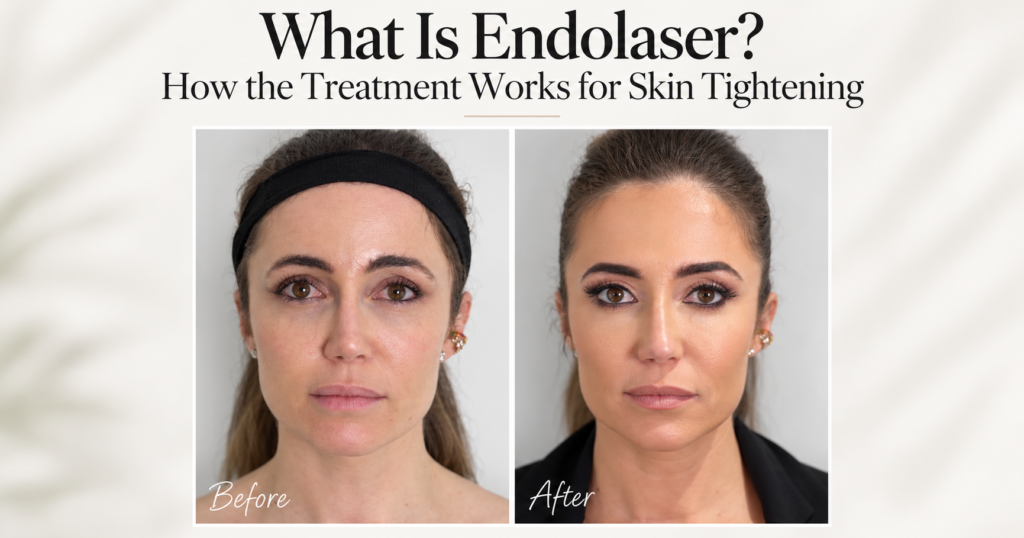
Endolaser is a minimally invasive laser-based aesthetic treatment that delivers controlled energy beneath the skin through a fine optical fibre. It may be considered for selected skin-laxity and localised fat concerns, depending on anatomy, treatment area and individual suitability.
Unlike a surface laser, Endolaser works below the skin. Its purpose is to create controlled thermal effects within selected tissue. Research has explored whether these effects may support tissue remodelling, collagen-related changes and laser-assisted lipolysis. However, the evidence base is still developing, so treatment outcomes should be discussed as variable rather than certain.
At Deep Aesthetics, Endolaser treatment is offered for selected facial and body concerns following an individual assessment. This guide explains what Endolaser is, how the treatment works, what it may be used for, what current research tells us and where its limitations become important.
What Is Endolaser Treatment?
Endolaser is a minimally invasive procedure in which a fine optical fibre is introduced beneath the skin to deliver laser energy to a targeted tissue layer.
This makes it different from many external laser procedures, where energy is delivered from a device positioned on the surface of the skin.
At a general treatment level, the aim is to create controlled thermal effects in subdermal tissue. Depending on the treatment goal, these effects may be relevant to tissue remodelling and selected localised fat concerns.
However, Endolaser should not be treated as a single solution for every type of loose skin or unwanted fat. For example, somebody with relatively mild skin laxity has a different anatomical concern from someone with a large amount of excess skin. Similarly, a small localised fat deposit is different from generalised body fat.
Identifying the underlying problem is therefore essential before deciding whether this treatment is appropriate.
How Does Endolaser Work?
Endolaser works by delivering controlled laser energy beneath the skin through a fine optical fibre. Two potential effects are particularly relevant in aesthetic treatment.
First, controlled heat may affect the surrounding tissue and contribute to a remodelling response. Research into laser-based procedures has investigated changes in collagen and tissue structure following thermal stimulation.
Second, laser energy may be used for laser lipolysis, where thermal effects are directed at selected fatty tissue.
Even when tissue responds to energy, the final appearance can depend on:
- skin quality
- degree of laxity
- fat distribution
- underlying anatomy
- treatment area
- technique
- individual healing response
Consequently, two people receiving treatment for apparently similar concerns may not achieve the same degree of improvement.
What Is Laser Lipolysis?
Laser lipolysis refers to the use of laser energy to create thermal effects in selected fatty tissue. In aesthetic practice, it may be considered when a relatively small amount of localised subcutaneous fat contributes to a contour concern.
However, Endolaser is not liposuction.
Surgical liposuction physically removes fat through a cannula and is generally used when a more substantial reduction or surgical contour change is required.
Endolaser may instead be considered as a non-surgical fat-reduction treatment in selected circumstances.
It is also not a weight-loss procedure. Overall body weight, the amount and distribution of fat, skin quality and the underlying anatomy all influence whether a particular concern is suitable for treatment.
How Can Endolaser Affect Skin and Collagen?
Skin tightening is one of the main reasons people search for Endolaser, but this part of the treatment needs careful explanation.
Thermal energy delivered beneath the skin may stimulate tissue-remodelling processes. Collagen-related responses are one possible mechanism by which skin appearance may change following laser treatment.
However, current evidence does not justify promising a particular amount of tightening.
A 2025 scoping review published in Lasers in Medical Science examined the scientific literature on aesthetic endolaser procedures. The researchers identified 26 publications:
- 1 randomised controlled trial
- 23 case series
- 1 case study
- 1 pilot study
Therefore, a responsible description is that Endolaser may contribute to improvement in selected skin-laxity concerns, rather than stating that it produces a predictable degree of tightening for everyone.
What Areas Can Endolaser Be Used For?
Endolaser may be considered for selected facial, neck and body areas where skin laxity, localised fat or a combination of the two contributes to the concern.
The important factor is not simply the name of the treatment area. Instead, the practitioner needs to establish what is creating the appearance.
For example, reduced jawline definition may relate to:
- localised submental fat
- skin laxity
- facial bone structure
- soft-tissue distribution
- muscle anatomy
- several factors occurring together
Treating localised fat cannot change the underlying skeleton. Likewise, addressing skin laxity will not necessarily correct a contour concern caused mainly by anatomy.
The same principle applies to body treatment.For this reason, treatment should be based on assessment rather than selecting Endolaser simply because it is marketed for a particular area.
What Happens During Endolaser Treatment?
An Endolaser treatment journey should begin with consultation and assessment.
The practitioner should review the area of concern, relevant medical history, previous treatments, expectations and whether the proposed procedure is suitable.
During treatment, a fine optical fibre is introduced beneath the skin through small entry points. Controlled laser energy is then delivered within the selected tissue plane according to the treatment plan.
The exact clinical protocol can vary according to the treatment area and individual circumstances. Therefore, treatment duration, comfort measures and aftercare should be confirmed directly during consultation rather than assumed from another person’s experience or from general information online.
Temporary treatment-related effects may occur afterwards as tissue responds and heals. However, detailed swelling, bruising, numbness, tingling and downtime information belongs in the separate Endolaser recovery guide rather than being duplicated here.
What Can Endolaser Not Do?
Understanding what Endolaser cannot realistically achieve is just as important as understanding how it works.
Endolaser should not be expected to:
- produce major weight loss
- change underlying bone structure
- correct every degree of loose skin
- achieve a predetermined measurement reduction
- provide the same result in every treatment area
- recreate the outcome of every surgical procedure
- stop normal ageing
- prevent future weight-related changes
For someone with substantial excess skin, a surgical skin-removal procedure may be more appropriate. Likewise, a person seeking substantial fat reduction may require an entirely different approach.
This does not mean surgery is automatically better. It means that different treatments address different anatomical problems.
What Does Research Say About Endolaser?
The available research suggests potential aesthetic applications, but the evidence remains limited and heterogeneous.
As noted above, the 2025 scoping review found 26 relevant publications, with case series accounting for most of the available literature. The review reported findings related to localised fat and skin rejuvenation but also concluded that more research was needed to standardise treatment approaches and clarify the evidence.
A 2026 literature overview examining technology-assisted lipolysis evaluated 88 studies. The authors reported substantial differences in methodology, sample sizes and follow-up periods.
Importantly, the review found insufficient evidence to establish technology-assisted approaches as universally superior to traditional liposuction, while also questioning whether a clear skin-tightening advantage had been established for endolaser procedures.
For patients, the practical conclusion is that Endolaser may have a role for selected concerns, but the expected degree of improvement should be assessed individually.
What Are the Risks of Endolaser?
Endolaser is not risk-free.
The 2026 literature overview reported complications associated with endolaser and other technology-assisted lipolysis procedures, including:
- burns
- seromas
- haematomas
- infection
- scarring
The authors emphasised the importance of clinicians understanding both prevention and management of complications.
Temporary local effects can also occur after treatment. Their nature and duration can vary according to the treatment area, technique and individual response.
Before proceeding, patients should understand the intended benefit, potential risks, alternatives, aftercare requirements and what pathway is available if an unexpected problem develops.
Who May Be Suitable for Endolaser?
Endolaser may be considered for selected adults where a concern involves mild skin laxity, a relatively small localised fat deposit or both.
However, suitability cannot be decided by age or treatment area alone.
An appropriate assessment should consider:
- anatomy and tissue quality
- location and amount of fat
- degree of skin laxity
- medical history
- previous treatments
- expectations
- alternative options
Someone seeking a much greater degree of change than the treatment can realistically provide may be better suited to another non-surgical procedure or a surgical assessment.
Individual results vary.
Endolaser Treatment at Deep Aesthetics
Deep Aesthetics offers Endolaser following an individual consultation to consider anatomy, treatment goals, suitability, realistic outcomes and recognised risks.
For patients looking for Endolaser treatment in London, the Deep Aesthetics London clinic is located at: Mirror Works, 12 Marshgate Lane, Stratford, London E15 2NH
The Stratford clinic’s current page confirms that consultations consider individual anatomy, treatment goals, realistic outcomes and recognised risks before treatment is agreed.The Deep Aesthetics Birmingham clinic is located at: 25 King Edwards Wharf, Sheepcote Street, Birmingham B16 8AB
These are the current clinic details supplied for Deep Aesthetics content. A consultation should first establish whether the concern relates primarily to skin laxity, localised fat, underlying anatomy or a combination before deciding whether Endolaser is appropriate.
Frequently Asked Questions
Question: Is Endolaser the same as liposuction?
No. Endolaser is not liposuction. Endolaser delivers laser energy beneath the skin and may be considered for selected localised fat and skin-laxity concerns. Surgical liposuction is a different procedure designed to physically remove fat.
Question:Is Endolaser a surface laser?
No. Endolaser uses a fine optical fibre to deliver laser energy beneath the skin rather than applying energy exclusively from the skin surface.
Question:Can Endolaser be used on the body?
Yes, selected body areas may be considered, depending on the underlying concern and individual suitability. Localised fat and skin laxity should be assessed separately because they are different anatomical problems.
Question:Does Endolaser work for everyone?
No. Results vary according to anatomy, tissue quality, treatment area, degree of laxity, fat distribution, technique and individual response. Not every concern is appropriate for Endolaser.
Question: Where does Deep Aesthetics offer Endolaser?
Deep Aesthetics offers consultations in Stratford, London, and Birmingham. The London clinic is at Mirror Works, 12 Marshgate Lane, Stratford, London E15 2NH. The Birmingham clinic is at 25 King Edwards Wharf, Sheepcote Street, Birmingham B16 8AB.
Conclusion: What Is Endolaser?
Endolaser is a minimally invasive aesthetic treatment that delivers controlled laser energy beneath the skin through a fine optical fibre. It may be considered for selected concerns involving skin laxity, localised fat or both.
Current research suggests possible applications in tissue remodelling, skin rejuvenation and laser-assisted lipolysis. However, the scientific evidence is still developing, and published reviews identify important limitations as well as recognised complications.
Therefore, the most useful question is not only “what is Endolaser?” but whether its mechanism and realistic capabilities match the concern being treated.
An individual consultation can assess the underlying anatomy, discuss the potential benefits and limitations and determine whether Endolaser or another approach is more suitable.
Disclaimer: This article provides general information only and does not constitute medical advice. Endolaser suitability, risks, response and recovery vary between individuals and treatment areas. An individual assessment with an appropriately trained and experienced practitioner is required before treatment.
