
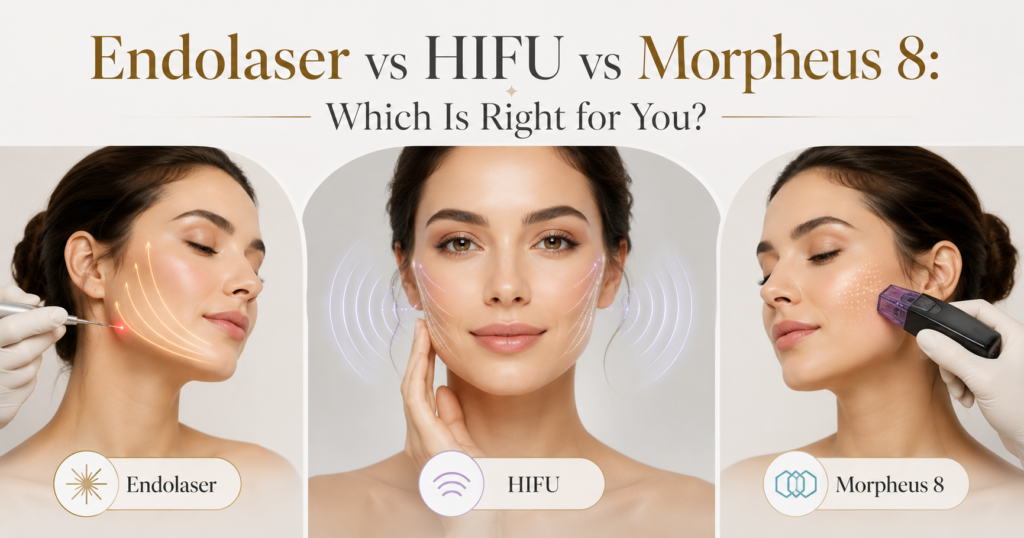
Endolaser vs HIFU vs Morpheus 8 can all be considered for non-surgical skin tightening, but they work in distinctly different ways. Endolaser delivers laser energy beneath the skin using a fine optical fibre, HIFU delivers focused ultrasound energy externally, and Morpheus 8 combines microneedling with radiofrequency energy. At Deep Aesthetics, the right option therefore depends less on which treatment is marketed as strongest and more on the tissue, treatment area and concern being addressed.
A patient concerned mainly about loose skin beneath the chin may need a different approach from someone whose priority is acne scarring, enlarged pores or uneven skin texture. Another patient may have a combination of lower-face laxity and localised submental fat, which changes the treatment discussion again. Understanding these differences is essential before comparing results, recovery or cost.
Endolaser vs HIFU vs Morpheus 8 at a Glance
| Feature | Endolaser | HIFU | Morpheus 8 |
| Energy | Laser | Focused ultrasound | Radiofrequency |
| Delivery | Fine fibre beneath the skin | Externally through the skin | Microneedles inserted into the skin |
| Treatment type | Minimally invasive | Non-invasive | Minimally invasive |
| Main focus | Laxity, contour and selected localised fat | Skin lifting and tightening | Texture, wrinkles, scars and laxity |
| Subdermal treatment | Yes | No | Energy delivered through needles |
| Localised fat component | May be relevant in selected areas | Not the primary facial use | Depends on treatment depth and settings |
| Acne scars and texture | Not usually the main indication | Not usually the main indication | Common treatment consideration |
| Recovery | Swelling, bruising, tenderness or altered sensation may occur | Redness, swelling or tenderness may occur | Redness, swelling and sensitivity may occur |
Do not interpret this table as a ranking of the three technologies. They act at different depths and may therefore suit different clinical concerns. A consultation should identify what is actually contributing to the appearance of the area before choosing a treatment.
What Is Endolaser?
Endolaser treatment is a minimally invasive procedure in which a fine optical fibre is introduced beneath the skin to deliver controlled laser energy within the treatment area. This subdermal approach allows the treatment to act beneath the skin rather than relying only on energy passing down from the surface.
This makes Endolaser particularly relevant when a concern involves more than surface skin quality alone. Lower-face laxity, a soft jawline, jowling and selected submental fullness may involve tissues beneath the visible skin surface.
Published evidence around subdermThe published evidence is encouraging but limited. A 2025 scoping review in Lasers in Medical Science identified only 26 publications on aesthetic Endolaser, 23 of which were case series rather than randomised trials, and reported considerable variation between treatment protocols.
For the full picture, see our guide to what Endolaser is and how it works, or the Endolaser treatment page.
What Is HIFU?
HIFU uses focused ultrasound delivered through the skin, with no fibre or needle entering the tissue. Energy is focused at set depths – commonly 1.5 mm, 3.0 mm and 4.5 mm – to create controlled heating at each layer and encourage tightening and remodelling.
Most of the stronger published evidence relates specifically to microfocused ultrasound rather than to every device marketed as HIFU. Reviews have found that microfocused ultrasound can improve mild to moderate facial laxity in selected patients, though devices, protocols and patient selection vary widely between studies, so results are not interchangeable across platforms.
The main practical advantages are that no anaesthetic injection is needed and downtime is usually limited to redness for a day or two. The main limitation is that HIFU is a tightening treatment – it is not designed to address localised fat or surface texture in the way the other two can. See our HIFU facial page for more.
What Is Morpheus 8?
Morpheus 8 is radiofrequency microneedling. Fine needles enter the skin and radiofrequency energy is delivered at a set depth, producing controlled thermal effects within the skin itself.
It may be considered for uneven texture, selected acne scarring, fine lines, enlarged pores and skin laxity. Most treatment plans involve three sessions spaced four to six weeks apart, with visible change from around six weeks and continued improvement over three months.
The key distinction: Morpheus 8 mostly works within the skin, while Endolaser works beneath it. Both influence laxity, but they are treating different tissue. That distinction matters most in the lower face and jawline.
Endolaser vs HIFU for Skin Tightening
The core difference is where the energy is delivered from. HIFU sends focused ultrasound in from outside, so some energy is lost passing through the skin. Endolaser places the fibre inside the tissue plane, so energy is delivered directly where it is intended.
That does not automatically make Endolaser better.
HIFU suits you if mild to moderate laxity is the concern, you want no injected anaesthetic and no insertion, and you can accept a more gradual, subtler change.
Endolaser suits you if the assessment finds laxity combined with contour change or localised fat, and you want a single treatment session with a more definite result – accepting local anaesthetic, one to two weeks of swelling and a three to six month timeline.
There is no strong head-to-head evidence showing Endolaser universally outperforms HIFU. The useful question is whether the problem is skin laxity alone, or laxity plus fat and contour.
Endolaser vs Morpheus 8
These overlap because both address laxity, but their strongest use cases differ.
Morpheus 8 suits you if laxity comes alongside acne scarring, uneven texture, enlarged pores or fine lines. Skin quality is where it does its best work, and three sessions build a cumulative result.
Endolaser suits you if the concern is deeper – lower-face laxity, a softened jawline, submental fullness – where surface treatment will not reach the tissue causing the appearance.
Neither should be chosen simply because it “stimulates collagen”. Both do. The question is at what depth, and whether that depth matches your problem.
Two people can describe the same “loose jawline” and need entirely different treatments. That is why assessment beats comparing before-and-after photographs.
Which Is Better for a Double Chin and Jawline?
A double chin is not a single anatomical diagnosis. Fullness beneath the chin can come from localised subcutaneous fat, loose skin, limited chin projection, jaw structure, neck anatomy, or several of these at once.
- Mainly loose skin, mild → HIFU or Morpheus 8 may be appropriate
- Loose skin with texture concerns → Morpheus 8
- Fat plus laxity, or a soft contour → Endolaser is worth assessing
- Mainly weak chin projection → this is a structural issue; chin and jawline filler addresses it, not an energy device
- Small isolated fat pocket, no laxity → fat dissolving injections may be the simpler option
- Substantial excess skin → a surgical assessment is the honest answer
Laser-assisted lipolysis has been studied for submental and neck contouring, but protocols and devices vary, so results from one published system should not be assumed for every Endolaser procedure. None of these treatments should be described as a guaranteed way to remove a double chin.
Which Treatment Is Better for Skin Texture?
Morpheus 8 generally has the clearest role when texture is a major treatment objective. Radiofrequency microneedling is used for concerns such as selected acne scars, enlarged pores, fine lines and uneven skin quality, in addition to some tightening effects. The microneedling component makes this a fundamentally different treatment proposition from Endolaser or HIFU.
HIFU is primarily discussed for tightening rather than for treating acne scars or surface irregularity. Endolaser can influence tissue remodelling, but surface texture is not usually the primary reason to select a subdermal laser treatment. A patient whose biggest concern is scarring or texture may therefore require a very different plan from someone seeking lower-face contour improvement.
This distinction helps prevent patients from comparing treatments that are not attempting to solve the same problem. Asking whether Endolaser or Morpheus 8 is better without defining the concern can produce an unhelpful answer. The treatment goal should always be established first.
Which Has the Least Downtime?
HIFU, by a clear margin. No insertion means recovery is usually limited to redness and tenderness for a few hours up to two days.
Morpheus 8 sits in the middle: redness, swelling and visible pinpoint marks for roughly two to five days, repeated across three sessions.
Endolaser has the most: swelling typically peaks at 48 to 72 hours and settles over 7 to 14 days, bruising usually resolves within 7 to 10 days, and numbness or tingling can persist for several weeks as nerves recover – but it is a single session rather than three.
So “least downtime” depends on whether you mean per session or in total. The phrase “no downtime” should not be used for any of the three.
Which Treatment Should You Choose?
Someone mainly concerned about mild skin laxity and seeking an externally delivered energy treatment may consider discussing focused ultrasound. When someone with laxity combined with acne scars, enlarged pores or textural concerns may find that radiofrequency microneedling is more closely aligned with the problem being treated. Someone with lower-face laxity, submental fullness or deeper contour concerns may instead be assessed for Endolaser.
Significant loose skin, substantial fat or major structural concerns require a different discussion. None of these technologies should automatically be presented as equivalent to surgery or capable of producing surgical-level change. Realistic expectations are essential when deciding whether a non-surgical or minimally invasive approach is worthwhile.
Other options may also be relevant depending on the assessment – EMFACE works on facial muscle and skin simultaneously, CO2 laser resurfaces the skin surface, and PDO thread lift provides mechanical lift. These are not interchangeable with the three compared here.
The better question is not “which machine is best” but which tissue needs treating, what degree of change is realistic, and which risk and recovery profile you are willing to accept.
Endolaser and Morpheus 8 at Deep Aesthetics
Deep Aesthetics provides Endolaser consultations at its Stratford clinic in London and its Birmingham aesthetics clinic. The London clinic is located at Mirror Works, 12 Marshgate Lane, Stratford, London E15 2NH, while the Birmingham clinic is located at 25 King Edwards Wharf, Sheepcote Street, Birmingham B16 8AB. Consultations consider anatomy, concerns, medical suitability and realistic treatment expectations.
Morpheus 8 is also available within the Deep Aesthetics treatment range, allowing different treatment approaches to be considered according to the concern being assessed. HIFU is included in this comparison for educational purposes by Deep Aesthetics. The appropriate treatment should be selected according to individual suitability rather than simply choosing between three device names.
Patients considering Endolaser treatment in London can discuss whether their concern involves skin laxity, localised fat, tissue contour or a combination of these factors.
Frequently Asked Questions
Is Endolaser better than HIFU?
Endolaser does not automatically work better than HIFU because the two technologies deliver energy in different ways. Clinicians deliver HIFU externally and mainly use it for tightening, while Endolaser acts beneath the skin and may also suit cases involving selected localised fat or deeper contouring. Anatomy, treatment goals and individual suitability should guide the choice.
Is Morpheus 8 better than Endolaser for loose skin?
Neither treatment works better for every case of loose skin. Morpheus 8 may suit patients who have laxity alongside texture concerns, enlarged pores, wrinkles or acne scarring, while clinicians may consider Endolaser when deeper contouring and subdermal laxity also need attention. Clinicians should assess the tissue carefully before choosing between them.
Which treatment is best for jawline tightening?
There is no single treatment that is best for every jawline. Skin laxity, submental fat, chin projection, bone structure and neck anatomy can all affect jawline definition. Identifying the main cause of the concern is therefore more important than choosing a technology first.
Can Endolaser replace a facelift?
Selected patients seeking a minimally invasive approach to skin laxity and contouring may consider Endolaser. Clinicians should not present it as equivalent to surgical facelift surgery because the procedures work differently and can produce different degrees of change. Patients with significant tissue laxity may need a different treatment approach.
Can Endolaser and Morpheus 8 be combined?
Clinicians may sometimes incorporate different technologies into a staged treatment plan when each one addresses a different concern. Combining treatments does not automatically produce better results, so clinicians need to consider timing, recovery and suitability carefully. They should base any combined plan on an individual assessment rather than apply the same protocol to every patient.
Book a Consultation
Choosing between Endolaser, HIFU and Morpheus 8 starts with identifying what is causing the concern, not with deciding which device sounds most advanced. Book a consultation to have your skin laxity, contour, localised fat and medical suitability assessed before any treatment is recommended.
Disclaimer: This article provides general information only and does not constitute medical advice. Suitability, risks, results and recovery vary between individuals and treatment areas. An individual assessment with an appropriately trained and experienced practitioner is required before treatment.
