
Table of Contents
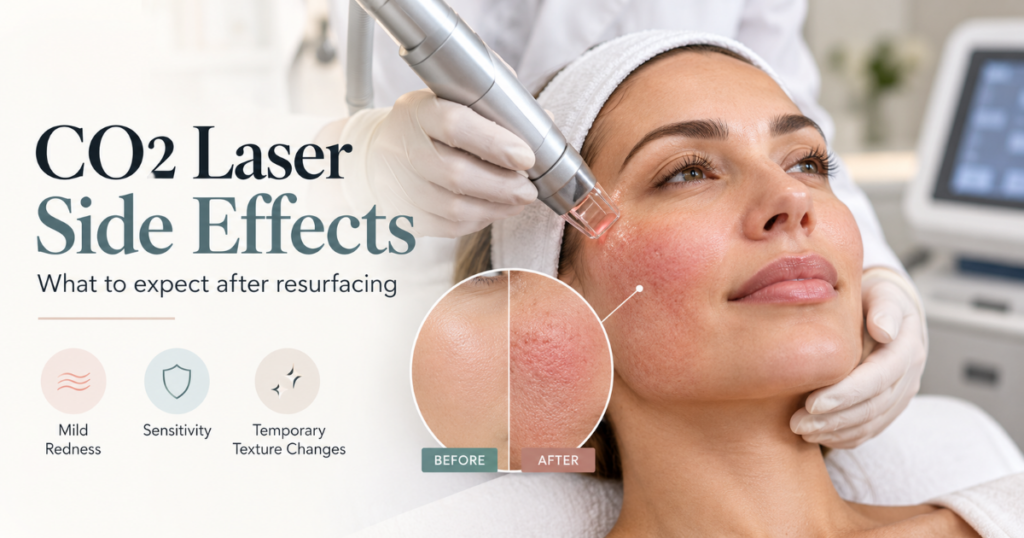
ToggleCO2 laser resurfacing side effects commonly include redness, swelling, warmth, tenderness, peeling, crusting and temporary sensitivity while the skin heals. Less common complications can include prolonged redness, acne or milia, infection, post-inflammatory hyperpigmentation, hypopigmentation and scarring. Risk varies with treatment intensity, skin characteristics and aftercare.
CO2 laser resurfacing deliberately creates controlled thermal and ablative injury in the skin. That controlled injury triggers healing and collagen remodelling, but it also explains why downtime and temporary inflammation are expected rather than unusual.
At Deep Aesthetics, we believe normal recovery effects should be clearly separated from complications that deserve clinical assessment. Treatment depth, density, skin type, medical history and the area being treated all need to be considered before treatment.
In this guide, we explain the most common CO2 laser side effects, less common complications, pigmentation risks, infection, scarring, warning signs and what may help reduce avoidable problems.
What Is Normal After CO2 Laser Resurfacing?
Some inflammation is expected because CO2 laser resurfacing removes or thermally affects controlled areas of skin.
During early healing, patients may experience:
| Expected temporary effect | What it may look or feel like |
| Redness | Pink or red treated skin |
| Swelling | Puffiness, particularly around the eyes |
| Warmth or burning | Similar to a strong sunburn sensation |
| Tenderness | Soreness or increased sensitivity |
| Peeling | Shedding as treated surface skin heals |
| Crusting | Small crusts or rough areas |
| Itching | Common as new skin develops |
| Tightness | Dry or tight feeling during healing |
These effects do not automatically mean something has gone wrong.
CO2 treatment intensity matters significantly. A light fractional treatment that creates separated microscopic treatment columns is different from more aggressive or fully ablative resurfacing.
Our existing explanation of what CO2 laser treatment is and how it works covers these differences between fractional and more intensive resurfacing in greater detail.
How Common Are CO2 Laser Complications?
There is no single trustworthy percentage that applies to every CO2 resurfacing procedure. Studies involve different laser systems, energy settings, treatment areas, skin types and definitions of an adverse event.
For example, one study of 373 fractional CO2 treatments recorded adverse events after 12.6% of treatments. The most commonly documented were contact or allergic dermatitis, acneiform eruptions, prolonged redness and herpes-simplex outbreaks.
Another study examining 490 deep fractional CO2 treatments reported adverse events after 13.6% of treatments. Acneiform eruptions were most frequent, while infections, pigmentation changes, contact dermatitis and prolonged redness were less common; no scarring or hypopigmentation was reported in that particular cohort.
Those figures should not be interpreted as Deep Aesthetics complication rates or universal CO2 statistics.
They mainly demonstrate that side effects vary substantially according to the procedure being studied.
How Long Can Redness Last?
Redness is one of the most predictable effects of ablative resurfacing, but duration depends heavily on treatment intensity.
The skin can remain pink even after the surface appears healed.
Modern fractional techniques generally aim to leave untreated tissue between microscopic treatment zones, helping recovery compared with traditional full-field ablative resurfacing. However, fractional treatment can still produce prolonged erythema in some patients.
Cleveland Clinic notes that redness following CO2 resurfacing can persist for weeks or months after healing, particularly following more intensive resurfacing.
Therefore, “the skin has closed” and “the skin looks completely normal again” are not necessarily the same recovery milestone.
Persistent redness that is worsening rather than gradually improving should be reviewed.
Can CO2 Laser Cause Hyperpigmentation?
Yes. Post-inflammatory hyperpigmentation, or PIH, is a recognised complication of CO2 laser treatment.
PIH occurs when healing skin produces excess pigment following inflammation, leaving areas that appear darker than the surrounding skin.
A 2023 review dedicated to PIH after CO2 laser found substantial variation between studies and concluded that better-quality research is still needed to identify its true incidence and risk factors.
More recent evidence across facial lasers also identifies PIH as one of the most frequently reported complications, with particular concern in more highly pigmented skin types.
That does not mean darker skin automatically cannot receive CO2 laser treatment.
It means pigmentation risk, previous PIH history, treatment settings and alternative resurfacing options deserve careful consideration before proceeding.
Can CO2 Laser Make the Skin Lighter?
Hypopigmentation, where treated skin becomes lighter than surrounding skin, is also a recognised complication.
Unlike temporary redness, pigment loss can sometimes be persistent.
Older full-field CO2 resurfacing literature documented hypopigmentation among longer-term complications, while fractional studies have generally reported lower rates.
Again, this difference highlights why simply asking whether “CO2 laser is safe” is too broad.
The more useful questions are:
- Which CO2 technique is being used?
- How aggressive will treatment be?
- Does it suit your skin?
- What pigmentation history do you have?
- How experienced is the practitioner with your skin type?
These are some of the factors already covered in our guide to choosing the best CO2 laser treatment.
Can CO2 Laser Cause Acne or Milia?
Yes. Acne-like breakouts and milia can develop during recovery. Milia are small white keratin-filled bumps that can appear as healing skin regenerates.
Acneiform eruptions were among the most frequently recorded adverse events in large fractional CO2 case series. Heavy occlusive products used during recovery may also affect acne-prone skin.
This does not mean patients should independently stop prescribed aftercare or start applying acne products to recently resurfaced skin.
Freshly treated skin can be highly sensitive, so any new skincare should follow the treatment team’s instructions.
Can CO2 Laser Cause Dermatitis?
Irritant, allergic or contact dermatitis can occur during the healing period. Recently resurfaced skin has a disrupted barrier and can react more strongly to products that would ordinarily cause no problem.
Potential triggers can include certain creams, cleansers, topical antibiotics, fragrances or other products used during recovery.
Contact or allergic dermatitis was the most frequently documented adverse event in one 373-treatment fractional CO2 study.
New intense itching, rash-like redness or irritation should therefore be assessed rather than automatically treated as routine post-laser redness.
Can CO2 Laser Cause Infection?
Yes. Because ablative resurfacing temporarily disrupts the skin barrier, bacterial, viral and fungal infections are recognised complications.
Reported infections include bacterial infection, Candida or other yeast infection, and reactivation of herpes simplex virus.
Herpes reactivation is particularly relevant for patients with a history of cold sores, although outbreaks have also been reported in patients without a known previous history.
DermNet lists bacterial infection, herpes simplex and Candida among recognised CO2 resurfacing complications.
Your medical history therefore matters before treatment.
Do not self-prescribe antibiotics, antiviral medication or strong topical treatments. Preventive medication, where appropriate, should be determined by the treating clinician.
Can CO2 Laser Cause Scarring?
Scarring is uncommon in many modern fractional CO2 studies, but it remains a recognised possible complication of ablative laser resurfacing.
Excessive thermal injury, infection, delayed healing and inappropriate treatment parameters can all increase concern about abnormal healing.
A 2026 systematic review of facial-laser complications found that ablative lasers, including CO2 systems, carried greater risks of infection and scarring than less aggressive non-ablative approaches.
Older literature has also documented hypertrophic and keloid scarring following resurfacing.
Anyone with a history of abnormal scarring should disclose this during consultation.
Are Eye Complications Possible?
Yes, although serious ocular complications are uncommon.
CO2 laser energy around the eyelids and periocular area requires appropriate eye protection and careful technique.
The 2026 facial-laser review described ocular injuries as less common but among the potentially more serious laser complications.
Older CO2 resurfacing literature also recognises ectropion, where the lower eyelid turns outward, as a rare serious complication of aggressive periocular resurfacing.
This is one reason treatment around the eyes requires specific anatomical assessment rather than treating every facial area with identical parameters.
Fractional vs Fully Ablative CO2: Which Has More Side Effects?
In general, more aggressive ablative resurfacing creates greater tissue injury and therefore usually involves more downtime and potentially greater complication risk.
Fractional CO2 creates microscopic treated columns separated by areas of untreated skin.
This allows untreated tissue to contribute to healing.
Traditional fully ablative resurfacing removes the surface more uniformly and historically produced considerably longer redness and higher pigment-change rates.
For example, an older study of 500 patients undergoing more traditional CO2 resurfacing reported hyperpigmentation in 37%, while modern fractional case series have reported substantially lower rates in their studied populations.
These figures should not be compared as if they came from the same technology, era or patient population.
Instead, they illustrate why treatment type and intensity are central to risk.
Who May Have a Higher Risk of Problems?
Risk assessment should consider more than skin appearance.
Relevant factors may include:
- previous post-inflammatory hyperpigmentation,
- tendency toward abnormal or keloid scarring,
- active infection or cold sores,
- impaired healing,
- certain medical conditions,
- current or recent medication,
- previous procedures in the area,
- significant recent sun exposure,
- treatment depth and density,
- treatment around sensitive anatomical areas.
This is not a complete contraindication list.
Suitability needs to be assessed individually rather than decided from a checklist online.
How Can CO2 Laser Side-Effect Risk Be Reduced?
No clinic can promise zero risk, but careful patient selection, treatment planning and aftercare can reduce avoidable complications.
Before treatment, provide an accurate medical history and disclose medications, previous cold sores, pigmentation problems and previous cosmetic procedures.
Treatment parameters should then match the skin, concern and treatment area rather than using the most aggressive setting simply to seek a stronger result.
After treatment, follow the specific cleansing, moisturising and sun-protection instructions provided to you.
Avoid introducing unapproved acids, retinoids, exfoliants or other potentially irritating products while the skin barrier is healing.
And perhaps most importantly, know how to contact the clinic if recovery stops following the expected pattern.
When Should You Contact the Clinic?
Contact your treating clinic promptly if you develop:
- increasing rather than improving pain,
- rapidly worsening swelling,
- spreading redness,
- pus or unusual discharge,
- blistering,
- new dark, grey or unusual skin changes,
- fever or feeling generally unwell,
- significant eye symptoms,
- persistent worsening numbness,
- delayed healing,
- any reaction substantially different from the recovery instructions you received.
These symptoms do not automatically mean a serious complication has occurred.
They mean the treatment area deserves professional assessment rather than self-diagnosis.
For severe symptoms, eye injury, breathing difficulty or acute illness, seek appropriate urgent medical care.
CO2 Laser Treatment in London and Birmingham
Deep Aesthetics offers CO2 laser consultations at its two current clinic locations:
London: Mirror Works, 12 Marshgate Lane, Stratford, London E15 2NH
Birmingham: 25 King Edwards Wharf, Sheepcote Street, Birmingham B16 8AB
Treatment selection should take account of skin type, the condition being treated, anticipated downtime and recognised risks before a procedure is agreed.
Patients comparing options can also review the current CO2 laser cost guide, since price can differ according to treatment area and planned intensity.
Frequently Asked Questions
What are the most common CO2 laser side effects?
Redness, swelling, warmth, tenderness, peeling, crusting and sensitivity are common early effects of ablative resurfacing. Acne-like eruptions, milia or dermatitis may also occur during healing. The severity and duration depend on treatment intensity, skin characteristics and individual healing.
Can CO2 laser permanently damage skin?
Permanent complications are uncommon but possible. Recognised long-term problems include scarring and persistent pigment loss. More intensive ablative treatments generally carry more risk than lighter fractional procedures. Appropriate patient selection, settings and prompt management of complications are important.
Is hyperpigmentation normal after CO2 laser?
Pigment darkening can occur after treatment, but it should be regarded as a recognised adverse effect rather than something every patient should expect. Its frequency varies substantially between studies and treatment protocols.
Can CO2 laser cause cold sores?
Yes. Laser resurfacing can reactivate herpes simplex, particularly when treatment involves facial areas. Tell your practitioner about previous cold sores before treatment so the clinical team can assess whether preventive antiviral management is appropriate.
Can CO2 laser cause infection?
Yes. Bacterial, viral and fungal infections are recognised complications because the skin barrier is temporarily disrupted. Increasing pain, spreading redness, discharge, fever or worsening symptoms should be reported to the treating clinic rather than assumed to be normal healing.
Does fractional CO2 have fewer side effects?
Fractional technology generally leaves untreated skin between microscopic treatment zones, which can reduce recovery burden compared with traditional full-field ablative resurfacing. However, fractional CO2 can still cause pigmentation changes, infection, dermatitis, prolonged redness and other complications.
Can darker skin have CO2 laser treatment?
Possibly, but pigmentary risk requires careful assessment. More recent facial-laser evidence highlights PIH as an important issue in more highly pigmented skin, although study findings on exact risk vary. Treatment type, settings, previous pigmentation history and alternatives should all be discussed.
How can I tell normal redness from a complication?
Normal redness should generally follow the recovery pattern explained by your treatment team and gradually improve. Increasing pain, spreading redness, discharge, blistering, fever, unusual colour changes or worsening swelling are reasons to contact the clinic for assessment.
Final Thoughts: What Are the Side Effects of CO2 Laser Resurfacing?
CO2 laser resurfacing side effects range from expected temporary redness, swelling, tenderness, peeling and sensitivity to less common complications such as prolonged erythema, dermatitis, acne, infection, hyperpigmentation, hypopigmentation and scarring.
The most important point is that “CO2 laser” does not describe one identical treatment. Fractional versus fully ablative techniques, treatment depth, density, anatomical area and individual skin characteristics all change the balance between potential benefit, downtime and risk.
Recent evidence continues to identify post-inflammatory pigmentation, infection and scarring as clinically important considerations with ablative laser procedures, while serious ocular complications deserve particular attention when treating around the eyes.
At Deep Aesthetics, treatment planning should therefore begin with individual skin assessment and realistic expectations rather than automatically choosing the strongest possible setting.
Individual recovery varies, and no aesthetic laser procedure can be guaranteed to be free from side effects or complications.
Disclaimer: This article is for general educational information only and does not constitute medical advice. It does not provide a complete list of CO2 laser contraindications, risks or aftercare instructions. Suitability depends on individual skin characteristics, medical history, treatment area and clinical assessment. If you develop concerning symptoms after treatment, contact your treating clinician; seek urgent medical care for severe or rapidly worsening symptoms.
