
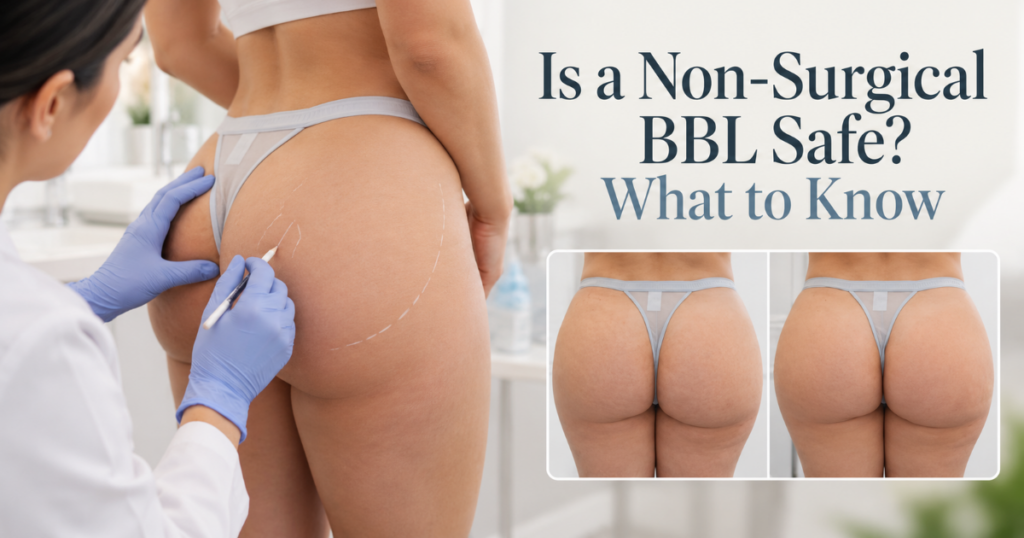
A non-surgical BBL using hyaluronic acid filler can be performed without surgery or fat transfer, but it is not risk-free. Temporary swelling, bruising and tenderness are possible, while less common complications can include infection, filler displacement, nodules, vascular injury and tissue damage. Serious complications have also been reported in published literature.
The phrase “non-surgical” can make Liquid BBL sound like a minor beauty treatment. In reality, buttock augmentation can involve relatively large volumes of injectable material placed into an anatomically complex area.
At Deep Aesthetics, we use hyaluronic acid body filler for Liquid BBL treatment and plan treatment according to anatomy, tissue condition, desired contour and an appropriate filler volume. Risks, limitations, recovery and realistic outcomes should be discussed before treatment rather than after a complication occurs.
In this guide, we explain what current research says about non-surgical BBL safety, which side effects may occur, which complications are more serious, how filler volume and practitioner technique matter, and what patients should ask before booking.
What Is a Non-Surgical BBL?
A non-surgical BBL, also called a Liquid BBL, uses injectable filler rather than transferred body fat to change buttock shape, projection, hip dips or symmetry.
At Deep Aesthetics, the treatment uses hyaluronic acid body filler. The current Liquid BBL London treatment page describes personalised volume and placement planning based on starting anatomy rather than automatically using the maximum available filler.
This distinction is important because the term “non-surgical BBL” can be used online for several different substances.
Safety evidence for one injectable material cannot automatically be applied to another.
A treatment using HA filler should therefore be evaluated as HA gluteal augmentation, rather than grouped together with permanent fillers, unlicensed substances or surgical fat transfer.
How Safe Is Hyaluronic Acid Buttock Filler?
Published evidence shows that HA has been used successfully for gluteal augmentation, but the evidence base remains relatively small and serious complications cannot be excluded.
A 2023 systematic review evaluated 10 publications involving 168 patients treated with HA for gluteal augmentation. Reported complications included bruising, erythema, inflammation, fluid collections, gel displacement and contour irregularity. Importantly, the review also identified serious complications, including a fatal event, and concluded that further controlled research was needed.
More recent studies provide some reassuring data but remain limited.
A 2026 retrospective study involving 26 patients treated with 200–360 mL of cross-linked HA filler reported minor self-limited adverse events in 19.2%, including swelling, bruising and temporary firmness. No vascular compromise, deep infection or migration was reported during six months of follow-up.
Another retrospective multicentre study involving 91 participants reported no serious adverse events during follow-up, although it used a specific HA product and observational methodology.
These studies should not be interpreted as proving that Liquid BBL is universally safe.
They show why product, technique, anatomy and patient selection matter.
What Are the Common Side Effects of a Liquid BBL?
Early side effects can include:
| Possible effect | What you may notice |
| Swelling | Temporary increased fullness |
| Bruising | Discolouration around injection areas |
| Tenderness | Soreness or sensitivity |
| Redness | Local reaction around injection points |
| Firmness | Treated tissue temporarily feeling harder |
| Early asymmetry | Swelling settling differently on each side |
| Mild discomfort | Pressure, aching or tenderness |
| Small injection marks | Temporary entry-point changes |
These effects are not necessarily signs of a complication.
For example, the recent 26-patient HA study reported swelling, bruising and temporary firmness as minor self-limited effects.
How these symptoms should behave over time is covered more specifically in Deep Aesthetics’ Non-Surgical BBL Recovery guide, where recovery is separated from the final settled cosmetic result.
What Serious Risks Can Occur?
Serious complications are less common than temporary injection-site effects, but they need to be part of informed consent.
Potential concerns include:
- infection,
- vascular compromise,
- tissue necrosis,
- significant inflammatory reactions,
- persistent nodules or firmness,
- filler displacement or migration,
- fluid collections,
- contour irregularities,
- severe asymmetry,
- unwanted cosmetic outcomes.
The wider HA filler literature recognises vascular occlusion as one of the most serious injectable complications because obstruction of blood supply can result in tissue injury.
Buttock augmentation deserves particular caution because it involves a large and anatomically complex treatment area.
BAAPS has specifically warned that injectable buttock augmentation should not be regarded as a simple procedure and has highlighted reported complications including infection, sepsis, tissue necrosis and scarring. BAAPS
Can a Non-Surgical BBL Cause Vascular Occlusion?
Vascular compromise is a recognised potential risk whenever filler is injected into tissue containing blood vessels.
This occurs when filler affects blood flow to tissue.
The consequences depend on the vessel involved and the severity of obstruction. Reduced blood supply can potentially lead to pain, skin changes and tissue damage.
HA-filler complication reviews emphasise the importance of anatomical knowledge, appropriate product selection, careful technique and the ability to recognise complications promptly.
This is one reason safety cannot be reduced to statements such as “a cannula makes Liquid BBL safe”.
Technique can influence risk, but no injection technique can make an invasive treatment completely complication-free.
Can Buttock Filler Cause Infection?
Yes. Infection is a possible complication because filler treatment crosses the skin barrier and places material into tissue.
Signs that deserve assessment may include increasing redness, worsening pain, unusual heat, discharge, increasing swelling or feeling systemically unwell.
Infection should not be self-treated by aggressively massaging the area or waiting indefinitely for symptoms to disappear.
Published reviews of minimally invasive buttock augmentation caution that severe infectious complications can occur, particularly when procedures are performed in inappropriate environments or by people unable to recognise and manage complications.
Can Liquid BBL Filler Move?
Filler displacement or migration has been reported after gluteal HA augmentation.
The 2023 systematic review identified several cases of gel dislocation among the studies it analysed. That does not mean filler commonly travels unpredictably throughout the body.
It means product can potentially move from its intended placement or create an unwanted contour. Treatment planning therefore needs to consider tissue characteristics, filler properties, placement and total volume.
Does Filler Volume Affect Safety?
Filler volume is an important part of treatment planning, but there is no universal “safe number of millilitres” suitable for everyone.
The 2023 systematic review reported an average injected volume of around 207 mL across the included literature, while the recent 26-patient study used 200–360 mL. Deep Aesthetics’ own treatment planning may involve different amounts depending on anatomy and intended correction.
This is why the amount discussed in the Liquid BBL filler-volume guide is based on anatomy, hip dips, asymmetry, projection and whether treatment is staged rather than assuming more filler is automatically better.
A larger number on a package should never be treated as a target that must be injected.
Is Hyaluronic Acid Safer Because It Can Be Dissolved?
Using HA can provide an important management option because hyaluronidase may be used to break down HA filler in selected situations. However, reversibility does not make the procedure risk-free.
Dissolving may be considered when clinically appropriate for unwanted filler, certain complications or correction.
But several qualifications matter:
- treatment may require assessment first,
- complete dissolution cannot always be assumed,
- tissue complications may still need separate treatment,
- hyaluronidase itself is a medical treatment with potential risks,
- urgent vascular complications require prompt management rather than assuming they can simply be “dissolved later”.
Deep Aesthetics’ Liquid BBL service information appropriately describes dissolution as something that may be considered, rather than guaranteeing immediate or complete reversal.
Is a Non-Surgical BBL Safer Than a Surgical BBL?
They have different risk profiles, so it is better to compare the procedures rather than simply declaring one “safe” and the other “dangerous”.
A Liquid BBL does not require liposuction, harvesting body fat or general anaesthesia.
A surgical BBL involves fat transfer. The NHS notes that surgical fat transfer can involve bleeding, infection, fat necrosis and fat embolism, and specifically states that surgical BBL has attracted serious safety concerns because injected fat can enter blood vessels and travel to the lungs.
However, avoiding surgical fat transfer does not mean filler-based augmentation carries zero serious risk.
| Liquid BBL | Surgical BBL |
| Uses injectable filler | Uses transferred body fat |
| No liposuction | Fat must be harvested |
| No general anaesthetic required for filler treatment | Surgery commonly involves anaesthesia |
| Temporary HA volume | Some transferred fat can persist |
| Injectable complications possible | Surgical and fat-transfer complications possible |
| Usually less extensive recovery | More substantial recovery |
| Cannot reproduce every surgical result | Can create larger structural volume change |
Who May Not Be Suitable for a Liquid BBL?
Suitability should be individual rather than based only on wanting a fuller buttock shape.
Relevant considerations may include:
- medical history,
- current medications,
- allergies,
- previous filler or surgery in the area,
- active infection or skin problems,
- tissue condition,
- unrealistic expectations,
- requested filler volume,
- ability to follow aftercare,
- whether the desired result exceeds what filler can reasonably provide.
A Liquid BBL is intended for selected cosmetic contouring concerns, not weight loss or correction of every body-shape issue.
Someone seeking a very large or dramatic transformation may need a different discussion rather than escalating filler volume simply to chase a surgical-scale change.
What Should You Ask Before Booking?
A safety-focused consultation should answer questions such as:
- What exact product will be injected?
- Is it hyaluronic acid or another substance?
- How much filler is being proposed in total?
- Why is that volume appropriate for my anatomy?
- Where will the filler be placed?
- What are the common and serious complications?
- How does the clinic recognise and manage a complication?
- Who should I contact urgently after treatment?
- What result is realistic from filler rather than surgery?
- Would staged treatment be more appropriate than one larger session?
The NHS similarly recommends researching both the procedure and practitioner and understanding risks before committing to any cosmetic treatment.
What Symptoms Need Prompt Assessment?
Temporary swelling or tenderness can occur, but worsening or unusual symptoms should not automatically be labelled “normal”.
Contact the treating clinic promptly if you develop:
- rapidly increasing or severe pain,
- significant worsening swelling,
- spreading redness,
- unusual skin discolouration,
- blistering or skin breakdown,
- discharge,
- fever or feeling unwell,
- increasing hardness or painful lumps,
- marked or worsening asymmetry,
- any change that concerns you.
For severe symptoms or acute illness, seek urgent medical care.
How Long Before a Liquid BBL Is Fully Settled?
Safety assessment and cosmetic assessment happen on different timelines.
HA filler creates volume immediately, but swelling, tenderness or firmness can distort the early appearance.
The settled contour therefore becomes easier to assess after early recovery.
Published research also shows that HA buttock augmentation is temporary rather than permanent. A systematic review estimated average product effectiveness at approximately 16 months across the included studies, but treatment protocols varied substantially.
Deep Aesthetics’ guide to how long a Non-Surgical BBL lasts explains why product type, volume, anatomy and individual breakdown make one fixed longevity promise inappropriate.
Is a Non-Surgical BBL Safe in London?
Deep Aesthetics offers Liquid BBL consultations at:
Mirror Works
12 Marshgate Lane
Stratford, London
E15 2NH
Treatment planning considers existing anatomy, hip dips, buttock projection, symmetry, tissue condition and appropriate filler volume.
The aim should be a treatment plan that fits the anatomy rather than automatically injecting the maximum package volume.
Is a Non-Surgical BBL Safe in Birmingham?
Consultations are also available at:
25 King Edwards Wharf
Sheepcote Street
Birmingham
B16 8AB
The same safety principles apply in Birmingham: product selection, medical history, previous procedures, proposed filler volume, realistic limitations, recognised complications and aftercare should all be discussed before treatment proceeds. Deep Aesthetics’ Liquid BBL Birmingham page provides location-specific treatment information.
Frequently Asked Questions
Is a non-surgical BBL completely safe?
No cosmetic injectable procedure is completely risk-free. HA Liquid BBL may cause temporary swelling, bruising and tenderness, while less common complications can include infection, inflammation, nodules, displacement, vascular injury and tissue damage. Published gluteal-filler literature also contains reports of serious complications.
What is the biggest risk of a Liquid BBL?
There is no single complication that occurs most often across every product and protocol. From a severity perspective, vascular injury, major infection and tissue necrosis are among the complications that require particular attention because they may cause significant harm if not recognised promptly.
Is HA buttock filler safe?
Published studies suggest that clinicians can use HA for gluteal augmentation, and many patients experience only temporary or minor effects. However, the evidence remains limited, and researchers have also reported serious complications. For this reason, clinicians should not describe HA buttock filler as universally safe.
Can Liquid BBL filler be dissolved?
Clinicians may use hyaluronidase to treat HA filler when they consider it clinically appropriate. However, they should assess the situation first, and hyaluronidase may not resolve every complication or remove all filler immediately. The treatment also carries its own medical risks.
Can a non-surgical BBL cause infection?
Yes. Infection is a recognised risk of injectable procedures. Increasing pain, redness, warmth, swelling, discharge or systemic illness needs clinical assessment rather than simply being assumed to represent routine post-treatment inflammation.
Can buttock filler migrate?
Filler displacement has been documented in published HA gluteal-augmentation research. Product properties, placement, tissue characteristics and treatment volume can all be relevant. A new or persistent contour change should be assessed rather than aggressively massaged without professional advice.
Is non-surgical BBL safer than surgery?
It avoids several elements of surgical BBL, including fat harvesting and surgical fat transfer, but it has a different set of injectable risks. Comparing the two requires considering anatomy, desired volume, recovery, product and individual risk rather than assuming either procedure is universally safe.
How can I make a Liquid BBL safer?
You cannot eliminate risk completely. To reduce the risks, attend a thorough consultation, share your full medical and treatment history, confirm exactly which product and volume your practitioner plans to use, understand the realistic limitations of the treatment, and discuss how your practitioner will recognise and manage any complications.
Final Thoughts: Is a Non-Surgical BBL Safe?
A non-surgical BBL using hyaluronic acid filler can avoid many features of surgery, but describing it as “safe because it is non-surgical” would be misleading.
The strongest buttock-specific systematic review identified both minor and serious complications, while more recent studies report encouraging outcomes with mostly temporary adverse effects in carefully treated cohorts. Taken together, the evidence supports cautious patient selection and informed consent, not claims of zero risk.
At Deep Aesthetics, Liquid BBL consultations in Stratford, London and Birmingham should consider anatomy, medical history, tissue condition, filler volume, cosmetic goals, recognised risks and expected recovery before treatment is agreed.
Individual results and complication risks vary. No practitioner can guarantee a particular outcome or a complication-free recovery.
Disclaimer: This article provides general educational information only and does not constitute medical advice. Liquid BBL is an invasive injectable cosmetic treatment with recognised risks. Suitability, product choice, filler volume, recovery and complication risk vary between individuals. Seek prompt clinical assessment for severe
