
Table of Contents
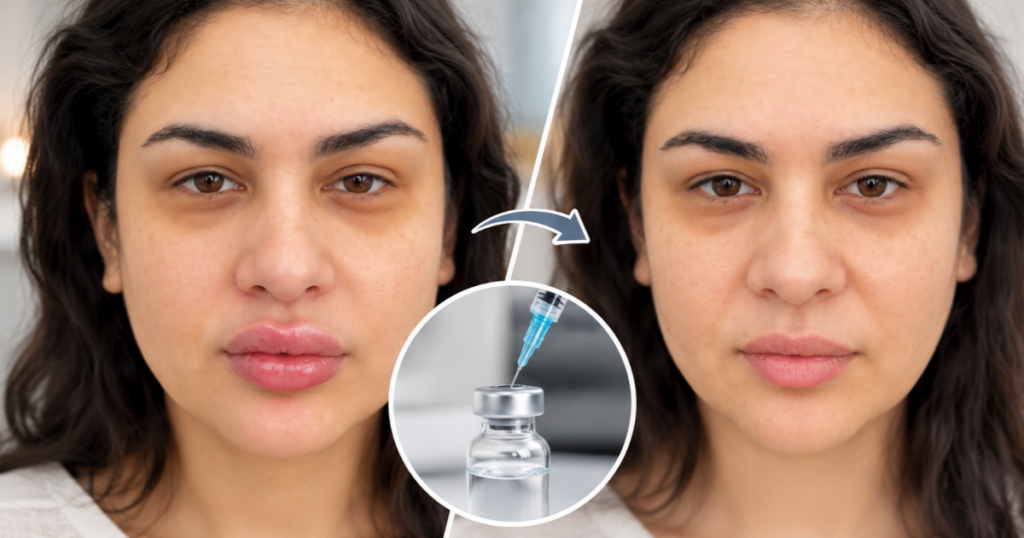
ToggleYes, many hyaluronic acid dermal fillers can be broken down using an injectable enzyme called hyaluronidase. However, not every type of filler can be dissolved this way, and complete correction may require more than one treatment. Whether dissolving is appropriate depends on the filler product, location, amount and reason for reversal.
People consider filler dissolving for many reasons. The result may feel too full, asymmetrical or different from what they expected. Filler may have been placed too superficially, or a lump, swelling or delayed reaction may need clinical assessment. Hyaluronidase also has an important role in the urgent management of certain complications involving hyaluronic acid fillers.
At Deep Aesthetics, filler concerns should be assessed before deciding whether to wait, adjust the result or dissolve some or all of the product.
In this guide, we explain which fillers can be dissolved, how hyaluronidase works, how quickly changes can occur, whether filler can be partly dissolved and the risks patients should understand.
Which Dermal Fillers Can Be Dissolved?
Hyaluronic acid, or HA, fillers are the main type that can be treated with hyaluronidase.
Hyaluronidase is an enzyme that breaks down the hyaluronic acid structure. Hyaluronic acid fillers are widely used for facial contouring and volume restoration, including areas such as the lips, cheeks, chin, jawline and tear troughs. Deep Aesthetics’ dermal fillers treatment explains that HA is one of the most commonly used types of facial filler.
Not all injectable fillers behave the same way.
| Filler type | Can hyaluronidase dissolve it? |
| Hyaluronic acid (HA) | Yes, generally |
| Calcium hydroxylapatite | No |
| Poly-L-lactic acid | No |
| PMMA | No |
| Permanent/non-HA fillers | Generally not with hyaluronidase |
A clinical review specifically notes that calcium hydroxylapatite, poly-L-lactic acid and polymethylmethacrylate are not dissolved by hyaluronidase.
This is why knowing exactly what product was injected is important before planning reversal.
How Does Hyaluronidase Dissolve Filler?
Hyaluronidase enzymatically breaks down the hyaluronic acid chains that form HA filler.
Although people commonly call the procedure “filler dissolving”, technically the enzyme degrades the HA structure into smaller fragments that the body can clear. Recent scientific discussion has suggested that “filler modification” or “enzymatic degradation” may be more biologically accurate terminology than literal dissolution.
In practical terms, the practitioner injects hyaluronidase into or around the area containing unwanted HA filler.
The response depends on several factors, including:
- which HA filler was originally used,
- how cross-linked or dense the filler is,
- how much product is present,
- where it was placed,
- how accurately the enzyme reaches the filler,
- the dose and technique used.
Research shows different HA products can respond differently to hyaluronidase and that direct contact with the filler is important.
Why Would Someone Want Dermal Filler Dissolved?
There are several possible reasons.
An Unwanted Cosmetic Result
Sometimes a result simply does not match the patient’s expectations. This can include excessive volume, poor proportion, asymmetry or filler placed in an unsuitable location.
Hyaluronidase may allow an HA result to be reduced before reassessing the area.
Lumps or Irregularity
Some irregularities may relate to swelling or the normal settling process rather than something that needs immediate dissolution.
That is why timing matters. Dermal filler can change as swelling settles, and the expected duration also varies considerably by product and treatment area. Our guide on how long dermal fillers last explains why filler persistence differs from one area to another.
Tyndall Effect
HA filler placed too superficially can sometimes create a bluish-grey appearance known as the Tyndall effect. Hyaluronidase is one recognised approach for correcting this problem.
This can be particularly relevant around delicate areas such as the under-eye region, where our tear trough filler guidance also highlights how important appropriate product selection and placement are.
Delayed Reactions or Nodules
Certain delayed reactions require clinical assessment before treatment is chosen. Hyaluronidase can sometimes have a role when HA filler is involved, but not every lump should simply be injected with dissolving enzyme.
Vascular Complications
A suspected vascular occlusion is different from elective cosmetic dissolving and requires urgent clinical management.
Consensus literature identifies hyaluronidase as an important treatment when a vascular complication is caused by HA filler.
Can You Dissolve Only Part of the Filler?
Potentially, yes.
A practitioner may sometimes aim to reduce an unwanted area rather than remove as much HA filler as possible.
However, selective dissolving is not perfectly predictable.
Hyaluronidase does not behave like an eraser that removes exactly one millimetre of filler at a time. Filler characteristics, tissue anatomy, enzyme concentration and injection placement all influence the response.
A 2024 ultrasound study found substantial reductions in HA filler volume after hyaluronidase but also demonstrated that degradation continues over time and varies according to the material being treated.
Therefore, partial correction should be approached conservatively and reassessed.
Does Filler Dissolve Immediately?
Hyaluronidase can begin affecting HA filler relatively quickly, but the final visible result should not necessarily be judged immediately.
Experimental research has shown measurable degradation within hours of treatment. In one ultrasound study, the largest reduction occurred during the first hour, with further reduction observed at 24 hours.
However, your face may also temporarily swell after hyaluronidase injections.
That means the area can look different before it has settled.
The practical question is not simply, “Has the enzyme started working?” but rather, “What does the area look like once the treatment reaction has settled?”
Can One Session Dissolve All Dermal Filler?
Not always.
Some HA filler may respond substantially to one treatment, while other cases require further assessment or another session.
Factors that can make degradation more difficult include product characteristics, cross-linking, larger filler deposits and inaccurate placement of hyaluronidase relative to the filler.
Therefore, claiming that filler will always disappear completely after one injection would be misleading.
Ultrasound may be useful in selected complicated cases to identify filler location and guide treatment more precisely.
Does Hyaluronidase Dissolve Your Natural Hyaluronic Acid?
Hyaluronidase can also act on naturally occurring hyaluronic acid, not only manufactured HA filler.
However, naturally occurring HA is continuously produced and broken down by the body.
This is another reason elective filler reversal should involve an appropriate assessment and dose rather than treating hyaluronidase as a risk-free cosmetic reset button.
What Are the Side Effects of Filler Dissolving?
Filler dissolving is a medical procedure with its own potential side effects and complications.
Possible effects include:
- swelling,
- bruising,
- redness,
- tenderness or discomfort,
- itching,
- temporary changes in contour,
- incomplete filler breakdown,
- a cosmetic result different from what was expected.
The most important recognised risk is an allergic reaction to hyaluronidase.
Published aesthetic guidelines describe local allergic reactions as uncommon but possible, while urticaria, angioedema and more serious hypersensitivity reactions have also been reported.
A history of significant reactions to bee or wasp stings can also be relevant because insect venom can contain hyaluronidase-related proteins. This should be disclosed during consultation.
Should You Dissolve Filler or Wait for It to Fade?
It depends on why you are unhappy with the result.
HA filler naturally degrades with time, so minor concerns may sometimes improve as swelling settles or the product gradually reduces.
Dissolving may be more appropriate when there is persistent unwanted filler, significant overcorrection, unsuitable placement or a clinical complication requiring treatment.
The decision should not be based only on how the filler looks during the first few days after injection.
Waiting is also not appropriate when there are symptoms suggesting a vascular complication or another urgent medical problem.
Can Lip Filler Be Dissolved?
Yes, if the lip filler is hyaluronic acid-based.
Hyaluronidase may be considered for excessive volume, persistent asymmetry, migration or another concern confirmed during assessment.
The same limitation applies: complete or perfectly selective reversal cannot be guaranteed from one treatment.
Can Tear Trough Filler Be Dissolved?
HA tear trough filler can also be treated with hyaluronidase.
Because the under-eye area has complex anatomy and very thin overlying tissue, assessment is particularly important.
Concerns can include puffiness, visible filler, irregularity or the Tyndall effect. The cause should be identified before simply attempting to dissolve the area.
Can You Have Filler Again After Dissolving?
Potentially, yes.
But the area should first be reassessed after the effects of the dissolving treatment and associated swelling have settled.
Before reinjection, it is worth asking why the previous result needed correcting. Product choice, volume, placement, anatomy and treatment goals should all be reconsidered rather than automatically repeating the same plan.
Frequently Asked Questions
Can all dermal fillers be dissolved?
No. Hyaluronidase is primarily used to break down hyaluronic acid fillers. Other fillers such as calcium hydroxylapatite, poly-L-lactic acid and PMMA are not dissolved by hyaluronidase and may require different management depending on the problem.
How quickly does filler dissolving work?
Hyaluronidase begins acting on HA relatively quickly, and experimental studies have demonstrated substantial degradation within hours. However, temporary swelling after treatment means the final cosmetic result should usually be reassessed after the area has settled.
Does filler dissolving hurt?
Some discomfort or stinging can occur during injection, and the area may feel tender afterwards. Individual experience varies according to the area treated, technique and amount of treatment required.
Can filler be partially dissolved?
Yes, targeted reduction may be attempted, but the degree of dissolution cannot be controlled with absolute precision. A conservative approach and reassessment may therefore be preferable when only part of the result needs adjustment.
Is filler dissolving safe?
Hyaluronidase is widely used in aesthetic medicine but is not risk-free. Swelling, bruising, discomfort and allergic reactions can occur. Appropriate consultation, medical history and management of potential complications are important.
What if hyaluronidase does not dissolve my filler?
The product may require further treatment, the enzyme may not have reached the filler effectively, or the original injectable may not be an HA filler. Imaging such as ultrasound can sometimes help determine where residual filler is located.
Final Thoughts: Can Dermal Fillers Be Dissolved?
Yes, hyaluronic acid dermal fillers can usually be reduced or reversed with hyaluronidase, but filler dissolving is not as simple or predictable as pressing a reset button.
The filler type, amount, location and reason for treatment all matter. Some patients may need only a small correction, while others require further assessment or more than one treatment.
Most importantly, not every dermal filler can be dissolved with hyaluronidase, and the procedure itself carries risks including swelling, bruising and allergic reactions.
At Deep Aesthetics, concerns about existing filler should be assessed individually before deciding whether to dissolve, adjust or simply allow the filler more time to settle.
Individual outcomes vary, and complete or immediate filler removal cannot be guaranteed.
Disclaimer: This article is for general educational purposes and does not constitute medical advice. If you experience severe pain, unusual skin-colour changes, visual symptoms or another concerning reaction after dermal filler treatment, seek urgent assessment from an appropriately qualified healthcare professional.
