
Table of Contents
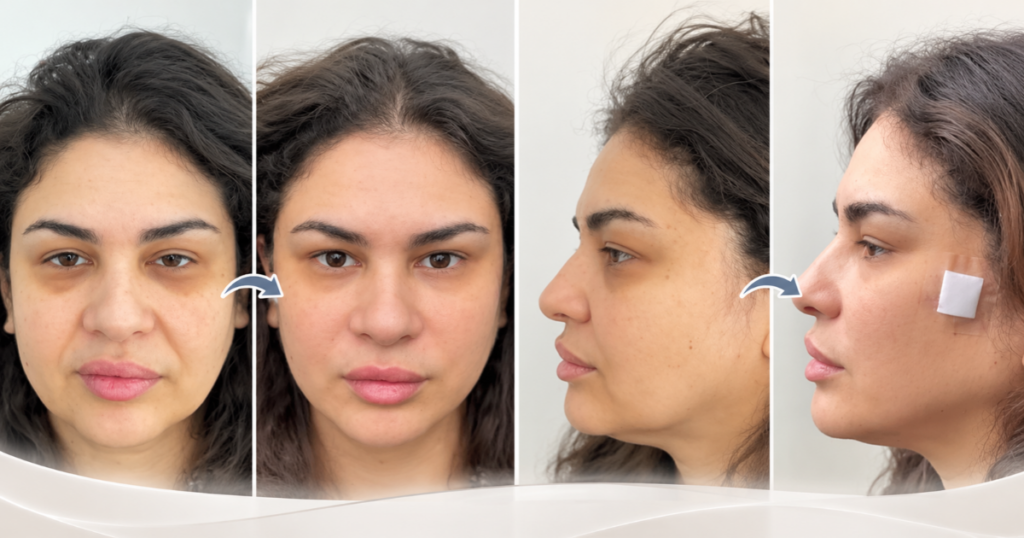
ToggleA PDO thread lift may provide visible lifting for around 6–12 months in many patients, although longevity varies considerably. The PDO threads themselves generally break down within roughly 6–8 months. Some tissue-quality changes may remain after the threads dissolve, but a two-year lifting result should not be assumed or guaranteed.
Thread lifts are often marketed as a long-lasting alternative to more invasive facial surgery, which can make it difficult to know what “long-lasting” really means. The mechanical lift, the presence of the thread beneath the skin and any longer-term collagen response are related, but they are not the same thing.
At Deep Aesthetics, PDO thread lift treatment is planned according to facial anatomy, skin laxity, tissue quality and realistic cosmetic goals rather than promising every patient the same duration.
In this guide, we explain how long PDO threads remain in the tissue, when results may begin to fade, what the research actually shows and what can influence how long a thread lift lasts.
How Long Do PDO Threads Stay in the Skin?
PDO threads are biodegradable, so they are gradually broken down rather than remaining permanently beneath the skin.
A large 2025 multicentre review of more than 111,000 facial thread-lifting procedures reported that PDO threads generally degrade within approximately 6–8 months. The researchers also described average thread-lift longevity in their clinical network as approximately 6–12 months, depending on the thread material and anatomical area.
Another clinical review discussing PDO complications notes that barbed PDO material is generally absorbed within about six months.
This means the thread itself is temporary.
However, the visible cosmetic result does not necessarily disappear on the exact day the material finishes degrading.
How Long Does the Actual Lifting Effect Last?
Published evidence suggests that the mechanical lifting effect of standalone PDO threads can decline noticeably during the first year.
One of the most relevant studies followed 160 patients treated with barbed PDO threads. Improvements were visible immediately and at one month, but the effect had declined noticeably by six months and was no longer apparent at one year in that study.
A newer randomized clinical study also found that although PDO threads produced initial tissue displacement, those objective changes had already diminished substantially by 60 days, and using more threads did not produce greater longevity.
This does not mean every PDO treatment stops working at exactly six or twelve months.
It means that PDO thread lifting should not be sold with a guaranteed fixed duration.
Can PDO Thread Lift Results Last 18–24 Months?
Some patients and some treatment combinations may show aesthetic improvement beyond one year, but this should be interpreted carefully.
A 2024 prospective study followed patients for two years after receiving both PDO threads and hyaluronic-acid dermal filler. Nine of eleven patients continued to report satisfaction or improvement at 24 months. However, because filler and threads were used together, the study does not prove that standalone PDO thread lifting lasts two years.
That distinction is important.
If someone has thread lifting plus filler, the ongoing appearance may reflect:
- thread-related lifting,
- collagen and tissue remodelling,
- filler volume,
- changes in facial contour,
- or a combination of these effects.
Therefore, “up to two years” may occur in selected circumstances, but 6–12 months is a more cautious evidence-led expectation for the visible mechanical lift from standalone PDO threads.
Why Can Results Continue After the Threads Dissolve?
PDO threads can produce more than mechanical suspension.
Insertion creates a controlled tissue response around the thread. Collagen and connective tissue can develop in the treated area as healing progresses.
This biological response is one reason the skin may continue to appear firmer even as the actual PDO material is gradually absorbed.
However, collagen stimulation should not be interpreted as meaning the original lifting effect remains unchanged indefinitely.
The broad mechanism of lifting plus tissue response is also explained in Deep Aesthetics’ existing What Is a PDO Thread Lift?
What Affects How Long a PDO Thread Lift Lasts?
There is no single longevity figure because several variables influence the result.
| Factor | Why it matters |
| Degree of laxity | Heavier or more advanced sagging places greater demand on the threads |
| Skin quality | Elasticity and thickness influence tissue response |
| Treatment area | Midface, jawline and neck move differently |
| Thread design | Smooth, cogged and barbed threads serve different purposes |
| Number and vector | Placement strategy affects mechanical support |
| Facial anatomy | Tissue weight and distribution vary between patients |
| Ageing | Natural facial ageing continues after treatment |
| Weight changes | Significant changes can alter facial volume and skin laxity |
| Technique | Correct depth, vector and anatomical planning are important |
A thread lift therefore lasts according to the interaction between the thread and the tissue, not simply according to the product’s theoretical degradation time.
Does Using More PDO Threads Make Results Last Longer?
Not necessarily.
A randomized comparative clinical trial specifically investigated whether increasing the number of PDO threads improved the magnitude or longevity of facial lifting.
Both groups showed initial changes, but tissue displacement diminished over time regardless of the number of threads used. The researchers concluded that using more PDO threads did not significantly improve longevity.
This is useful because it challenges a common assumption: More threads do not automatically equal a longer-lasting result.
Treatment should instead be based on anatomy and the appropriate lifting vectors.
Does the Treatment Area Affect Longevity?
Yes. A thread positioned in the cheek or midface behaves in a different mechanical environment from one supporting the jawline or neck.
Facial movement, tissue weight, skin thickness and the direction of gravitational forces all vary between areas.
A prospective study of 27 patients receiving absorbable barbed threads for lower-face reshaping showed that some objective contour changes remained measurable through 12 months. However, by the 12-month assessment, 56% showed no lifting effect on photographic laxity grading compared with baseline.
This again illustrates why different methods of measuring “results” can produce different longevity figures.
Contour may remain changed while the obvious visible lift becomes less noticeable.
Who Is More Likely to Get a Longer-Lasting Result?
Thread lifts generally make more sense for selected patients with mild-to-moderate facial laxity than for substantial loose or heavy tissue.
Severe skin laxity places greater mechanical demand on absorbable threads and can make a modest treatment appear to fade quickly.
A 2025 large-scale clinical review also noted lower long-term satisfaction and increased complication considerations in older patients, reinforcing the importance of patient selection rather than applying the same treatment to everyone.
PDO threads cannot remove excess skin.
When significant redundant skin is the main concern, repeated thread lifting may not reproduce the structural change achieved by surgery.
When Do PDO Thread Lift Results Look Their Best?
There can be an immediate visible effect because barbed or cogged threads mechanically reposition tissue.
However, the appearance immediately after treatment may also be affected by swelling, tissue tension or temporary puckering.
As healing progresses, early swelling settles and the tissues adapt around the threads.
This means the most useful assessment is not necessarily the photograph taken immediately after insertion.
Individual follow-up is particularly important because thread-lifting research shows that swelling, bruising, dimpling and palpable threads can occur during recovery. A recent meta-analysis covering 2,827 patients confirmed that early tissue reactions are common, while persistent thread visibility, dimpling or migration occur less frequently.
When Can You Repeat a PDO Thread Lift?
There is no universal maintenance timetable that applies to every patient.
Repeat treatment should be considered when:
- the original lifting effect has meaningfully reduced,
- the anatomy remains suitable,
- the patient still has mild-to-moderate laxity,
- previous treatment healed appropriately,
- and another thread procedure offers a realistic benefit.
Automatically booking a thread lift every six or twelve months without reassessing the face is less sensible than reviewing how the tissues have changed.
Natural ageing continues, so the treatment plan that was appropriate the first time may not necessarily remain the best option several years later.
Is a PDO Thread Lift Permanent?
No. PDO thread lifting is temporary.
The material is absorbable, facial ageing continues and skin and soft tissues gradually change.
This is fundamentally different from surgical facial lifting, which repositions deeper tissues and removes selected excess skin.
Thread lifting can be attractive precisely because it is less invasive, but the trade-off is that the result is generally more modest and shorter-lived.
Deep Aesthetics’ PDO Thread Lift treatment page describes the procedure as a non-surgical option for selected facial laxity; suitability should still be assessed individually.
How Much Does a PDO Thread Lift Cost?
Deep Aesthetics currently lists PDO Thread Lift from £695. Final treatment planning depends on the area treated and individual assessment.
Cost should also be considered alongside longevity.
A treatment that requires periodic repetition has a different long-term cost profile from a one-off procedure, so patients should understand both the expected result and realistic maintenance before proceeding.
Frequently Asked Questions
How long does a PDO thread lift last?
Visible lifting commonly lasts somewhere around 6–12 months, although results vary. Published evidence shows some PDO lifting effects can diminish noticeably by six months and may no longer be obvious by one year in some patients.
How long do PDO threads take to dissolve?
PDO threads generally degrade within approximately 6–8 months, although exact timing can vary according to the thread and tissue environment.
Can PDO threads last two years?
Some aesthetic improvements may persist longer, particularly when PDO threads are combined with treatments such as dermal filler. However, current evidence does not support guaranteeing that a standalone PDO mechanical lift will remain unchanged for two years.
Do PDO threads stimulate collagen?
PDO thread insertion can trigger a healing response and collagen formation around the treated tissue. This may contribute to tissue quality after the thread itself begins to degrade, although collagen stimulation does not guarantee prolonged mechanical lifting.
Can I repeat PDO threads after the results fade?
Potentially, yes. Repeat treatment should follow reassessment of skin laxity, anatomy, previous healing and current cosmetic goals rather than being performed automatically on a fixed timetable.
Are PDO threads as long-lasting as a facelift?
No. A surgical facelift provides substantially greater structural correction and generally lasts much longer. PDO threads are intended as a less invasive option for selected mild-to-moderate laxity, not as an equivalent replacement for surgery.
Final Thoughts
PDO thread lift results are temporary, and a realistic evidence-led expectation for visible lifting is often around 6–12 months rather than a guaranteed two-year result.
PDO material itself usually degrades within about six to eight months. Some patients may continue to notice contour or skin-quality improvement afterwards, but studies of standalone PDO lifting show that the mechanical effect often declines during the first year.
The most important factors are patient selection, facial anatomy, degree of laxity, thread design, placement technique and realistic expectations.
At Deep Aesthetics, PDO thread lift consultations are available in Stratford, London and Birmingham, with treatment planned according to individual anatomy rather than a guaranteed duration.
Individual results vary, and no specific longevity or degree of lifting can be guaranteed.
Disclaimer: This article is for general educational purposes and does not constitute medical advice. PDO thread-lift results, longevity, risks and suitability vary between individuals. An appropriately trained practitioner should assess your anatomy, medical history and treatment goals before recommending treatment.
